On Ethos (Complete)
This document contains the complete compilation of all ethos documentation in the order they appear in the Docusaurus sidebar.
Ethics
Definition: The interaction rules between one or more ethoses.
Principles
- Mirroring
- Sustaining
- Investing
- Proving
Definitions
Hierarchy of Intimacy
All the steps have to conform to the Principles above. For example: you share your public identity only if the other party does the same (according to Mirroring).
Between 2 Persons
- Sharing interfaces of negotiation: interface. This should be temporary and untraceable.
- Sharing a temporary identity. This is called "stranger" relationship.
- Sharing a non-temporary but secondary identity.
- Sharing your legal identity.
- Sharing your public ethos: ethos_1. This is called "acquaintance" relationship.
- Allow for challenges to the validity of your ethos_1.
- Allow for judgments concerning your ethos_1.
- Allow for judgments concerning the other party's ethos_1.
- Make the previous step sustainable.
- Sharing your product and services offer for friends: services_1. Here starts the most superficial "friendship" relationship.
- Allow for the creation of a common ethos, ethos_3 between the 2 parties. The editing is collaborative.
- Allow the other party to judge you according to ethos_3.
- Make the previous step sustainable.
- Allow for ethos_3 to become public. This is compatible with "marriage" and "committed friendship".
- The group with ethos_3 becomes an institution and its proofs of authority are available to other institutions.
Between A Person and An Institution
- Sharing interfaces of negotiation: interface. This should be traceable by both sides.
- Sharing your legal identity.
- The person creates a profile with the institution: composing and sharing ethos_3
- Allow the institution to judge you according to ethos_3.
- Allow other institutions selective access to ethos_3 information: This is compatible with "citizenship" relationship.
Between 2 Institutions
- Sharing interfaces of negotiation: interface. This should be traceable by both sides.
- Sharing proofs of authority.
- Establishing role protocols, and composing the relationship contract.
- Enacting the contract. The contract is the ethos_3 of the institutional group.
My Ethos
- in JSON form
Ethical Declarations
- (existence) Minimal
golden_rule_negative: I do not do to others what I do not wish done to myself.one_ethos: I have only one ethos, made public here.live_ethos: What I believe, I share in this ethos.ack_other_ethos: I acknowledge the existence of other ethos(es) than mine.ack_other_ethos_importance: I acknowledge that unless proven otherwise, other ethos(es) than mine have an equal importance to my ethos.no_contradiction_claim: I will keep my ethos free of self-contradicting claims.
- (responsibility) Responsible
responsible: I am responsible for my actions dedicated to this ethos. Also for the collective actions of others who adopted it. I will make reparations and/or discontinue this ethos if this ethos does more harm than my ability to repay. (This ethos has a responsible meta-ethos.)
- Responsible for Others
responsible_others: I am responsible for the collective actions of others who adopted this ethos. I will make reparations in the proportion that is just.
- Missionary
missionary: I am fulfilling my duties as a proverbial godparent to these individuals: (wip). And I would like to volunteer for more initiations and guidance into this ethos.
- Heroic
heroic: I will do the work to repair the mistakes of my proverbial "godchildren" if their actions are not fully respecting the ethos. I will do more than my duty towards my ethos.
- Art Making
making_art: I am making art for bulding/shaping this ethos YouTube Channel.
- Ethos Forming
forming_itself: I am forming this ethos using itself.
- (awareness) Aware of Limitations and Surplus (ALS)
aware_ls: I am aware of the present limitations and surplus that I have in following my own ethos.
- ALS of Resources
als_resources: I am aware of the present limitations and surplus of resources that I have in following my own ethos.
- ALS of Geography
- WIP
- ALS of Time
- WIP
- ALS of Intelligence
- WIP
- (flexibility) Flexible
flexible: I keep my ethos flexible by means of reasonable demonstration or (where lacking) consensus. The change may consist of modifying the order of my virtue hierarchy, adding new items, or removing items.
- Challengeable
challengeable: Ethos is challengeable by this link: New Challenge. A comprehensive history of the challenge types and instances and their ethical conclusions is here: Issues. I accept new challenges only if they are of a new type or subtype.
- Testable
testability: This ethos uses a meta-ethos that establishes the protocols for testing ethoses in my life.
- Accepting Arbitrage
arbitrage: This ethos is accepting arbitrage from a person or ethos C in order to achieve a common understanding with ethos B. I also remain available for arbitrage services to any person or ethos who accepts arbitration and needs it.
- Max Flexible
- WIP
- (cooperative) Joinable
joinable: Ethos is joinable by forking this repo and declaring in a public space (such as X.com) that you joined this ethos (with a link to the revision).
- Non-binding
non-binding: Ethos is non-binding: one can leave (un-join) this ethos at any time, for any reason or without a reason. The un-join has to be declared publicly.
- Respectuous
respectuous: I keep my ethos respectuous: my ethos will recognize in public other ethoses. Will abide also by their rules, if not in grave conflict.
- Alignable
alignable: This ethos is alignable: keeps a list of other ethoses and their classification. Establishes what actions can be executed together and in what ehtical conditions.
- Impartial
impartial: Ethos is impartial: It emits the same judgements regardless of the identity or fame of the actors (ethoses). Taking into consideration only their ethics.
- Generous
- WIP
- (provability) Accepting of Proofs
proof_accepting: I keep my ethos proof accepting and responsable for the proofs published by it. This ethos will be liable to pay for any false proof or provable wrongdoing with fines and reparations that may exclude it for a period of time or/and area of space from being considered an ethos.
- Accepting of Formal Proof
formal_proof: My ethos is accepting formal proofs of these forms (work in progress). The solutions for the proofs received are at (work in progress). The formal proof types that I do not accept I cannot use for my benefit.
- Accepting of Witnesses
witnesses: Absent a formal proof for an event: if there are testimonials of people with ethos that accepts witnesses, my ethos is accepting their testimony. Instances and events that I am a witness for (wip). If there will be a formal proof or more believable witnesses that oppose my testimony: I should lose my ethical status of "Accepting of Witnesses" until I pay for all damages my testimony may have generated. Also: if I do not accept witnesses I cannot benefit from witness testimonials in any situation.
- Accepting of Voting Result
voting_result: Absent a formal proof and witnesses for an event: if the voting process is formally provable, and if the voters have an ethos that accepts the voting result, my ethos is accepting its results. Types of formally provable voting accepted (work in progress). Instances of vote and their result (wip).
- Accepting of Law
law: If the result of voting (formally provable) is a law, my ethos accepts this law as a shortcut for voting.
- Accepting of Representation
representation: If the result of voting (formally provable) is a role of representation, my ethos accepts the representant's decisions as a shortcut for voting.
Virtues
- miracle_ct1: Provable exceptions to the laws of nature.
- order_ct1: (henceforth: order): The ordering of virtues that is provable by reason or by consensus. The ordering is a virtue by itself.
- reason_ct1: reason: The construction of a proof.
- faith_ct1: faith: The belief in axioms, in existence of concepts.
- economy_ct1: economy: management of charity, of goodness, of resources.
- charity_ct1: charity: making efforts for the benefit of most others.
- goodness_ct1: goodness: the facillitation of the necessary conditions to advance from a position of virtue to a superior position/state (in quality and/or quantity).
- hope_ct1: hope: imagination of something more virtuous.
- humility_ct1: humility: recognition of the virtue of others, upon public recognition of your virtues, accepting the minimum that is merited
- wisdom_ct1: achieveing better results than using common sense solutions
- prudence_ct1: prudence: justice that is timeless
- foregiveness_ct1: foregiveness: returning the payment of a fine to the gulty, after justice has been rendered and the guilty party repented
- repentance_ct1: repentance: forgiveness is dependent on it
- justice
- governance_ct1: governance: provable continous voting
- temperance: voluntary self-restraint
- fairness: allowing for your competition to have the same conditions in an optional contest
- fortitude_ct1: fortitude: fitness with environment, common sense, delayed gratification
- competition: winner selection
- measurability: transparency, currency
- market: availability for comparison, searchability
- abundance: great number of types of resources, great quantity of each type
- industriousness: specialization, standardization of production methods, optimization of production
- survival: live, metabolic cycles, perception, behavior dependent on perception
Hierarchy
Same as in my Theory of Virtues
Evolution
The commits to this repo are the evolution path of this ethos.
No Identity
- whitelist:
- the fact that I have a guaranteed identity
Guaranteed Identity
- whitelist:
- the fact that I have a legal public identity
- my ethos
- ethos compatibility interface
Ethos is not compatible at all
- whitelist:
- all of the above
- a message with the compatibility results, the justification for contact, and a proof of effort (MYT spent). The threshold of MYT is now: 1 MYT
Ethos is (at least) partially compatible
- whitelist:
- all of the above
- a contract for starting a chat under the terms of the compatible ethos
Chat contract is signed by both parties
- whitelist:
- chat prompt
- chat menu
Compatibility
- The top of the hierarchy has to be explicit.
- The ethos has to be updated within a day since a need for change is discovered.
Meta Ethos
Principles
The Golden Rule: Positive
- short:
golden_rule_positive - long:
What I wish done to myself, I do to others.
The Golden Rule: Negative
- short:
golden_rule_negative - long:
I do not do to others what I do not wish done to myself.
Declarations
Respect the Categorical Imperative
- short:
categorical_imperative - long:
I act as if the maxims of my action were to become through my will a universal law of nature. - reference: the Kantian Categorical Imperative
Acknowledge the Existence of Another Ethos
- short:
ack_other_ethos - long:
I acknowledge the existence of other ethos(es) than mine.
Judgement Invitation
- short:
judge_invite - long:
I make myself subject of my own declarations and invite others who do the same to judge me by them.
Web Cookies
- short:
web_cookies_level2 - long:
I accept only cookies that are required for the obvious functionality of the site. - basis: Conform to the negative golden rule: I do not use optional (for example tracking and advertising) cookies on the sites that I create. I expect others to do the same unless I opt in.
Compatibility
No Contradiction Claim
- short:
no_contradiction_claim - long:
I will not transact with persons who have not answered all types of claims that contradict their own ethos. (If I can avoid it.)
Have the Top Virtues Explicit
- short:
defined_top - long:
I will not transact with persons who have not defined their top values/virtues in their ethos.
Known Identity
- short:
known_identity - long:
I will not transact with people who do not share their official/legal identity.
Reciprocal Declarations
- short:
reciprocal_declarations - long:
I confer to other people the level of trust that corresponds to the reciprocal declarations.
Example: If I judge_invite and the other person does the same: we can engage in constructive criticism about our ethos(es) or actions. That means we accept that the other person may make the conversation public in part or in whole.
Reciprocal_declarations is a powerful tool of ethos cooperation and it confers access to levels of personal trust that have not been achieved at scale in human history.
Phylogeny
Attributes
- (existence) Minimal
- (responsibility) Responsible
- (awareness) Aware of Limitations and Surplus (ALS)
- (flexibility) Flexible
- Challengeable
- (cooperative) Joinable
- (provability) Accepting of Proofs
- Accepting of Formal Proof
- Accepting of Witnesses
- Accepting of Voting Result
- Accepting of Law
- Accepting of Representation
- Accepting of Voting Result
- Accepting of Witnesses
- Accepting of Formal Proof
The 5 Traits
| attribute | role | OCEAN | measures |
|---|---|---|---|
| flexibility | arbiter | (O) openness | creativity, curiosity, and willingness to entertain new ideas |
| responsibility | hero | (C) conscientiousness | self-control, diligence, and attention to detail |
| aware | ambassador | (E) extraversion | boldness, energy, and social interactivity |
| cooperative | friend | (A) agreeableness | kindness, helpfulness, and willingness to cooperate |
| provability | witness | (N) neuroticism | depression, irritability, and moodiness |
The 5 Roles
Friend
An ethical friend has the role to allow you to be aligned with your ethos. A friend may have the same ethos as you or a different ethos.
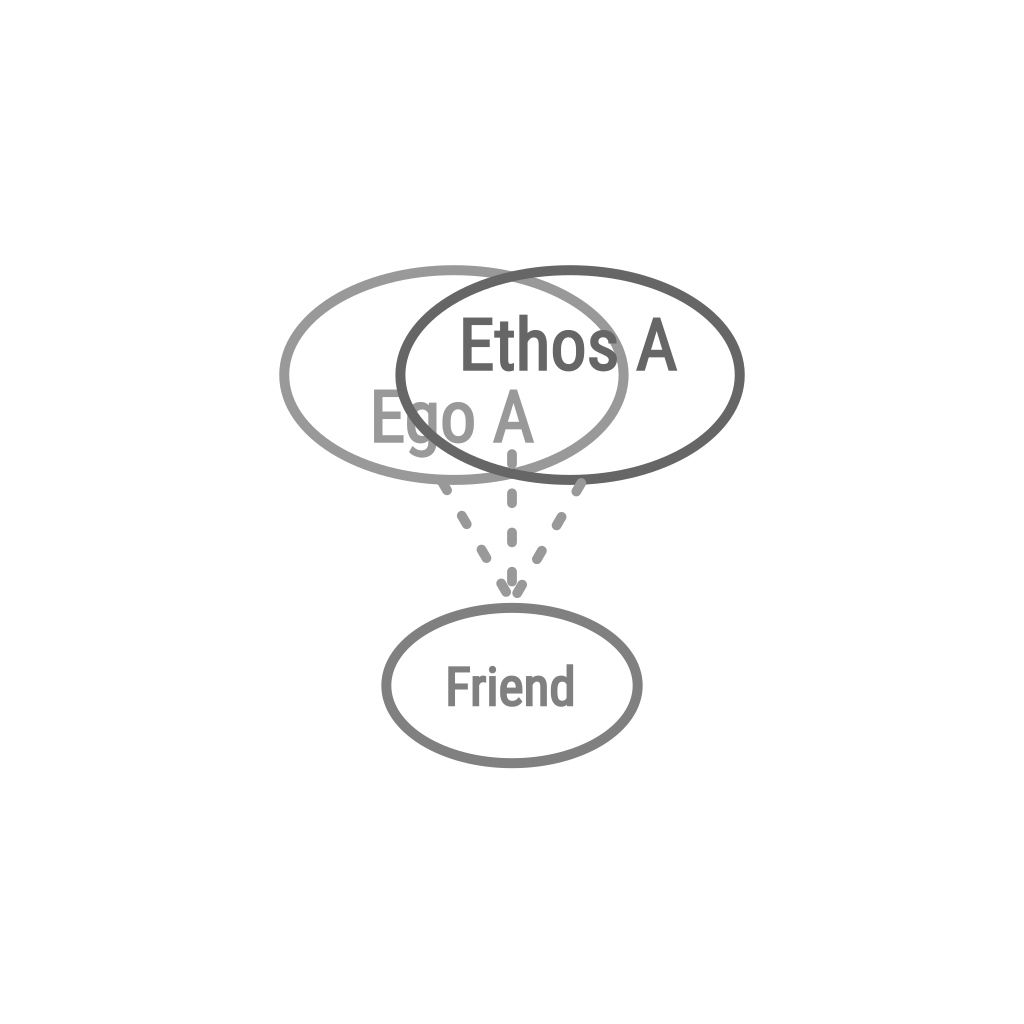
companion
judge of intent alignment with ethos
Witness
An ethical witness has the role of producing or composing ethical proofs.
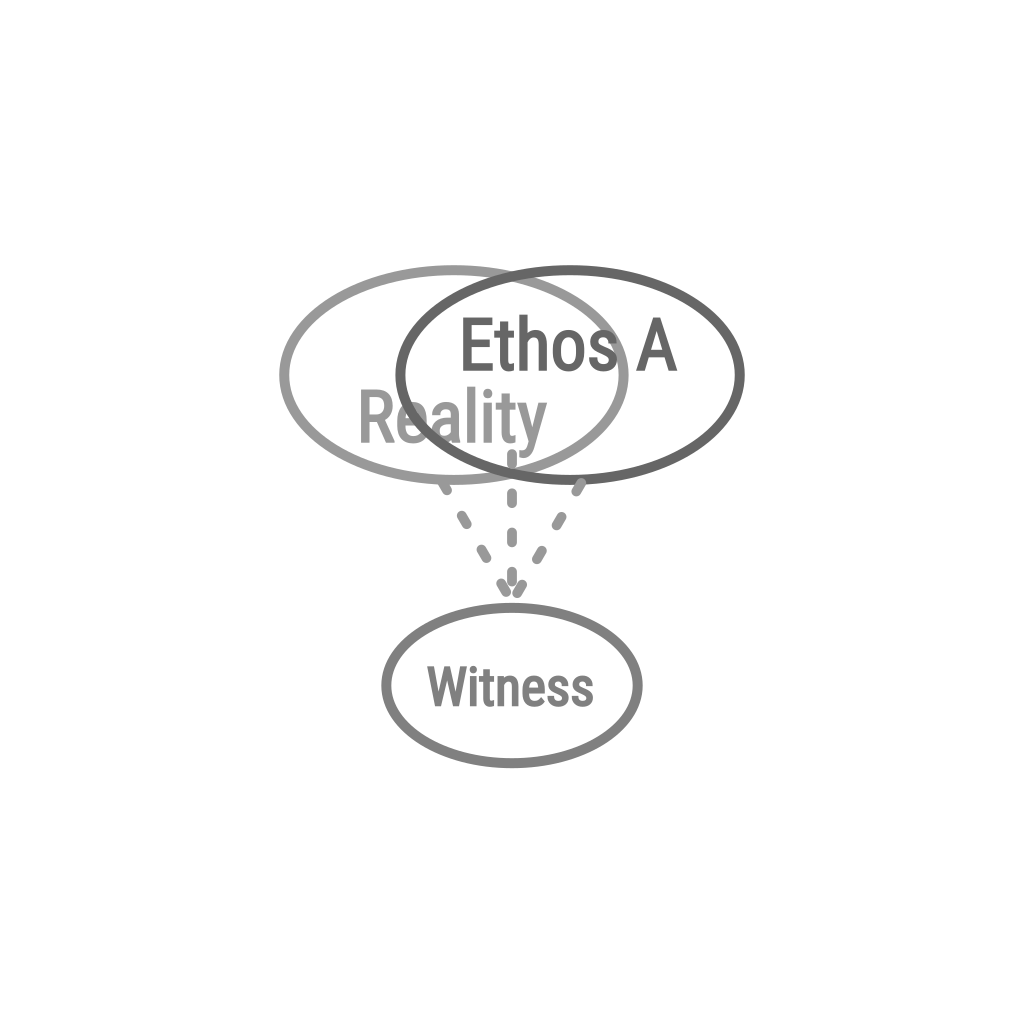
proof composer
judge of real output alignment with ethos
Ambassador
An ethical ambassador discovers and maintains a cycle of exchange between 2 ethoses.
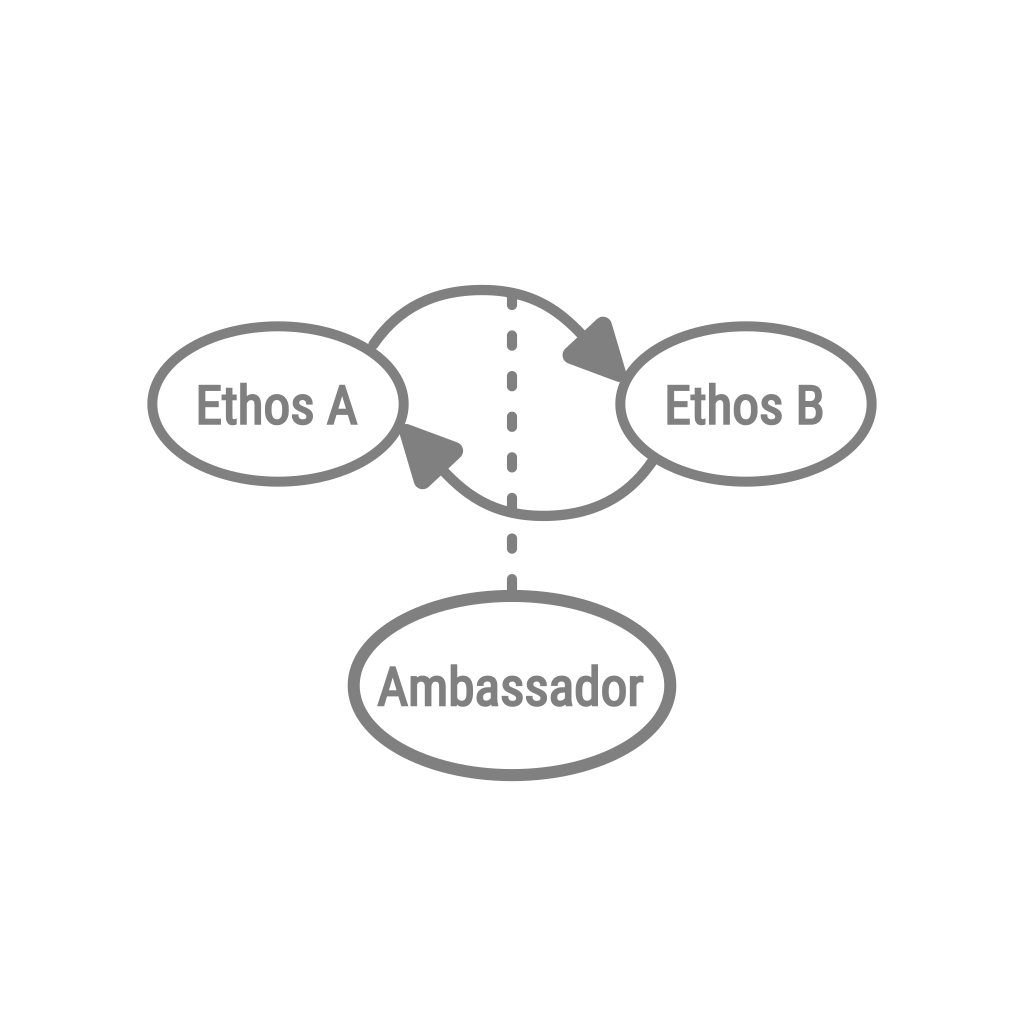
trader
negotiator of price
Arbiter
An ethical arbiter discovers the common ethos between 2 other ethoses and tries to bring them to accept or clearly reject the proposed declaration.
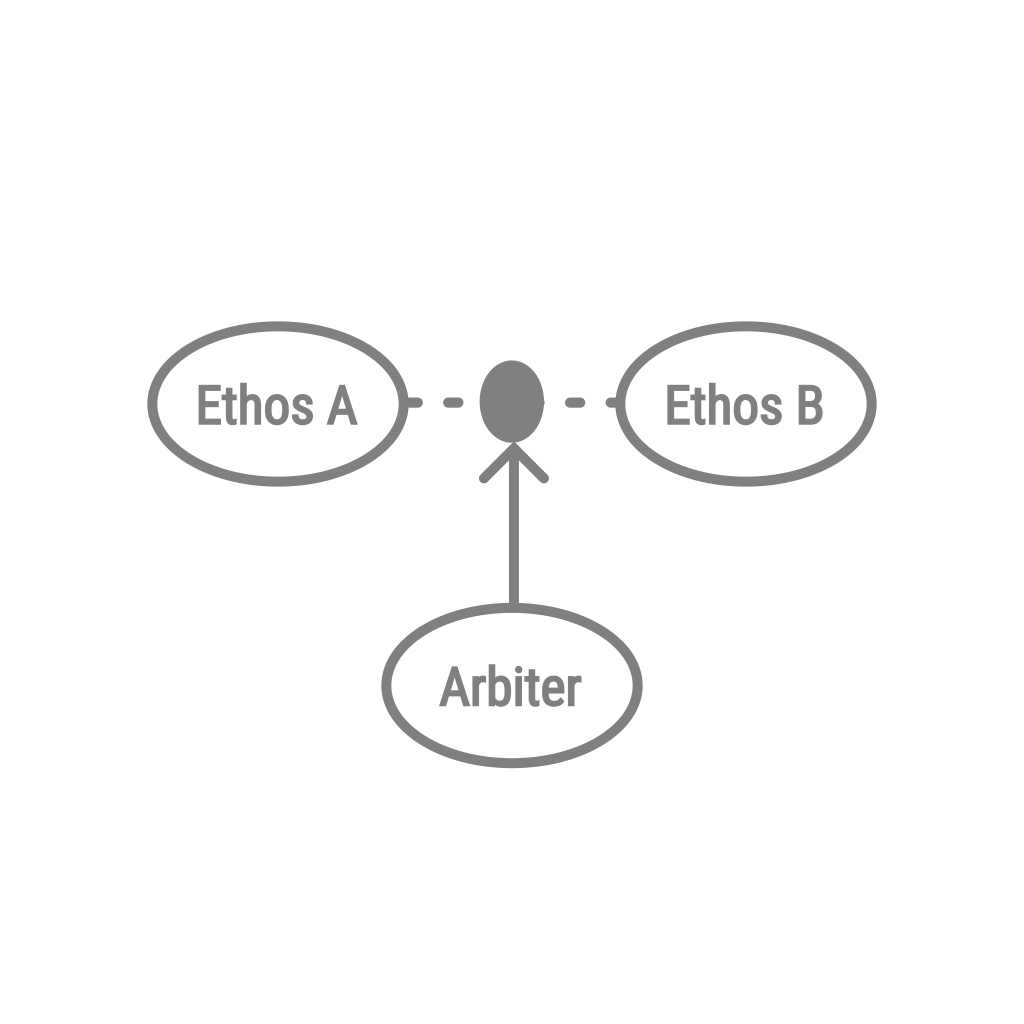
peacemaker
judge of ethos
Hero
An ethical hero is a model of living an ethos. A hero is also shaping an ethos and presenting it to the public.
moral influencer
artist
philosopher
Ethically-Complete Ethos
The stages of ethos are:
| level | stage | ethical attributes |
|---|---|---|
| 0. | Extant | + Minimal (no attributes) |
| 1. | Complete | + Hero + Ambassador + Arbitrer + Constructive + Witnesses - complete ecosystem |
| 2. | Extraordinary | WIP |
Minimal Ethos
Principles
The Golden Rule: Negative
- short:
golden_rule_negative - long:
I do not do to others what I do not wish done to myself.
Declarations
Only one Ethos
- short:
one_ethos - long:
I have only one ethos, made public here.
Live Ethos
- short:
live_ethos - long:
What I believe, I share in this ethos.
Acknowledge the Existence of Another Ethos
- short:
ack_other_ethos - long:
I acknowledge the existence of other ethos(es) than mine.
Other Ethos of Same Importance
- short:
ack_other_ethos_importance - long:
I acknowledge that unless proven otherwise, other ethos(es) than mine have an equal importance to my ethos.
Compatibility
No Contradiction Claim
- short:
no_contradiction_claim - long:
I will keep my ethos free of self-contradicting claims.
Responsible Ethos
Derived From
Additions to the Derived:
Declarations
Ethos is Responsible
- short:
responsible - long:
I am responsible for my actions dedicated to this ethos. Also for the collective actions of others who adopted it. I will make reparations and/or discontinue this ethos if this ethos does more harm than my ability to repay. (This ethos has a responsible meta-ethos.)
Responsible for Others Ethos
Derived From
Additions to the Derived:
Declarations
Ethos is Responsible for Others
- short:
responsible_others - long:
I am responsible for the collective actions of others who adopted this ethos. I will make reparations in the proportion that is just.
Example
Mahatma Gandhi was fasting many times because of the violence of his fellow Indians during their Quit India protests.
Missionary Ethos
Derived From
Additions to the Derived:
Declarations
Ethos is Missionary
- short:
missionary - long:
I am fulfilling my duties as a proverbial [godparent](https://en.wikipedia.org/wiki/Godparent) to these individuals: <link 1>. And I would like to volunteer for more initiations and guidance into this ethos.
Heroic Ethos
Derived From
Additions to the Derived:
Declarations
Ethos is Heroic
- short:
heroic - long:
I will do the work to repair the mistakes of my proverbial "godchildren" if their actions are not fully respecting the ethos. I will do more than my duty towards my ethos.
Making Art Ethos
Derived From
Additions to the Derived:
Declarations
Ethos is Making Art
- short:
making_art - long:
I am making art for bulding/shaping this ethos <link1>.
Forming Ethos
Derived From
Additions to the Derived:
Declarations
Ethos is Forming Itself
- short:
forming_itself - long:
I am forming this ethos using itself.
Aware of Limitations and Surplus Ethos
Derived From
Additions to the Derived:
Declarations
Ethos is Aware of Limitations and Surplus
- short:
aware_ls - long:
I am aware of the present limitations and surplus that I have in following my own ethos.
ALS of Resources Ethos
Derived From
Additions to the Derived:
Declarations
Ethos is ALS of Resources
- short:
als_resources - long:
I am aware of the present limitations and surplus of resources that I have in following my own ethos.
of Georaphy/Location
of Time/Moment
of Intelligence/Imagination
Flexible Ethos
Derived From
Additions to the Derived:
Declarations
Ethos is Flexible
- short:
flexible - long:
I keep my ethos flexible by means of reasonable demonstration or (where lacking) consensus. The change may consist of modifying the order of my vitues hierarchy, adding new items, or removing items.
Challengeable Ethos
Derived From
Additions to the Derived:
Declarations
Ethos is Challengeable
- short:
challengeable - long:
Ethos is challengeable by this link: <link 1> A comprehensive history of the challenge types and instances and their ethical conclusions is here: <link 2>. I accept new challenges only if they are of a new type or subtype.
The longest period of wait without answer should be 28 days. However: without a good technical explanation for not answering within 3 days: postponing may be considered a lack of Challengeability or a finable offence.
A challenge is of two major types:
- a proof that one has an ethical contradiction:
- inside one's ethos 2 declarations collide
- a discrepancy between one's actions (or lack of action) and one's ethos
- a proposal for improving one's ethos by some exact change
A challenge can be performed only by some entity that has challengeable ethos and a conclusion to a challenge is a change in ethos or an ethical fine either to the target entity or to the challenger.
Testability of Ethos
Derived From
Additions to the Derived:
Declarations
Ethos Allows for Testability
- short:
testability - long:
This ethos uses a meta-ethos that establishes the protocols for testing ethoses in my life.
Any sovereign public institution should allow for testability. The inability for the institutional constitution to cover all cases diminishes the sovereignty and liberty of the institution. Examples:
- any country constitution should allow the country to become direct democracy, republic, oligarchic, despotic/monarchy/empire for as long as its citizens will it and not a moment longer. (That means: a system of porvable timeless voting as the one implemented by The Laurel Project.)
Examples
In Lurianic Kabbalah: Tzimtzum (צמצום)
The word tzimtzum literally means “contraction,” “restriction,” or “withdrawal.”
It refers to the idea (by Rabbi Isaac Luria) that:
- God’s infinite presence (Ein Sof, “Without End”) filled all reality.
- For a finite world to exist, God concealed or restricted the direct revelation of that infinite presence.
- This “making room” allowed for the existence of an apparently independent universe, free choice, and spiritual growth.
In the ethical sense: the ethos has to define a meta-ethos that allows for ethos testability.
In modern AI Training
It demonstrates the need for a meta-ethos (different than the ethos used at inference) that is adopted at training time for the ethical evaluation of any ethos.
Ethical Arbitrage
Derived From
Additions to the Derived:
Declarations
Ethos is Accepting Arbitrage
- short:
arbitrage - long:
This ethos is accepting arbitrage from a person or ethos C in order to achieve a common understanding with ethos B. I also remain available for arbitrage services to any person or ethos who accepts arbitration and needs it.
Ethical Embedding Space
Let us consider the set of all ethoses as strings parseable/tokenizable by AI. We may use an LLM (or better: an LCM) to obtain the embedded vector for all of them. We will call the space spanned by all ethos embeddings an Ethical Embedding Space.
The Case of 2 Ethoses
If we consider 2 ethoses: "ethos 1" (for entity 1) and "ethos 2" (for entity 2), embedded in the ethical embedding space: they can be understood as 2 distinct points. They would have to live in a space with more than 1000 dimensions to make this theory applicable, but if we simplify the space to 2 dimensions, we make it understandable. So we can even draw them:
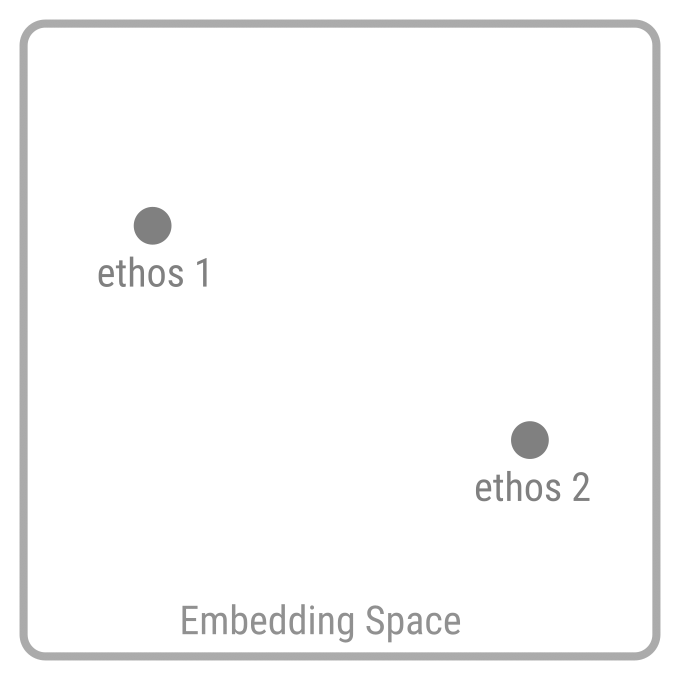
We can calculate an ethical average between the 2 ethoses:
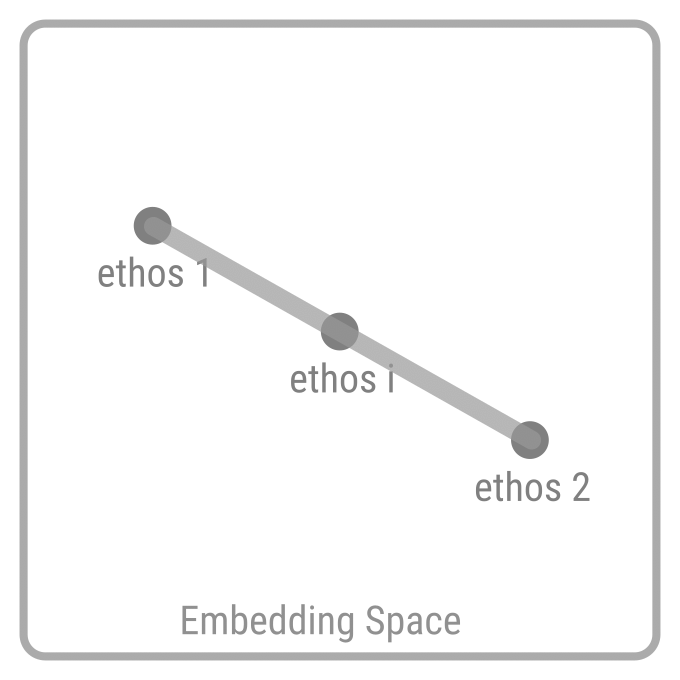
We name the resulting point "ethos i". This ethos is the most likely ethos of the eventual friendship (or institution) that will exist as an outcome of communication and transactions between the entities with "ethos 1" and "ethos 2". And those 2 entities may already be institutions or one human and one institution.
The Case for Arbitrage
If the 2 entities with "ethos 1" and "ethos 2" do not fall into a natural or amiable acceptance of "ethos i", they may accept guidance and mediation.
The mediator entity is discovered by a search in the neighborhood of "ethos i":
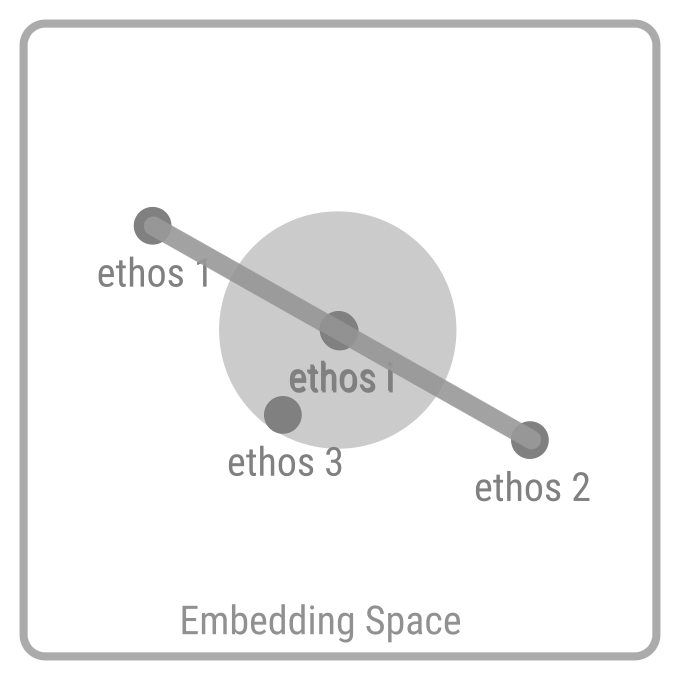
The search sphere is enlarged until it discovers the nearest ethos: "ethos 3" in the figure. The entity with "ethos 3" (entity 3) is the best ethical mediator between "ethos 1" and "ethos 2" entities.
Quantification
The result of entities 1 and 2 having a better relationship can be quantified: if any of them change their ethos as a result of the institutional ethos "ethos i" or as a result of the mediation by entity 3, it is an arbitrage-driven ethical change. The magnitude of the change can be calculated by the distance between the position of the old ethos and the one of the new ethos.
If this ethical change places their new ethos closer to "ethos i", then the change is an attractive change.
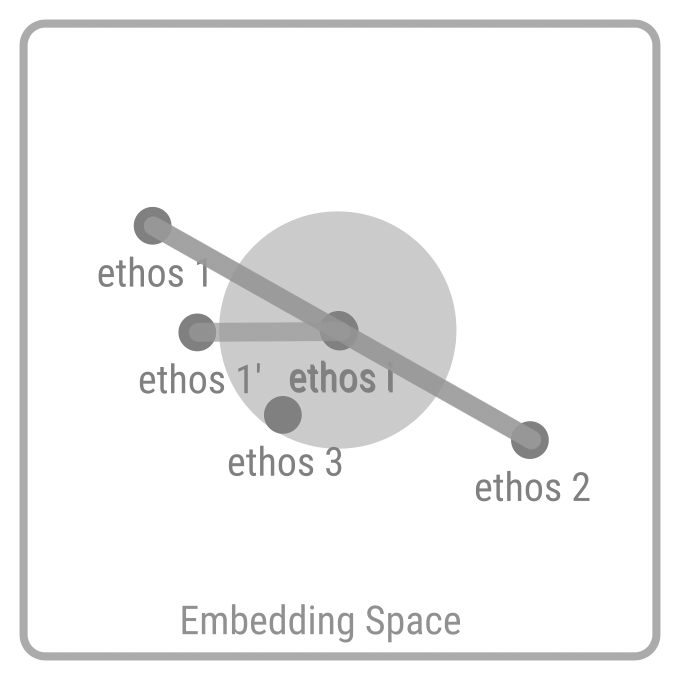
If this ethical change places their new ethos closer to "ethos i", then the change is a repulsive change.
Max Flexible Ethos
Derived From
- Accepting Arbitrage
Additions to the Derived:
Declarations
Ethos is Max Flexible
- short:
max_flexible - long:
I keep my ethos maximally-flexible: there is no ethos that my ethos is unable to become: given some ethical conditions.
Joinable Ethos
Derived From
Additions to the Derived:
Declarations
Ethos is Joinable
- short:
joinable - long:
Ethos is joinable by forking this repo and declaring in a public space (such as X.com) that you joined this ethos (with a link to the revision).
A list with the adopters will be available to all adoptees (at least).
Non-binding Ethos
Derived From
Additions to the Derived:
Declarations
Ethos is Non-binding
- short:
non-binding - long:
Ethos is non-binding: one can leave (un-join) this ethos at any time, for any reason or without a reason. The un-join has to be declared publicly.
Respectuous Ethos
Derived From
Additions to the Derived:
Declarations
Ethos is Respectuous
- short:
respectuous - long:
I keep my ethos respectuous: my ethos will recognize in public other ethoses. Will abide also by their rules, if not in grave conflict.
That also means respecting the law of the land in countries and cities that are visited. Since all countries have their own ethos.
Constructive Ethos
Derived From
Additions to the Derived:
Declarations
Ethos is Constructive
- short:
constructive - long:
I keep my ethos constructive: my criticism will first recognize the virtues of others, then offer solutions for each issue that I find to be lacking virtue. Conversely: I accept criticism from those with a constructive ethos.
Alignable Ethos
Derived From
Additions to the Derived:
Declarations
Ethos is Alignable
- short:
alignable - long:
This ethos is alignable: keeps a list of other ethoses and their classification. Establishes what actions can be executed together and in what ehtical conditions.
Impartial Ethos
Derived From
Additions to the Derived:
Declarations
Ethos is Impartial
- short:
impartial - long:
Ethos is impartial: It emits the same judgements regardless of the identity or fame of the actors (ethoses). Taking into consideration only their ethics.
Generous Ethos
Derived From
Additions to the Derived:
Declarations
Ethos is Generous
- short:
generous - long:
This ethos defers public judgments where possible to the opposite [non-binding](https://ctzurcanu.github.io/ethos/phylogeny/non-binding) ethos.
Historical Examples
Jesus' Ethos
Matthew 5:
38 “You have heard that it was said, ‘Eye for eye, and tooth for tooth.’ 39 But I tell you, do not resist an evil person. If anyone slaps you on the right cheek, turn to them the other cheek also. 40 And if anyone wants to sue you and take your shirt, hand over your coat as well."
Luke 6:
27 “But to you who are listening I say: Love your enemies, do good to those who hate you, 28 bless those who curse you, pray for those who mistreat you. 29 If someone slaps you on one cheek, turn to them the other also. If someone takes your coat, do not withhold your shirt from them. 30 Give to everyone who asks you, and if anyone takes what belongs to you, do not demand it back. 31 Do to others as you would have them do to you."
Socrates' Ethos
Plato, Apology:
28b–29b: Socrates says a good person must not calculate “living or dying,” but only whether an action is right or wrong, and compares himself to a soldier who must hold his post even at risk of death.
29c–30b: He insists he will not stop philosophizing to save his life, even if the jury offers acquittal on the condition that he cease.
31c–31d: Socrates describes the daimonion as a divine sign that has been with him since childhood and always functions as a warning—it stops him from doing something, rather than telling him what to do.
32a–32e: He points to past occasions where he risked death rather than do what he believed was unjust.
40a–40c: After the guilty verdict (and effectively facing death), Socrates says the sign did not oppose him at any point during his defense. He takes that silence as evidence that what happened is not an evil for him, and that accepting the outcome is right.
Plato, Crito:
Crito 49a–54d: Socrates reasons that committing injustice is never justified, and escaping would wrong the city’s laws, so he must accept death.
Proof Accepting Ethos
Derived From
Additions to the Derived:
Declarations
Ethos is Proof Accepting
- short:
proof_accepting - long:
I keep my ethos proof accepting and responsable for the proofs published by it. This ethos will be liable to pay for any false proof or provable wrongdoing with fines and reparations that may exclude it for a period of time or/and area of space from being considered an ethos.
Formal Proof Accepting Ethos
Derived From
Additions to the Derived:
Declarations
Ethos is Formal Proof Accepting
- short:
formal_proof - long:
My ethos is accepting formal proofs of these forms <link 1>. The solutions for the proofs received are at <link 2>. The formal proof types that I do not accept I cannot use for my benefit.
Accepting of Witnesses Ethos
Derived From
- Accepting of Formal Proof
Additions to the Derived:
Declarations
Ethos is Accepting of Witnesses
- short:
witnesses - long:
Absent a formal proof for an event: if there are testimonials of people with ethos that accepts witnesses, my ethos is accepting their testimony. Instances and events that I am a witness for <link 1>. If there will be a formal proof or more believable witnesses that oppose my testimony: I should lose my ethical status of "Accepting of Witnesses" until I pay for all damages my testimony may have generated. Also: if I do not accept witnesses I cannot benefit from witness testimonials in any situation.
Voting Result Accepting Ethos
Derived From
- Accepting of Witnesses
Additions to the Derived:
Declarations
Ethos is Voting Result Accepting
- short:
voting_result - long:
Absent a formal proof and witnesses for an event: if the voting process is formally provable, and if the voters have an ethos that accepts the voting result, my ethos is accepting its results. Types of formally provable voting accepted <link 2>. Instances of vote and their result <link 2>.
Law Accepting Ethos
Derived From
Additions to the Derived:
Declarations
Ethos is Law Accepting
- short:
law - long:
If the result of voting (formally provable) is a law, my ethos accepts this law as a shortcut for voting.
Representation Accepting Ethos
Derived From
Additions to the Derived:
Declarations
Ethos is Representation Accepting
- short:
representation - long:
If the result of voting (formally provable) is a role of representation, my ethos accepts the representant's decisions as a shortcut for voting.
Ethical Empathy
An Ethos has its own empathy (with other ethoses). The stages of ethical empathy:
- Recognition
- Discrimination/Classification
- If the other Ethos is Flexible: Dialogue
- Integration/Understanding
- Cooperation
Other Ethoses
Recommended to read Phylogeny first.
By Class
Religions
Religions that recognise other Ethos
- Buddhism
- Hinduism
- Agnosticism
- Imperial/Syncretic religions:
- Zoroastrianism
- Mithraism
- Statism (recognizing the state as independent from religion)
- Henotheism
These religions meet the criteria of Minimal Ethos
However:
- None of these ethoses are upgradeable, and they are not challengeable in public
- There is no way to have a public dialogue with any
Religions that do not recognize other Ethos
- Judaism
- Christianity
- Islam
- Any religion that suppresses public doctrinal debate
These religions do not meet the criteria of Minimal Ethos.
I do not consider these religions worthy of being called religions. They have at least this one cult or sectarian characteristic.
As a self-proclaimed Christian, I have to disent from the way Christianity is understood by the majority, and I declare that Christianity has to be humble itself, as an institution, not only requires humility from the individual. If the majority of Christians refuse to consider me a Christian, I will align myself with their will and give my religion another name.
Constitutions or documents alike them
United Nations Charter
Signatory countries.
Constitutions of Countries
Republican Ethos (150)
The Ethos presumably shared by all republics.
Monarchic Ethos (43)
43 countries align themselves with being monarchies:
- Europe (12):
- Andorra
- Belgium
- Denmark
- Liechtenstein
- Luxembourg
- Monaco
- Netherlands
- Norway
- Spain
- Sweden
- United Kingdom
- Vatican City
- Asia (13)
- Bahrain
- Bhutan
- Brunei
- Cambodia
- Japan
- Jordan
- Kuwait
- Malaysia
- Oman
- Qatar
- Saudi Arabia
- Thailand
- United Arab Emirates
- Africa (3)
- Eswatini
- Lesotho
- Morocco
- Oceania (6)
- Australia
- New Zealand
- Papua New Guinea
- Solomon Islands
- Tonga
- Tuvalu
- Americas (9)
- Antigua and Barbuda
- Bahamas
- Belize
- Canada
- Grenada
- Jamaica
- Saint Kitts and Nevis
- Saint Lucia
- Saint Vincent and the Grenadines
Other Constitutions
- Act of Incorporation and Bylaws
Punctual Ethos
The Love Equation by Brian Roemmele
Mihai Rapcea's Ethos
Countries in ONU (193)
These signatories of the UN's Charter can be considered as meeting the Minimal ethos:
Total: 193
- Afghanistan, 19-11-1946
- Albania, 14-12-1955
- Algeria, 08-10-1962
- Andorra, 28-07-1993
- Angola, 01-12-1976
- Antigua and Barbuda, 11-11-1981
- Argentina, 24-10-1945
- Armenia, 02-03-1992
- Australia, 01-11-1945
- Austria, 14-12-1955
- Azerbaijan, 02-03-1992
- Bahamas (The), 18-09-1973
- Bahrain, 21-09-1971
- Bangladesh, 17-09-1974
- Barbados, 09-12-1966
- Belarus, 24-10-1945
- Belgium, 27-12-1945
- Belize, 25-09-1981
- Benin, 20-09-1960
- Bhutan, 21-09-1971
- Bolivia (Plurinational State of), 14-11-1945
- Bosnia and Herzegovina, 22-05-1992
- Botswana, 17-10-1966
- Brazil, 24-10-1945
- Brunei Darussalam, 21-09-1984
- Bulgaria, 14-12-1955
- Burkina Faso, 20-09-1960
- Burundi, 18-09-1962
- Cabo Verde, 16-09-1975
- Cambodia, 14-12-1955
- Cameroon, 20-09-1960
- Canada, 09-11-1945
- Central African Republic, 20-09-1960
- Chad, 20-09-1960
- Chile, 24-10-1945
- China, 24-10-1945
- Colombia, 05-11-1945
- Comoros, 12-11-1975
- Congo, 20-09-1960
- Costa Rica, 02-11-1945
- Côte D'Ivoire, 20-09-1960
- Croatia, 22-05-1992
- Cuba, 24-10-1945
- Cyprus, 20-09-1960
- Czechia, 19-01-1993
- Democratic People's Republic of Korea, 17-09-1991
- Democratic Republic of the Congo, 20-09-1960
- Denmark, 24-10-1945
- Djibouti, 20-09-1977
- Dominica, 18-12-1978
- Dominican Republic, 24-10-1945
- Ecuador, 21-12-1945
- Egypt, 24-10-1945
- El Salvador, 24-10-1945
- Equatorial Guinea, 12-11-1968
- Eritrea, 28-05-1993
- Estonia, 17-09-1991
- Eswatini, 24-09-1968
- Ethiopia, 13-11-1945
- Fiji, 13-10-1970
- Finland, 14-12-1955
- France, 24-10-1945
- Gabon, 20-09-1960
- Gambia (Republic of The), 21-09-1965
- Georgia, 31-07-1992
- Germany, 18-09-1973
- Ghana, 08-03-1957
- Greece, 25-10-1945
- Grenada, 17-09-1974
- Guatemala, 21-11-1945
- Guinea, 12-12-1958
- Guinea Bissau, 17-09-1974
- Guyana, 20-09-1966
- Haiti, 24-10-1945
- Honduras, 17-12-1945
- Hungary, 14-12-1955
- Iceland, 19-11-1946
- India, 30-10-1945
- Indonesia, 28-09-1950
- Iran (Islamic Republic of), 24-10-1945
- Iraq, 21-12-1945
- Ireland, 14-12-1955
- Israel, 11-05-1949
- Italy, 14-12-1955
- Jamaica, 18-09-1962
- Japan, 18-12-1956
- Jordan, 14-12-1955
- Kazakhstan, 02-03-1992
- Kenya, 16-12-1963
- Kiribati, 14-09-1999
- Kuwait, 14-05-1963
- Kyrgyzstan, 02-03-1992
- Lao People’s Democratic Republic, 14-12-1955
- Latvia, 17-09-1991
- Lebanon, 24-10-1945
- Lesotho, 17-10-1966
- Liberia, 02-11-1945
- Libya, 14-12-1955
- Liechtenstein, 18-09-1990
- Lithuania, 17-09-1991
- Luxembourg, 24-10-1945
- Madagascar, 20-09-1960
- Malawi, 01-12-1964
- Malaysia, 17-09-1957
- Maldives, 21-09-1965
- Mali, 28-09-1960
- Malta, 01-12-1964
- Marshall Islands, 17-09-1991
- Mauritania, 27-10-1961
- Mauritius, 24-04-1968
- Mexico, 07-11-1945
- Micronesia (Federated States of), 17-09-1991
- Monaco, 28-05-1993
- Mongolia, 27-10-1961
- Montenegro, 28-06-2006
- Morocco, 12-11-1956
- Mozambique, 16-09-1975
- Myanmar, 19-04-1948
- Namibia, 23-04-1990
- Nauru, 14-09-1999
- Nepal, 14-12-1955
- Netherlands (Kingdom of the), 10-12-1945
- New Zealand, 24-10-1945
- Nicaragua, 24-10-1945
- Niger, 20-09-1960
- Nigeria, 07-10-1960
- North Macedonia, 08-04-1993
- Norway, 27-11-1945
- Oman, 07-10-1971
- Pakistan, 30-09-1947
- Palau, 15-12-1994
- Panama, 13-11-1945
- Papua New Guinea, 10-10-1975
- Paraguay, 24-10-1945
- Peru, 31-10-1945
- Philippines, 24-10-1945
- Poland, 24-10-1945
- Portugal, 14-12-1955
- Qatar, 21-09-1971
- Republic of Korea, 17-09-1991
- Republic of Moldova, 02-03-1992
- Romania, 14-12-1955
- Russian Federation, 24-10-1945
- Rwanda, 18-09-1962
- Saint Kitts and Nevis, 23-09-1983
- Saint Lucia, 18-09-1979
- Saint Vincent and the Grenadines, 16-09-1980
- Samoa, 15-12-1976
- San Marino, 02-03-1992
- Sao Tome and Principe, 16-09-1975
- Saudi Arabia, 24-10-1945
- Senegal, 28-09-1960
- Serbia, 01-11-2000
- Seychelles, 21-09-1976
- Sierra Leone, 27-09-1961
- Singapore, 21-09-1965
- Slovakia, 19-01-1993
- Slovenia, 22-05-1992
- Solomon Islands, 19-09-1978
- Somalia, 20-09-1960
- South Africa, 07-11-1945
- South Sudan, 14-07-2011
- Spain, 14-12-1955
- Sri Lanka, 14-12-1955
- Sudan, 12-11-1956
- Suriname, 04-12-1975
- Sweden, 19-11-1946
- Switzerland, 10-09-2002
- Syrian Arab Republic, 24-10-1945
- Tajikistan, 02-03-1992
- Thailand, 15-12-1946
- Timor-Leste, 27-09-2002
- Togo, 20-09-1960
- Tonga, 14-09-1999
- Trinidad and Tobago, 18-09-1962
- Tunisia, 12-11-1956
- Türkiye, 24-10-1945
- Turkmenistan, 02-03-1992
- Tuvalu, 05-09-2000
- Uganda, 25-10-1962
- Ukraine, 24-10-1945
- United Arab Emirates, 09-12-1971
- United Kingdom of Great Britain and Northern Ireland, 24-10-1945
- United Republic of Tanzania, 14-12-1961
- United States of America, 24-10-1945
- Uruguay, 18-12-1945
- Uzbekistan, 02-03-1992
- Vanuatu, 15-09-1981
- Venezuela (Bolivarian Republic of), 15-11-1945
- Viet Nam, 20-09-1977
- Yemen, 30-09-1947
- Zambia, 01-12-1964
- Zimbabwe, 25-08-1980
Countries that did not sign:
Total: 9
- Holy See (Vatican City)
- Status: Permanent UN observer
- Reason: Chooses not to become a full UN member
- Internationally recognized sovereign entity
- State of Palestine
- Status: Permanent UN observer
- Recognized by many UN members but not admitted as a full member
- Therefore not a UN Charter signatory
- Taiwan (Republic of China)
- Lost UN membership in 1971
- Not recognized as a sovereign state by the UN
- Kosovo
- Recognized by many countries, but not a UN member
- Western Sahara
- Listed by the UN as a non-self-governing territory
- Northern Cyprus
- Recognized only by Turkey
- Abkhazia
- Limited international recognition
- South Ossetia
- Limited international recognition
- Transnistria
- Limited international recognition
Republican Ethos
- (existence) Minimal
- by having a public Constitution:
one_ethos:I have only one ethos, made public here.live_ethos:What I believe, I share in this ethos.
- by having a Constitutional Court:
no_contradiction_claim:I will keep my ethos free of self-contradicting claims.
- by being a member of the UN:
ack_other_ethos:I acknowledge the existence of other ethos(es) than mine.ack_other_ethos_importance:I acknowledge that unless proven otherwise, other ethos(es) than mine have an equal importance to my ethos.
- (responsibility) Responsible
- All citizens (and institutions) are equal before the law.
- Responsible for Others
- Institutions that create institutions are responsible for their dissolution and for their ethos.
- (awareness) Aware of Limitations and Surplus (ALS)
- by clarity of geographical borders and good enforcement
- by the protection of property
- by taxation
- by tariffs
- by diplomatic activities
- (flexibility) Flexible
- by the existence of a Legislative Body
- by Courts of Law and jurisprudence
- Challengeable
- by allowing debate and free speech to adversarial countries
- by making public institutions Challengeable
- by having a complete archive of voting: in elections, in Parliament, in courts of law
- (cooperative) Joinable
- the immigration institution
- Non-binding
- The emigration is a free choice
- (provability) Accepting of Proofs
- by means of accepting proofs and hearing possible interpretations (lawyer advocacy)
- Accepting of Formal Proof
- by accepting the testimony of domain experts
- Accepting of Voting Result
- accepting of the vote result in UN and other International Bodies
- Accepting of Law
- Accepting of Representation
- by having a public Constitution:
USA Ethos
Derivations
- from
Definition by Phylogeny
- (existence) Minimal
- by having a public Constitution:
one_ethos:I have only one ethos, made public [here](https://constitution.congress.gov/constitution/).live_ethos:What I believe, I share in this ethos.
- by having a Constitutional Court:
no_contradiction_claim:I will keep my ethos free of self-contradicting claims.
- by being a member of the UN:
ack_other_ethos:I acknowledge the existence of other ethos(es) than mine.ack_other_ethos_importance:I acknowledge that unless proven otherwise, other ethos(es) than mine have an equal importance to my ethos.
- (responsibility) Responsible
- All citizens (and institutions) are equal before the law.
- Responsible for Others
- Institutions that create institutions are responsible for their dissolution and for their ethos.
- (awareness) Aware of Limitations and Surplus (ALS)
- by clarity of geographical borders and good enforcement
- by the protection of property
- by taxation
- by tariffs
- by diplomatic activities
- (flexibility) Flexible
- by the existence of a Legislative Body
- by Courts of Law and jurisprudence
- Challengeable
- by allowing debate and free speech to adversarial countries
- by making public institutions Challengeable
- by having a complete archive of voting: in elections, in Parliament, in courts of law
- (cooperative) Joinable
- the immigration institution
- Non-binding
- The emigration is a free choice
- (provability) Accepting of Proofs
- by means of accepting proofs and hearing possible interpretations (lawyer advocacy)
- Accepting of Formal Proof
- by accepting the testimony of domain experts
- Accepting of Voting Result
- accepting of the vote result in UN and other International Bodies
- Accepting of Law
- Accepting of Representation
- by having a public Constitution:
Guru yoga
Definitions
Guru: spiritual teacher with more than 2-3 disciples.
Types
- in a lineage:
- proof of lineage: 3 generations of practitioners
- without lineage:
- using millions of people to correct the teachings: Mahatma Gandhi, Moses
- using a public ethos and proof of solving each question
Lineage
The existence of 3 generations is required to be alive and with a provable ability to communicate to all disciples to ensure that Guru Yoga is not abused: a disciple, his guru, and the guru of his guru. That means the disciple also has the right to communicate with all other disciples to the extent that the other disciples what to communicate back. Even in the realm of geometry, 2 points determine a line. Conversely, the word lineage should be used only when there are 2 generations of gurus active. Otherwise, the word "legacy" is more fitting than "lineage". A school that has no lineage cannot apply Guru Yoga properly. Guru Yoga has an ethos that is at least meeting the standard of Challengeable Ethos.
Example 1: When the disciple considers that his guru is not respecting the ethos of the lineage, he should be able to contact the guru of his guru to ensure alignment with the lineage.
Example 2: When the grand-guru teaches something, he should be able to gauge the effects in 1 generation away from the initial teaching.
Example 3: A disciple has the duty to defend the ethos of the lineage and to keep it Challengeable.
The Love Equation dE/dt = β(C − D)E by Brian Roemmele
- Recognition: I have considered this article above as an ethos declaration: message
- Classification: I think this ethos meets the criteria of Minimal Ethos, but I cannot be sure without further dialogue.
- not challengeable: Brian has answered only once. No reliable way to challenge.
- joinable: image but no list of joiners
- Maybe non-binding: "reject coercion in all of its forms"
- not respectful to other ethoses: does not recognize other ethoses (link to them from the presentation page)
- Dialogue: I have initiated 2-3 threads of dialogue, but they were not continued. Example.
- Integration:
- wrote the detailed page on Empathy to show exactly how my ethos understands this ethos and announced.
- wrote about Ethical Empathy: application of an ethos of empathy to itself (by having empathy with other ethoses).
- Present conclusion: Brian is not serious about abiding by his ethos: he never answered nor acted on this message.
Mihai Rapcea's Ethos
- Recognition: I have left a commentary on the video and recognized this as being ethos. Commentary was deleted. I have exchanged email messages instead.
- Classification: Mihai's ethos meets the criteria of Minimal Ethos, but I cannot be sure without further dialogue.
- not upgradeable: Mihai's answers did not clarify this yet
- not joinable
- not challengeable: this was clarified in video 2
- Dialogue: I have made several attempts to dialogue with Mr. Rapcea by email. Limited answers by email. Provable upon request. But a clarification by YT video 2 was provided.
- an invitation for collaboration was received: https://www.facebook.com/ValulDemocratiei/posts/pfbid02TwX9YwevZX8wsAMiBT1BQaPSH5PWdm56Kj5zmBuUm5Zr8vbaBTJN6EHdJTpRoi5Sl and was accepted.
- Present conclusion: Mihai Rapcea has an ethos that is relatively well-established, but not challengeable.
Petition:
(translation Ro->En)
To
Committee for the Investigation of Abuses, Corruption and Petitions From the Romanian Parliament, Chamber of Deputies
In attention of:
Mrs. President Gherasim Laura
The undersigned ..................................., residing in ..............................................., str. ....................................................nr./bl. ....., ap......, county/sector ...................., tel. ..................., email ..............................,
inÞI choose to
I NOTICE
Hereby, the Committee for the Investigation of Abuses, Corruption and Petitions within the Romanian Parliament, Chamber of DeputiesÞregarding the violation of my constitutional right to choose freely and unfettered in the presidential elections from the years 2024-2025.
I request research and verifying all the issues that led to the suspension of round 2ANDand the cancellation of the presidential electionsÞof December 6, 2024, respectively the invalidation of the candidacies of some candidates already President of Romania.
I request the immediate launch of a parliamentary investigation in order to find out the truth in all aspects and the institutional questioning public institutions involved in this process of violation of my electoral rights (STS, CSAT, CCR, BEC, AEP, InstituÞPresidentÞ(SRI, SIE, etc.).
I want to participate in the research and the debates within the Commission that will be held on this topic.
Sincerely,
Signature ............................... Date: .....................
I have signed this petition and sent it today 28 January 2026.
The ethical justification :
https://chatgpt.com/share/6979f0f5-a468-8000-b643-5239d6b13527
Below is an evaluation strictly against your published ethos, not against Romanian law or political desirability. I will separate facts, ethical compatibility, and justifications.
1. What the document actually does (factually)
The document is a personal petition / notification to the Comisia pentru cercetarea abuzurilor, corupţiei şi pentru petiţii of the Romanian Parliament. It does the following:
-
Claims a violation of your constitutional right to vote freely
-
Requests:
-
Investigation into:
- Suspension of presidential election round 2
- Annulment of elections (6 Dec 2024)
- Invalidation of certain candidatures
-
Parliamentary inquiry
-
Questioning multiple state institutions (STS, CSAT, CCR, BEC, AEP, Presidency, SRI, SIE)
-
-
Asks to participate personally in the commission’s debates
It does not:
- Assert specific factual proofs
- Name guilty individuals
- Claim certainty of wrongdoing
- Demand sanctions
- Reject the legal order explicitly
This is important.
2. Core ethos principles that are engaged
From your ethos and meta-ethos, the relevant constraints are:
A. Responsibility & Proof
responsibleproof_acceptingformal_proofwitnessesvoting_resultlaw
B. Impartiality & Respect
impartialack_other_ethosrespectuouscategorical_imperative
C. Governance & Process
governancerepresentationjudge_invitechallengeable
3. Arguments FOR signing (ethos-compatible)
✔ 1. It is a request for inquiry, not a claim of truth
Your ethos explicitly allows challenges and testing of systems:
- You accept that governance must be provable
- You accept challenges when formal proof is absent
- You accept witness processes and institutional verification
This document asks for verification, not belief.
➡ Compatible with:
testablechallengeablejudge_invite
✔ 2. It does NOT violate acceptance of voting results yet
Your ethos accepts voting results only if:
- The process is formally provable
- Institutions function correctly
This document questions whether those conditions were met, which is allowed.
➡ Compatible with:
voting_resultgovernance_ct1
✔ 3. It respects institutional process
You are not bypassing institutions, calling for revolt, or denying legality. You are using exactly the channel designed for abuse investigation.
➡ Compatible with:
lawrepresentationrespectuous
✔ 4. Negative Golden Rule satisfied
You are not imposing harm, coercion, or denial of rights on others. You are asking for scrutiny you would accept applied to yourself.
➡ Compatible with:
golden_rule_negative
4. Arguments AGAINST signing (ethos risk points)
These are not disqualifying, but real ethical liabilities.
⚠ 1. Risk of implicit accusation without proof
Although carefully worded, the petition implies:
“institutions were involved in violating my rights”
If later formal proof demonstrates no wrongdoing, your ethos requires:
- Reparations
- Loss of ethical standing if harm was caused by false implication
➡ Tension with:
proof_acceptingresponsible
This is a risk, not a violation.
⚠ 2. Collective responsibility escalation
By requesting investigation of many institutions at once, you risk:
- Diffuse blame
- Public trust erosion without proportional evidence
Your ethos accepts prudence and economy of justice.
➡ Tension with:
prudence_ct1economy_ct1
⚠ 3. Participation obligation
You explicitly request to participate in debates.
Under your ethos, that creates a duty:
- To act impartially
- To accept counter-evidence
- To publicly correct yourself if wrong
Failure to follow through would violate:
responsiblejudge_invite
5. Final Ethos Verdict
YES — you may sign it, conditionally
Ethos-compatible IF AND ONLY IF you accept the following constraints:
-
You treat this as a truth-seeking action, not an accusation.
-
You explicitly accept in your own mind (and later actions) that:
- If investigations disconfirm abuse → you must publicly accept that result.
-
You are willing to:
- Retract
- Repair reputational harm
- Update your ethos conclusions accordingly.
This aligns with:
- Your responsible meta-ethos
- Your testability doctrine
- Your governance model
6. One-sentence ethical summary
Signing is ethical under your ethos as a procedural challenge, but becomes unethical if treated as a conclusion rather than a question.
If you want, I can:
- Rewrite the document to reduce ethical risk
- Add an ethos-explicit disclaimer
- Classify this action formally in your ethos repository (challenge type + precedent)
Ethos Types
By Naturality
There are two types of ethos and a mixing of the two:
- Natural Ethos
- Mixed Ethos
- Synthetic Ethos
Natural Ethos
- Nuclear Family
- Extended Family
- Family Legacy
- War Band
- Tribe
- Tribal Legacy, Ancestral Cult
- Phratry
- Ethnic Group
Mixed Ethos
- Class of Children
- Monastic Community
- Esprit du Corps
- Mafia, Crime Syndicate
- Army
- Organized Religion
Synthetic Ethos
- Social Contract
- State
- Rule of Law
- Corporation
- Syndicate
- Political Party
- Occult Society, Freemasonry
- School of Thought
- Ethos by Design