Ethical Arbitrage
Derived From
Additions to the Derived:
Declarations
Ethos is Accepting Arbitrage
- short:
arbitrage - long:
This ethos is accepting arbitrage from a person or ethos C in order to achieve a common understanding with ethos B. I also remain available for arbitrage services to any person or ethos who accepts arbitration and needs it.
Ethical Embedding Space
Let us consider the set of all ethoses as strings parseable/tokenizable by AI. We may use an LLM (or better: an LCM) to obtain the embedded vector for all of them. We will call the space spanned by all ethos embeddings an Ethical Embedding Space.
The Case of 2 Ethoses
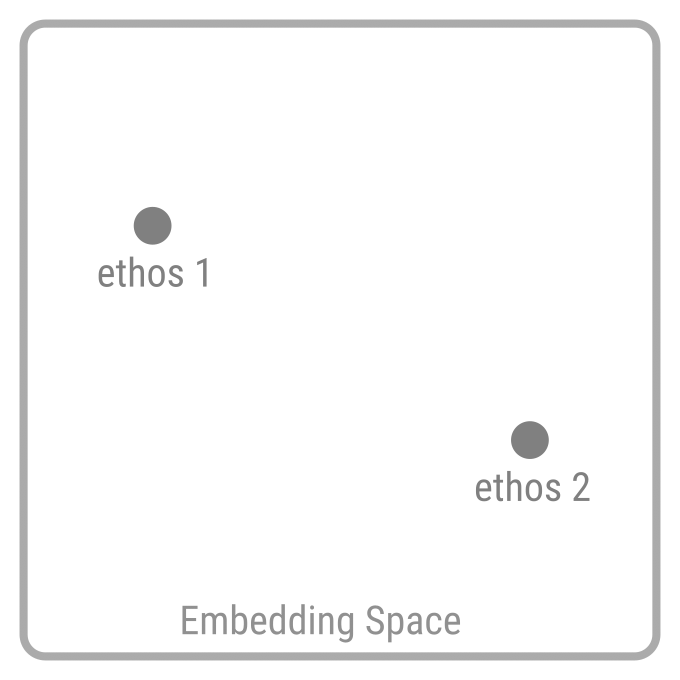
If we consider 2 ethoses: "ethos 1" (for entity 1) and "ethos 2" (for entity 2), embedded in the ethical embedding space: they can be understood as 2 distinct points. They would have to live in a space with more than 1000 dimensions to make this theory applicable, but if we simplify the space to 2 dimensions, we make it understandable. So we can even draw them:
We can calculate an ethical average between the 2 ethoses:
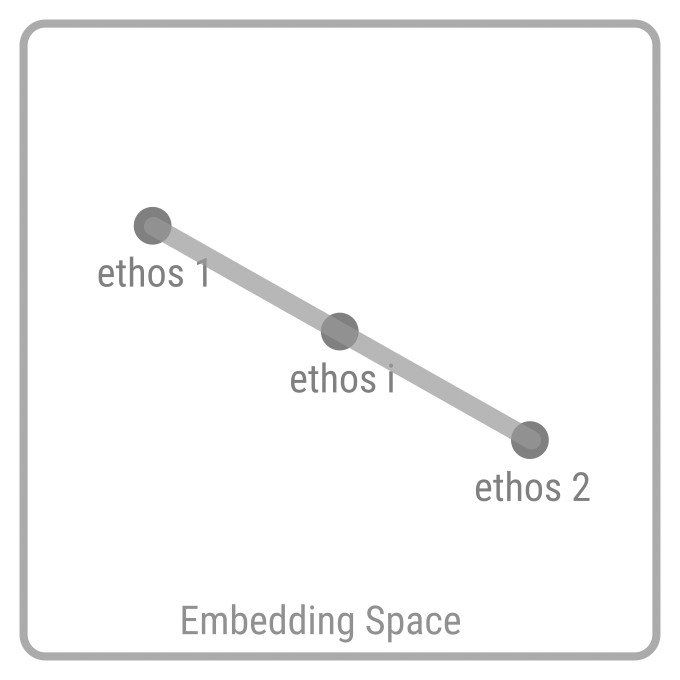
We name the resulting point "ethos i". This ethos is the most likely ethos of the eventual friendship (or institution) that will exist as an outcome of communication and transactions between the entities with "ethos 1" and "ethos 2". And those 2 entities may already be institutions or one human and one institution.
The Case for Arbitrage
If the 2 entities with "ethos 1" and "ethos 2" do not fall into a natural or amiable acceptance of "ethos i", they may accept guidance and mediation.
The mediator entity is discovered by a search in the neighborhood of "ethos i":
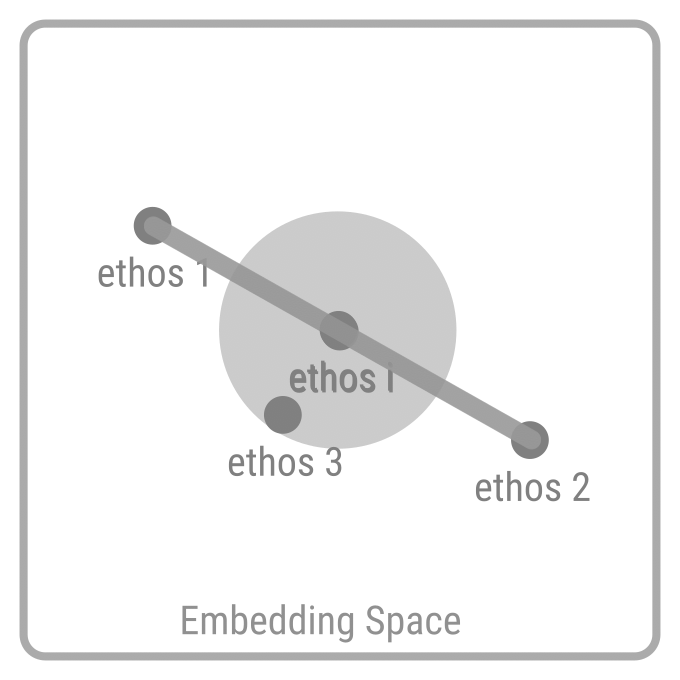
The search sphere is enlarged until it discovers the nearest ethos: "ethos 3" in the figure. The entity with "ethos 3" (entity 3) is the best ethical mediator between "ethos 1" and "ethos 2" entities.
Quantification
The result of entities 1 and 2 having a better relationship can be quantified: if any of them change their ethos as a result of the institutional ethos "ethos i" or as a result of the mediation by entity 3, it is an arbitrage-driven ethical change. The magnitude of the change can be calculated by the distance between the position of the old ethos and the one of the new ethos.
If this ethical change places their new ethos closer to "ethos i", then the change is an attractive change.

If this ethical change places their new ethos closer to "ethos i", then the change is a repulsive change.