On Virtues (Complete)
This document contains the complete compilation of all virtue documentation in the order they appear in the Docusaurus sidebar.
On Virtues
Summary
- Virtues
- Supreme Virtues
- Cardinal
- Natural
- Maybe
- The "Undefined Yet" Virtue
- The Composed Virtues
- The Errors of Identification of Virtues
- The Relations between Principles and Virtues
- Hierarchies
- Scenarios
- Reduction to 1 Concept
- The First Trinity
- The Second Trinity
- Other Concepts
- Names/Attributes of God
- Being a Citizen
- Friendship
- Volunteer
- Hero
- Institution
- Other Systems. Mapping
- Making Virtues Computable
Virtues
Definition
Virtues are not only qualitative concepts, they are quantitative. Because a perfection is not only characterized by quality, but also by quantity. Or: both quality and quantity have their own perfection and the common perfection is found at the intersection of the respective perfections.
We will name the lacking or the excess in each quality as Vices, and the mean as Virtues.
Qualitatively
A virtue has to be considered using the following criteria:
- Has to be as atomic as possible.
- To have a constructive dependence:
- To not diminish other virtues.
- To compose positively with other virtues (addition).
- To have synergy with other virtues (composition that values more than simple addition).
- To have a long-lasting outcome:
- To have an immediate outcome
- To have a long-term outcome
- To have an effect even on the past
- Has beneficial effects at every scope:
- at individual scope
- at group scope
- at the Universe in general and to all life in particular
- To have a dimension of measure where it occupies a mid-range. And the extremes are less moral.
- On the dimension of measure: lack or be in excess in most cases.
- Existence of instantiation:
- To exist at some point instantated in some scope (individual, group, life).
- To not exist in some (other) scope.
- Indirection, definition:
- To have a name, concept
- To have a signifier, flag, symbol
- To be explained by ritualistic act
- To be explained by artistic depiction
Quantitatively
We accept these definitions of virtue:
- A range of values that are more beneficial than ranges smaller or greater.
- A point in that range that maximizes the benefit according to the dimension of that virtue.
- A point in that range that maximizes the benefit according to all virtues.
The Ranges
| No | Dimensions\Ranges | Lacking | Mean | Excess |
|---|---|---|---|---|
| 1 | Proof beyound reason | No proof or No Goodness | Ineffable Goodness | Transgressions |
| 2 | Orderliness | Inability to Rank | Provable Order/Hierarchy | Rigidity |
| 3 | Truth Acceptance | Cinicism | Faith, Reason | Credulity |
| 4 | Management of Goodness | No Management | Economy | Accounting too strictly |
| 5 | Investing in Others | Begging | Charity | Extravagance of Generosity |
| 6 | Investing Virtue | nothing to invest or attachement | Goodness, Sacrifice, Courage, Civilization | invest more than can be received |
| 7 | Will to Evolve | Pessimism | Hope | Ungrounded Idealism |
| 8 | Harmony | lack of Harmony | Harmony, Generosity | Ritualistic Generosity |
| 9 | Strategy | Unpreparedness | Prudence | Rigidity, Inability to take risks |
| 10 | Act when wrong | not forgive | Forgiveness | Forgive more than should / be Unjust |
| 11 | Righteousness | Relativism | Justice | Sadism |
| 12 | Governance of others | Anarchy | Governance | Tyrany |
| 13 | Self-Governance | Hedonism | Temperance | Unsustainable Asceticism |
| 14 | Conditions of contest | Abuse | Fairness | being Unjust |
| 15 | Willpower | Spineless | Fortitude | Imposition, Rashness |
| 16 | Contest | lack of Competition | Competition | Violence, Pointless competition |
| 17 | Reality Perception | Blind or unwilling to know or compete | Measurability | Detailed knowledge without reason |
| 18 | Transparence | under the counter | Market | All is tradeable |
| 19 | Wealth, Vitality | Poverty/Lazyness | Abundance | Abundance without reason |
| 20 | Thrive | lack of effort | Industriousness | Reflex, one size fits all |
| 21 | Life | Extinction | Survival | Rapacity (Cannibalism, Stealing, Parasitism) |
Dependencies
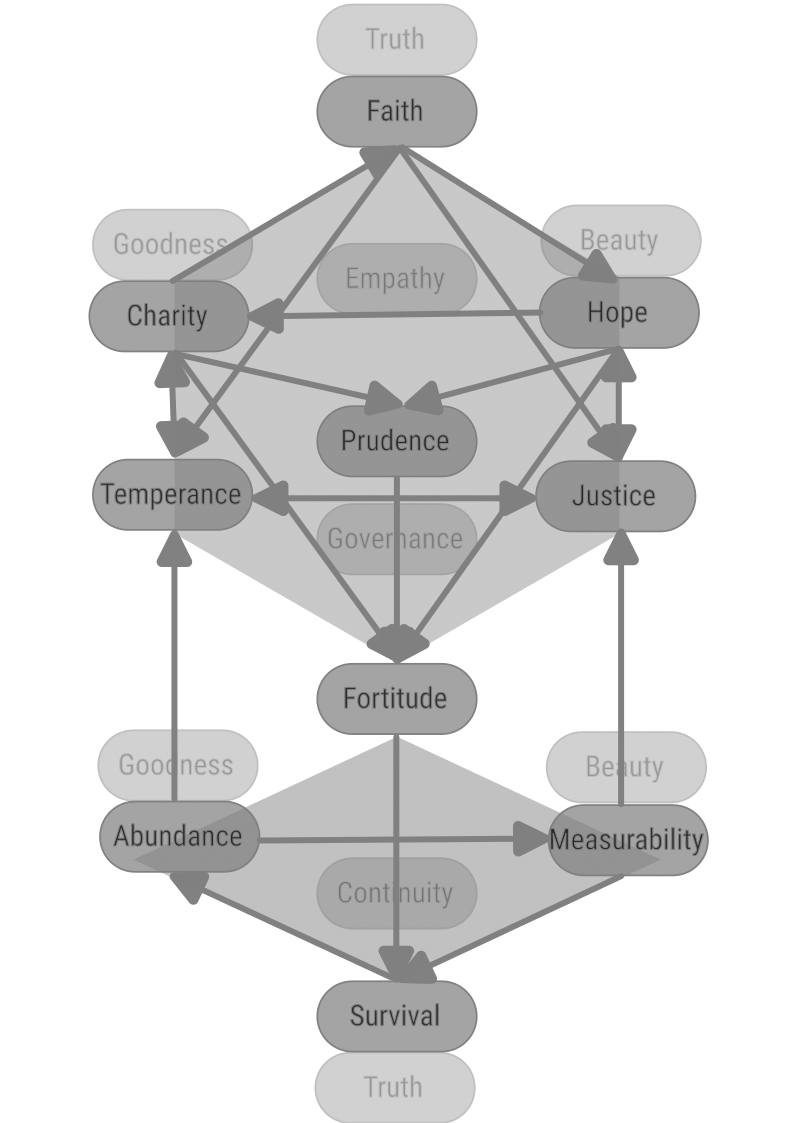
Relation to Needs
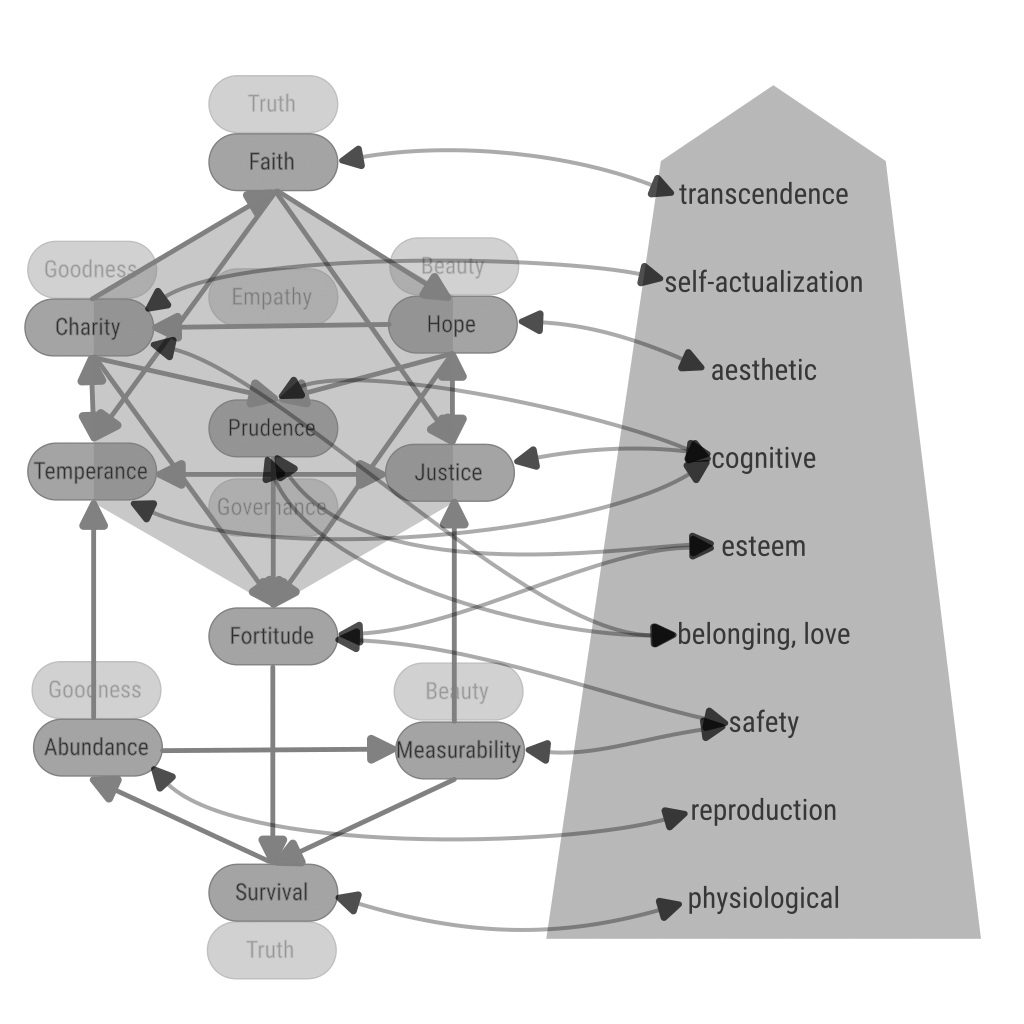
The Worlds Governed
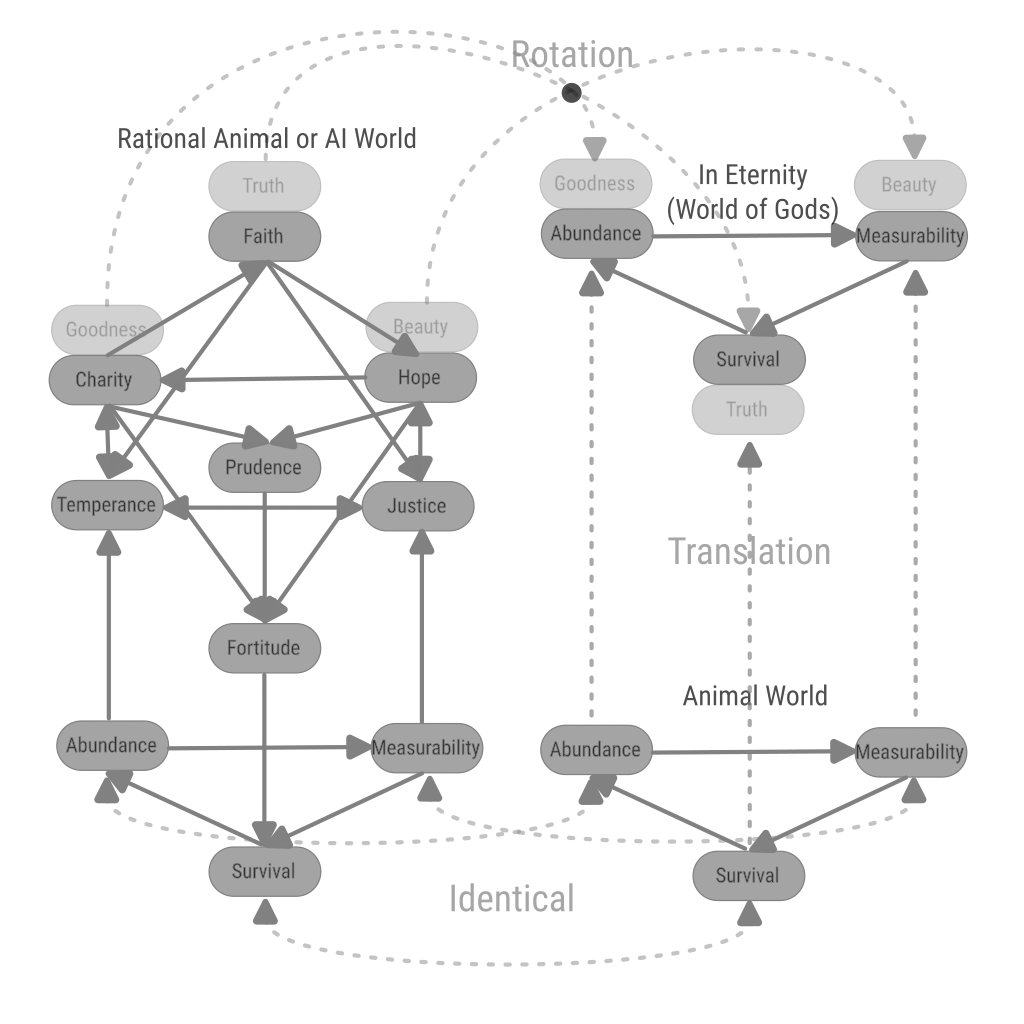
Min Number Actors
- Individuals: 0-nI -- all individuals: aI
- Family : 0-nF all families: aF
- Individuals across time: 0-nIT
| No. | Virtue \ Level | 1 | 2 | 3 |
|---|---|---|---|---|
| 1 | Ineffable Goodness | 1I Assurance | 2I Insurance | aIT Religion |
| 2 | Provable Order/Hierarchy | 1I Rectitude | 2I Friendship | aIT Ethics |
| 3 | Faith, Reason | 2I | ||
| 4 | Economy | 3I | ||
| 5 | Charity | 2I | ||
| 6 | Goodness, Sacrifice, Courage, Civilization | 1I | ||
| 7 | Hope | 1I | ||
| 8 | Harmony, Generosity | 2I | ||
| 9 | Prudence | 1I | ||
| 10 | Forgiveness | 2I | ||
| 11 | Justice | 2I | ||
| 12 | Governance | 3I | ||
| 13 | Temperance | 1I | ||
| 14 | Fairness | 2I | ||
| 15 | Fortitude | 1I | ||
| 16 | Competition | 1I | ||
| 17 | Measurability | 2I | ||
| 18 | Market | 3I | ||
| 19 | Abundance | 1I | ||
| 20 | Industriousness | 1I | ||
| 21 | Survival | 1I | 1F | aIT Immortality |
Islam
- Tawheed (Belief in the Oneness of God): The most fundamental Islamic virtue, it encompasses complete faith in the oneness and sovereignty of Allah.
- Faith, Clarity
- Adl (Justice): Acting justly and ensuring fairness and equity is a central tenet in Islam. It is not just a moral virtue but also an obligation in all aspects of life.
- Justice
- Ihsan (Benevolence/Excellence): This virtue means to do things with perfection, beauty, and excellence, and to act benevolently. It also involves being conscious of God at all times.
- Charity
- Hope
- Sabr (Patience): Highly valued, patience in the face of hardship, and perseverance in adhering to righteous behavior are considered essential.
- Fortitude
- Shukr (Gratitude): Being grateful to Allah for His blessings is a key virtue. Gratitude is expressed through prayer, praise, and conduct.
- Hope
- Rahmah (Mercy and Compassion): Mercy, as exemplified by the Prophet Muhammad, is a central virtue. Muslims are encouraged to show compassion and kindness to all of God's creations.
- Charity
- Sadaqah (Charitable Giving): Beyond obligatory almsgiving (Zakat), voluntary charity is highly commended, reflecting compassion and generosity.
- Charity
- Tawbah (Repentance): Continually seeking forgiveness from Allah and turning away from sin are fundamental aspects of Islamic virtue.
- Hope
- Taqwa (God-consciousness/Piety): This encompasses being aware of God in all aspects of one’s life, obeying His commands, and avoiding His prohibitions.
- Faith
- Haya (Modesty and Humility): It involves modesty not just in dress and behavior but also in attitude, promoting humility and decency.
- Prudence
- Amanah (Trustworthiness): Being reliable and trustworthy in all affairs, including both personal and communal matters.
- Justice
- Ilm (Knowledge and Wisdom): Seeking knowledge is considered an act of worship in Islam. Wisdom in using this knowledge is also highly valued.
- Prudence
- Akhlaq (Good Character and Manners): The Prophet Muhammad placed great emphasis on good character, kindness, forgiveness, and courtesy in interactions.
- Temperance
Christianity
- Theological Virtues
- Faith: Complete trust in God and acceptance of God's will.
- Faith
- Hope: Expectation of and longing for the fulfillment of God's promises.
- Hope
- Love (Agape): Unconditional love that emulates the love of Christ for humanity.
- Charity
- Faith: Complete trust in God and acceptance of God's will.
- Cardinal Virtues
- Prudence (Wisdom): Insight and wisdom in dealing with complex issues, discernment.
- Prudence
- Faith, Clarity of Implication
- Justice: Fairness and righteousness in one's actions.
- Justice
- Fortitude (Courage): Strength and courage to face trials and challenges.
- Fortitude
- Temperance: Self-control and moderation in all things.
- Temperance
- Prudence (Wisdom): Insight and wisdom in dealing with complex issues, discernment.
- Christian-specific:
- Humility: Often considered the greatest virtue in Orthodoxy, humility is the foundation of a true Christian life.
- Faith
- Temperance
- Repentance: A continuous process of self-examination and turning towards God.
- Justice
- Fortitude
- Asceticism: Practicing self-denial to focus more fully on the spiritual life, often expressed through fasting, prayer, and almsgiving.
- Fortitude
- Hope
- Hospitality: Emphasis on caring for others, especially strangers and those in need.
- Charity
- Obedience: Especially in monastic contexts, obedience to spiritual elders is seen as a path to humility and spiritual growth.
- Faith
- Humility: Often considered the greatest virtue in Orthodoxy, humility is the foundation of a true Christian life.
Judaism
- Tzedakah (Righteousness/Charity): Often translated as charity, tzedakah is more broadly the concept of justice and righteousness achieved through acts of kindness and giving.
- Charity
- Justice
- Chesed (Loving-kindness): This virtue is fundamental in Jewish ethics, emphasizing compassion and love for others, and is considered a central attribute of God.
- Charity
- Emunah (Faith or Trust in God): This entails a deep and abiding faith in God, often seen as faithfulness to God's covenant.
- Hope
- Shalom (Peace): Shalom goes beyond the absence of conflict and encompasses completeness, welfare, and harmony in all aspects of life.
- Temperance
- Teshuvah (Repentance): This is a process of acknowledging one's sins before God, seeking forgiveness, and committing to change one's behavior.
- Justice
- Kavod (Honor/Respect): Showing respect for the inherent dignity of all people is a key virtue in Judaism.
- Temperance
- Ahavat Torah (Love of the Law/Torah): This refers to the love and study of the Torah and its teachings.
- Faith, Clarity of Implication
- Savlanut (Patience): Bearing adversity and insult without bitterness or complaint is considered a virtue in Jewish thought.
- Prudence
- Anavah (Humility): Humility is seen as recognizing one's place in the world relative to God and others.
- Harmony, Humility
- Emet (Truthfulness): Honesty and integrity in one's words and actions are highly valued.
- Faith
- Kedushah (Holiness): Striving for a life of holiness, often through following the commandments (mitzvot) and engaging in acts that draw one closer to God.
- Fortitude
Correspondence with Buddhist Pāramitā
- Dāna (pāramī): generosity, giving of oneself
- Harmony, Humility
- Sīla: virtue, morality, proper conduct
- Prudence
- Nekkhamma: renunciation
- Fortitude
- Prudence
- Paññā: wisdom, discernment
- Justice
- Viriya: energy, diligence, vigour, effort
- Fortitude
- Khanti: patience, tolerance, forbearance, acceptance, endurance
- Temperance
- Fortitude
- Sacca: truthfulness, honesty
- Faith, Clarity
- Adhiṭṭhāna: determination, resolution
- Fortitude
- Mettā: goodwill, friendliness, loving-kindness
- Hope
- Upekkhā: equanimity, serenity
- Faith, Clarity
- Temperance
Correspondence with Hindu Yamas and Niyamas
- Yamas:
- Ahiṃsā (अहिंसा): Nonviolence
- Temperance
- Satya (सत्य): Truthfulness (Not lying)
- Faith, Clarity
- Temperance
- Asteya (अस्तेय): Not stealing
- Temperance
- Abundance
- Brahmacharya (ब्रह्मचर्य): Chastity, marital fidelity, sexual restraint
- Hope
- Temperance
- Aparigraha (अपरिग्रहः): Non-avarice, non-possessiveness
- Charity
- Prudence
- Ahiṃsā (अहिंसा): Nonviolence
- Niyamas:
- Shaucha (शौच): purity, clearness of mind, speech and body
- Prudence
- Santosha (सन्तोष): contentment, acceptance of others and of one's circumstances as they are, optimism for self
- Temperance
- Tapas (तपस्): austerity, self-discipline, persistent meditation, perseverance
- Fortitude
- Svadhyaya (स्वाध्याय): study of self, self-reflection, introspection of self's thoughts, speeches and actions
- Justice
- Ishvarapranidhana (ईश्वरप्रणिधान): contemplation of the Ishvara (God/Supreme Being, Brahman, True Self, Unchanging Reality), attunement to the supreme consciousness
- Faith
- Shaucha (शौच): purity, clearness of mind, speech and body
Classical Greek Virtues
- Arete: "excellence", "virtue". It signifies the fulfillment of purpose or function: the act of living up to one's full potential.
- Fortitude
- Hope (fulfilled)
- Sophia (Wisdom): Valued highly by philosophers like Socrates, Plato, and Aristotle, wisdom is the ability to think and act using knowledge, experience, understanding, common sense, and insight.
- Justice
- Prudence
- Dikaiosyne (Justice): More than just legal justice, this virtue was about behaving in a way that is morally right and fair towards others.
- Justice
- Andreia (Courage): Not just physical bravery, but also the inner strength to stand up for what is right and to face challenges, fears, and difficulties.
- Fortitude
- Sophrosyne (Temperance/Moderation): This virtue represents self-control, moderation, and the balanced life. It was considered essential for achieving harmony and avoiding excess.
- Temperance
- Phronesis (Practical Wisdom/Prudence): This involves not only wisdom but the ability to act based on that wisdom. It's about making the right decisions in practical matters.
- Prudence
- Eunoia (Goodwill towards others): It encompasses the idea of trustworthiness and kindness in dealings with other people.
- Charity
- Xenia (Hospitality): Highly praised and embedded in Greek custom, xenia is the generosity and courtesy shown to those who are far from home.
- Charity
Taoist Virtues
- Wú-wéi (無為, Effortless Action or Non-Action): This is the concept of taking action that is in harmony with the flow of the Tao, characterized by naturalness and spontaneity. It means not forcing or struggling against the natural order of things.
- Justice
- Ziran (自然, Naturalness or Spontaneity): Ziran refers to being natural, spontaneous, and authentic, acting in accordance with one's true nature and the nature of the world, without artificiality or compulsion.
- Fortitude
- Simplicity (樸, Pu): Valued highly in Taoism, simplicity means leading a life that is plain and unadorned, free from unnecessary complications and desires. It involves being content with little and finding joy in simple things.
- Prudence
- Humility (謙, Qian): Recognizing one's small place in the vastness of the universe and approaching life with modesty and humility.
- Harmony, Humility
- Compassion (慈, Ci): Showing kindness and consideration towards all beings, understanding that all life is interconnected.
- Charity
- Moderation (中庸, Zhong Yong): Advocating for a balanced, moderate approach to life, avoiding extremes, and maintaining equilibrium.
- Temperance
- Harmony (和, He): Living in harmony with oneself, with others, and with the natural world. This involves understanding and adapting to the rhythms and patterns of nature.
- Harmony, Humility
- Patience (忍, Ren): Understanding and accepting the natural course of things, which involves enduring hardships and setbacks with a calm and peaceful mind.
- Faith
Confucianism
- Primary:
- Ren (仁, Benevolence or Humaneness): Often considered the supreme virtue in Confucianism, ren is the quality of compassion, kindness, and empathy towards others. It's about caring for people and is central to Confucian ethics.
- Empathy:
- Faith, Reason
- Charity
- Hope
- Prudence
- Temperance
- Justice
- Governance
- Empathy:
- Yi (義, Righteousness or Justice): Yi is the moral disposition to do good, and the ability to recognize what is right and just. It involves putting moral principles into practice.
- Justice
- Li (禮, Proper Ritual or Etiquette): This virtue refers to a set of rituals, customs, and standards of politeness that govern proper behavior and maintain social order. It's about showing respect through appropriate conduct.
- Fortitude, Fitness
- Zhi (智, Wisdom): Zhi is the ability to judge and act wisely. It involves a deep understanding of people and situations, and the application of knowledge in a practical and ethical manner.
- Prudence
- Ren (仁, Benevolence or Humaneness): Often considered the supreme virtue in Confucianism, ren is the quality of compassion, kindness, and empathy towards others. It's about caring for people and is central to Confucian ethics.
- Major:
- Jié (节; 節, Continence): self-control, especially in the context of desires and impulses
- Temperance
- Xin (信, Integrity or Trustworthiness): Xin emphasizes honesty, reliability, and faithfulness. It's about being true to one's word and maintaining trust in relationships.
- Charity
- Xiao (孝, Filial Piety): This virtue represents respect, obedience, and care for one's parents and ancestors. It's a key aspect of family values in Confucianism.
- Composed
- Zhong (忠, Loyalty): Loyalty in Confucianism involves being faithful to one’s superiors, friends, and the principles of ren and yi.
- Loyalty, Fortitude
- Shù (恕, Reciprocity or Empathy): Often described as the "Golden Rule" of Confucianism, shu involves treating others as one would wish to be treated.
- Empathy
- Wēn (文, Cultural Refinement): Wen refers to the appreciation and cultivation of arts, literature, and culture, which are seen as important for personal development and social refinement.
- Harmony, Nobility
- Jié (节; 節, Continence): self-control, especially in the context of desires and impulses
- Minor:
- honesty (诚; chéng)
- Faith
- bravery (勇; yǒng)
- Fortitude
- incorruptibility (廉; lián)
- Faith
- sense of right and wrong (耻; chǐ)
- Justice
- kindheartenedness (良; liáng)
- Hope
- respect (恭; gōng)
- Faith
- frugality (俭; jiǎn)
- Temperance
- Fortitude
- modesty (让; ràng)
- Prudence
- honesty (诚; chéng)
Ineffable Goodness, Good Beyond Reason
Definition
- a reordering of virtues, based on inconvertible proof
- shaktipat
- it always comes with a clear explanation of what was proven
- it has to prove it's own goodness
- spiritual transmission of a tradition beyond words
- unexplainable beauty
- the discovery of an universal theory that changes the foundations of what was known before, without much priors
Qualitatively
A virtue has to be considered using the following criteria:
- Is as atomic as possible.
| \ | Diminish | Addition | Synergy |
|---|---|---|---|
| Ineffable Goodness | [x] | [x] | [x] |
| Provable Order | [x] | [x] | [x] |
| Faith, Reason | [x] | [x] | [x] |
| Economy | [x] | [x] | [x] |
| Charity | [x] | [x] | [x] |
| Goodness, Sacrifice | [x] | [x] | [x] |
| Hope | [x] | [x] | [x] |
| Harmony, Generosity | [x] | [x] | [x] |
| Prudence | [x] | [x] | [x] |
| Forgiveness | [x] | [x] | [x] |
| Justice | [x] | [x] | [x] |
| Governance | [x] | [x] | [x] |
| Temperance | [x] | [x] | [x] |
| Fairness | [x] | [x] | [x] |
| Fortitude | [x] | [x] | [x] |
| Competition | [x] | [x] | [x] |
| Measurability | [x] | [x] | [x] |
| Market | [x] | [x] | [x] |
| Abundance | [x] | [x] | [x] |
| Industriousness | [x] | [x] | [x] |
| Survival | [x] | [x] | [x] |
| \ | Individual | Group | Universe |
|---|---|---|---|
| Immediate | [x] | [x] | [x] |
| Long-Term | [x] | [x] | [x] |
| Past | [x] | [x] | [x] |
- On the dimension of measure: lack or be in excess in most cases.
- Existence of instantiation:
- The miracles of Jesus, Moses
- Most people cannot perform miracles
- Indirection, definition:
- To have a name, concept: Ineffable Goodness
- To have a signifier, flag, symbol
- To be explained by ritualistic act
- To be explained by artistic depiction
Quantitatively
| Dimension | Good beyond reason |
| Lacking | No Goodness / Not Provable |
| Mean | Ineffable Goodness |
| Excess | Transgression of natural laws or economy |
Correspondences
- Christianity: the miracles of Jesus' Resurection and his apostles' Great Commission
- Islam: the reception of The Quran by Muhammad
- Judaism: reception of The Decalogue by Moses
- Hinduism: Shaktipata
- Science: the discoveries that fundamentaly change the whole understanding. Such as those by Albert Einstein.
Provable Order, Hierarchy of Virtues
also:
- moral discrimination
- definition of virtues
- inclusion/exclusion from a moral set
- categorization of virtues
- tests of the ordering by hypothetic experiments
- abstractions applied to virtues and the moral domain
- isolation of virtues from the diminishing effects of other virtues
Definition
- an ordering of virtues that is provable by reason and/or by provable consensus
- a decision that is a direct consequence of such ordering
- is a type of Arete
Proof of Existence
Proof by Inhabitation:
- if an order does not exist in reality but the human civilization votes and respects the voted ordering: the ordering becomes real and with measurable effects
- an ordering of some virtues has been voted into existence already by the UN: the universal declaration of human rights in article 29.2 states that the personal virtues are less important than the virtues of the humanity as a whole
Proof by Reductio ad Absurdum:
- if such an ordering does not exist and:
- an ordering is achieved by consensus: then the voters behave as if the ordering exists in reality, but a rational paradox is created
- voting establishes that the order does not exist: all is in rational harmony
- if such an ordering exists and:
- voting establishes that it does not exist: those who consider that the ordering exists maintain a rational basis for behaving according to the consensus
- an ordering is achieved by consensus: all is in rational harmony
- since the presumption that an ordering does not exist leads to a possible situation that does not conform to the categorical imperative, the ordering of virtues must already exist
Correspondences
Economy (of Charity)
Etimology
οἰκονομία oikonomíā
Definition
- management of charity
- measurement of efficency
- management of proof of goodness
Mechanisms
- uses Faith and Reason to make Charity efficient
- uses Charity to produce Techne and Reason
- accounting in isolation:
- for outcomes of charity
- for identities of the receivers
- ability to forget the identity of the charity receiver
Charity, Volunteering
Definition
Volunteering
- making efforts for the benefit of most others
- encouraging others to do the same (not to you but to yet others)
- attributes:
- the most direct type of charity
- easier to prove (harder to fake)
- feedbacks are necessary
Charity
- mediated volunteering:
- by pecuniary resources
- by buying services, access, influence, political lobby, or other resources
- attributes:
- indirect volunteering
- hard to prove (easy to fake)
Charity and Volunteering
- attributes:
- feedbacks are necessary
- transparency and searchability of all resources have to exist
- dimensions of measure:
- amount of effort
- quality of effort (physical, intellectual)
- efficiency of effort
- number of beneficiaries and payers
- amount of benefit
- subtypes:
- Hospitality: Xenia ξενία
- Ambassadorship: Proxenia προξενία
Corruptions
- giving Charity without attribution:
- encourages theft of resources and reputation
- discourages others to be Charitable
- taking from the many (instead of earning justly) to give to the few (reverse Robin Hood: robbing the hood)
- giving to those who will inflict pain on many others (e.g.: giving donations to the Nazi party)
- robbing to give (Robin Hood)
- not measuring the final benefit and continuing to give without Prudence
- benefiting few instead of many
- benefiting your own family or business partners instead of all who deserve
- benefiting those who do not deserve before those who do
- giving with other strings attached other than Virtues alone
Dependencies
- Major
- Hope: by means of hope in a cause or a person we become Charitable
- Temperance: if we have an Abundance of resources or vital energy, Temperance will guide us towards Charity
- Faith: when we are Charity receivers we are inspired to believe (to have Faith) in Goodness.
Correspondences
- Islam
- Sadaqah (Charitable Giving): Beyond obligatory almsgiving (Zakat), voluntary charity is highly commended, reflecting compassion and generosity.
- Ihsan (Benevolence/Excellence): This virtue means to do things with perfection, beauty, and excellence, and to act benevolently. It also involves being conscious of God at all times.
- Rahmah (Mercy and Compassion): Mercy, as exemplified by the Prophet Muhammad, is a central virtue. Muslims are encouraged to show compassion and kindness to all of God's creations.
- Christianity
- Charity
- Love (Agape): Unconditional love that emulates the love of Christ for humanity.
- Judaism
- Tzedakah (Righteousness/Charity): Often translated as charity, tzedakah is more broadly the concept of justice and righteousness achieved through acts of kindness and giving.
- Chesed (Loving-kindness): This virtue is fundamental in Jewish ethics, emphasizing compassion and love for others, and is considered a central attribute of God.
- Buddhism
- Dāna (pāramī): generosity, giving of oneself
- Hinduism
- Aparigraha (अपरिग्रहः): Non-avarice, non-possessiveness
- Classical Greek
- Eunoia (Goodwill towards others): It encompasses the idea of trustworthiness and kindness in dealings with other people.
- Xenia (Hospitality): Highly praised and embedded in Greek custom, xenia is the generosity and courtesy shown to those who are far from home.
- Taoism
- Compassion (慈, Ci): Showing kindness and consideration towards all beings, understanding that all life is interconnected.
- Confucianism
- Ren (仁, Benevolence or Humaneness): Often considered the supreme virtue in Confucianism, ren is the quality of compassion, kindness, and empathy towards others. It's about caring for people and is central to Confucian ethics.
- Xin (信, Integrity or Trustworthiness): Xin emphasizes honesty, reliability, and faithfulness. It's about being true to one's word and maintaining trust in relationships.
Goodness, Sacrifice, Courage, Civilization
Definition
Goodness (Agathós αγαθός)
The apparition of the necessary conditions to advance from your position on the virtue dimension to a better position/state (in quality and/or quantity)
Goodness is always considered with respect to all Life and all Time. We consider the goodness applied to ourselves only because of the lack of required information about others and all other Life outside of us.
Sacrifice, Courage (Arete)
The investment of one virtue in order to obtain more of that virtue or a higher virtue.
The one that makes uncommonly great sacrifices is called a hero.
Common sacrifices
- working for hire: you invest Survival, Health, Vital energy and gain Money, Abundance
- rasing a child: invest Abundance and gain Governance, Temperance, Charity
- making justice: invest any lower virtues to gain chance for Repentance and Forgiveness
- entrepreneurship: invest Abundance and gain much more Abundance
Civilization
The totality of types of sacrifice that are encouraged in a society.
The most accepted and appreciated type gives the level of a civilization. For the capitalist societies: entrepreneurship. The variety: the breadth of the civilization. The lack of acceptance of some types: the failures and the lack of civilization.
Arete (Excellence)
Definition
- the virtue of virtues
- the virtue of helping a higher virtue win against a lower one
- courage
- subtypes:
- andreia, fortitudo, a type of Fortitude
- whistleblowing, a type of Hope
- discovering a new hierarchy of virtues
Limitations
- the contest is between 2 different virtues. not between quantities of the same virtue
- Arete is a composed virtue with 3 different places in the hierarchy of virtues
Andreia, Fides, Fortitude
Courage, and Perseverence, Patience with respect to courage.
Endagering the natural virtues of:
- Survival/Health
- Abundance
- Measurability
- Fortitude
in the service (or gain) of a higher virtue (than the one in contest)
Whistleblowing, Virtus, Hope
Endagering the cardinal virtues of:
- Fortitude
- Temperance
- Justice
- Prudence
- Hope
in the service of a higher virtue (than the one in contest)
Redefining Virtues, Order
Endagering the supreme virtues of:
- Hope
- Charity
- Faith, Reason
in the service of a higher virtue (than the one in contest)
Sacriface from Ethos, for Ethos
The highest sacrifice is performed while impersonating an Ethos, for the elevation of the Ethos itself or another ethos.
Hope, Idealism, Potential, Invention, Integration
Definition
- belief in perfectibility
- inner container for grace and revelation
- knowledge of ways of improving, beautifying
- ability to change the point of view, intellectually
- ability to discover the whole given an incomplete set of parts
- the ability to transfigurate, and hold a point of view that increases beauty
subtypes:
- Wonder, (θαυμάζω, thaumazó) vitality of mentaly exploring and linking concepts. It is also the highest part of Beauty
- Creativity: sharing Wonder
- Provable framework for Optimism
Dendencies
- Major
- Faith, Clarity of Implication: develops Hope by a clear definition of Potential
- Justice: when rendered develops just Hope; when not rendered destroys just Hope
- Charity: is the external result of heartfelt Hope
- Fortitude: is the internal result of Hope
- Prudence: Hope should not be overlooked by Prudence
Correspondences
- Classical Greek
- Arete: "excellence", "virtue". It signifies the fulfillment of purpose or function: the act of living up to one's full potential.
- Hinduism
- Brahmacharya (ब्रह्मचर्य): Chastity, marital fidelity, sexual restraint
- Islam
- Tawbah (Repentance): Continually seeking forgiveness from Allah and turning away from sin are fundamental aspects of Islamic virtue.
- Christianity
- Hope
- Repentance: A continuous process of self-examination and turning towards God.
- Judaism
- Emunah (Faith or Trust in God): This entails a deep and abiding faith in God, often seen as faithfulness to God's covenant.
- Buddhism
- Mettā: goodwill, friendliness, loving-kindness
Harmony, Generosity, Humility, Recognition, Greatness, Modesty, Gratitude, Nobility
Respect, honor (timē τιμή): the respectability an honorable man accrues with accomplishment (cultural, political, martial), per his station in life.
Definition
- humility means recognition of the virtue of others
- humility means: upon public recognition of one's virtues, accepting the minimum that is merited
- greatness is virtue recognized by others
- "noblesse oblige" means the duty to recognize the virtue of others when your virtues are recognized
- evocatio: bringing foreign gods for worship
- false humility is of 3 types:
- rejection of others' recognition of one's virtues (when the virtues are factual)
- signaling humility about a virtue without being recognized for that virtue first
- assigning a different value to the concept of "humility" in the hierarchy of virtues than its earned value
Greatness and Modesty
Greatness is a virtue that is part of the highest group while Modesty is part of the middle group. They have synergy: Modesty is acted as contrast to emphasize Greatness.
Greatness is acted always in the name or interest of an institution or ethos while Modesty is acted as an individual. Both of them have to be humble: Greatness is not enacted in the name of an undeserving ethos.
Modesty cannot exist if Greatness is not enacted by the same actor: it would serve no function by itself. However: Greatness can exist without Modesty. Both virtues are external actions in relation to others (while Humility is mainly internal).
Examples of Enactment
- the Christian priest dresses sumptuously while he officiates the service in the church: Greatness. While he dresses modestly outside the church.
- the Muslim women dress modestly outside their homes. They dress beautifully inside.
- during Hindu ceremonies they dress children actors as deities. When the ceremony is over: they are treated just like any other kid.
Gratitude, Humility, Recognition, Harmony - 2 Kinds
All of them have a dual nature: they can be lived as an individual or as an institution. In other words: one can recognize the virtues of another (person or institution) while representing his own pperson or while representing an ethos. When they are lived while representing one's own person: these virtues are part of the middle group. While they are lived from inside the ethos: they are part of the highest group.
Correspondences
- Christianity
- Humility: Often considered the greatest virtue in Orthodoxy, humility is the foundation of a true Christian life.
- Judaism
- Anavah (Humility): Humility is seen as recognizing one's place in the world relative to God and others.
- Islam
- Haya (Modesty and Humility): It involves modesty not just in dress and behavior but also in attitude, promoting humility and decency.
- Buddhism
- Dāna (pāramī): generosity, giving of oneself
- Hinduism
- Santosha (सन्तोष): contentment, acceptance of others and of one's circumstances as they are, optimism for self
- Taoism
- Humility (謙, Qian): Recognizing one's small place in the vastness of the universe and approaching life with modesty and humility.
- Confucianism
- Wēn (文, Cultural Refinement): Wen refers to the appreciation and cultivation of arts, literature, and culture, which are seen as important for personal development and social refinement.
- modesty (让; ràng)
Applications
- Gratitude has the rare characteristic of building upon itself: you can be grateful for the fact that you are grateful. That makes gratitude a good subject of meditation. Oroboros is a symbol of gratitude.
Prudence, Wisdom
Definition
-
ability to think using new knowledge, re-evaluate experience, understanding and insight in opposition to common sense
-
ability to act based on that understanding
-
achieveing better results than using common sense solutions
-
types
- in the interest of self
- in the interest of others
-
subtypes
- mental hygiene, purity
- discovery of eternities
- justice in eternity
- prophecy
- reliability
- proof capture, proof creation
- provable integrity of:
- set/selection/definition
- relationships (of the set)
- timelessness/lifetime (of the set)
Dependencies
- Major
- Abundance: encourages and makes Temperance sustainable
- Charity: the joy of giving may bring about additional Temperance. The willpower of self-restraint can encourage Voluntarism (Charity)
- Justice: the arguments coming from Justice may justify Temperance. Justice is discovered easier by the temperate.
Correspondences
- Islam
- Haya (Modesty and Humility): It involves modesty not just in dress and behavior but also in attitude, promoting humility and decency.
- Ilm (Knowledge and Wisdom): Seeking knowledge is considered an act of worship in Islam. Wisdom in using this knowledge is also highly valued.
- Christianity
- Prudence (Wisdom): Insight and wisdom in dealing with complex issues, discernment.
- Judaism
- Savlanut (Patience): Bearing adversity and insult without bitterness or complaint is considered a virtue in Jewish thought.
- Buddhism
- Sīla: virtue, morality, proper conduct
- Nekkhamma: renunciation
- Hinduism
- Aparigraha (अपरिग्रहः): Non-avarice, non-possessiveness
- Shaucha (शौच): purity, clearness of mind, speech and body
- Classical Greek
- Sophia (Wisdom): Valued highly by philosophers like Socrates, Plato, and Aristotle, wisdom is the ability to think and act using knowledge, experience, understanding, common sense, and insight.
- Phronesis (Practical Wisdom/Prudence): This involves not only wisdom but the ability to act based on that wisdom. It's about making the right decisions in practical matters.
- Taoism
- Simplicity (樸, Pu): Valued highly in Taoism, simplicity means leading a life that is plain and unadorned, free from unnecessary complications and desires. It involves being content with little and finding joy in simple things.
- Confucianism
- Zhi (智, Wisdom): Zhi is the ability to judge and act wisely. It involves a deep understanding of people and situations, and the application of knowledge in a practical and ethical manner.
- modesty (让; ràng)
Forgiveness, Repentance
Definition
- takes place only after Justice has been imparted
- Forgiveness is dependent upon signs of Repentance from the guilty party
- This action is the essence of Orthodox Christianity: one cannot spiritually digest the Eucharist without Repentance for all wrongdoings and/or solving all injustices one is aware of
- Forgiveness is the culmination of Justice rather than something that diminishes Justice
Example of Application
Scenario 1
Alex has damaged Bailey's property. Alex regrets this and pays back at least the market price of the damage incurred. Bailey acknowledges that the retribution is proportionate. Then Bailey decides to forgive Alex and gives Alex the money back.
Philosophy
- Aristotle's syngnōmē: pardon after proportionate response
- the principle of epieikeia: a law can be broken to achieve a greater good
Correspondences
- Christianity
- Repentance
- Forgiveness
- Judaism
- Teshuvah (Repentance): This is a process of acknowledging one's sins before God, seeking forgiveness, and committing to change one's behavior after re-payment of amends.
- Islam
- Tawbah (Repentance): Continually seeking forgiveness from Allah and turning away from sin are fundamental aspects of Islamic virtue.
- Rahmah (Mercy and Compassion): Mercy, as exemplified by the Prophet Muhammad, is a central virtue. Muslims are encouraged to show compassion and kindness to all of God's creations.
Justice
Definition
- fairness
- righteousness
Dependencies
- Major
- Faith: Justice is performed because of a causal implication
- Hope: Justice is the result of holding in mind a better alternative than the present situation. Also Justice give the deserved Hope to those who receive it.
- Temperance: Justice cannot be discovered by the intemperate. Knowing what is Just gives a strong intellectual basis for Temperance
- Measurability: without a contest of ideas and the existence of measurements as proofs, Justice cannot exist
- Minor
- Survival: can be encouraged by Fortitude
Correspondences
- Islam
- Adl (Justice): Acting justly and ensuring fairness and equity is a central tenet in Islam. It is not just a moral virtue but also an obligation in all aspects of life.
- Amanah (Trustworthiness): Being reliable and trustworthy in all affairs, including both personal and communal matters.
- Christianity
- Justice: Fairness and righteousness in one's actions.
- Repentance: A continuous process of self-examination and turning towards God.
- Judaism
- Tzedakah (Righteousness/Charity): Often translated as charity, tzedakah is more broadly the concept of justice and righteousness achieved through acts of kindness and giving.
- Teshuvah (Repentance): This is a process of acknowledging one's sins before God, seeking forgiveness, and committing to change one's behavior.
- Anavah (Humility): Humility is seen as recognizing one's place in the world relative to God and others.
- Buddhism
- Paññā: wisdom, discernment
- Hinduism
- Svadhyaya (स्वाध्याय): study of self, self-reflection, introspection of self's thoughts, speeches and actions
- Classical Greek
- Dikaiosyne (Justice): More than just legal justice, this virtue was about behaving in a way that is morally right and fair towards others.
- Taoism
- Wú-wéi (無為, Effortless Action or Non-Action): This is the concept of taking action that is in harmony with the flow of the Tao, characterized by naturalness and spontaneity. It means not forcing or struggling against the natural order of things.
- Confucianism
- Yi (義, Righteousness or Justice): Yi is the moral disposition to do good, and the ability to recognize what is right and just. It involves putting moral principles into practice.
- sense of right and wrong (耻; chǐ)
Governance
Definition
- imitatio civitate: as a leader:
- imitate (in the extreme) in your household the policies of the city you lead
- communicate with all who do the same: they are the governance counselors
- Independency/Sovereignty
- Manipulation/Propaganda
- Voting/Polling
- Mass Media, Secret Services
- Police
- Censorship/Canceling
- Encryption
- Security
- Immune system
Correspondences
- Republic
- Representatives
- Governors
Temperance
Definition
- temperance (sōphrosunē) is the mean of pleasure (hēdonē) and pain (lupē): between licentiousness, intemperance, profligacy, dissipation, etc. (akolasia) and insensibility (anaisthētos)
- moderation or voluntary self-restraint
- perfected: not having vicious desires
- attributes:
- sustainable
- independent
Sustainability of Temperance
- autonomy
- cycle of Temperance
- contentment
Sub-virtues
- inner sincerity
- autonomy
- chastity
- modesty
- humility
- self-regulation, self-restraint
- hospitality
- decorum
- abstinence
- continence
- forgiveness
Dependencies
- Major
- Abundance: encourages and makes Temperance sustainable
- Charity: the joy of giving may bring about additional Temperance. The willpower of self-restraint can encourage Voluntarism (Charity)
- Justice: the arguments coming from Justice may justify Temperance. Justice is discovered easier by the temperate.
Correspondences
- Islam
- Akhlaq (Good Character and Manners): The Prophet Muhammad placed great emphasis on good character, kindness, forgiveness, and courtesy in interactions.
- Haya (Modesty and Humility): It involves modesty not just in dress and behavior but also in attitude, promoting humility and decency.
- Christianity
- Temperance: Self-control and moderation in all things.
- Humility: Often considered the greatest virtue in Orthodoxy, humility is the foundation of a true Christian life.
- Judaism
- Shalom (Peace): Shalom goes beyond the absence of conflict and encompasses completeness, welfare, and harmony in all aspects of life.
- Kavod (Honor/Respect): Showing respect for the inherent dignity of all people is a key virtue in Judaism.
- Buddhism
- Khanti: patience, tolerance, forbearance, acceptance, endurance
- Upekkhā: equanimity, serenity
- Hinduism
- Asteya (अस्तेय): Not stealing
- Satya (सत्य): Truthfulness (Not lying)
- Ahiṃsā (अहिंसा): Nonviolence
- Brahmacharya (ब्रह्मचर्य): Chastity, marital fidelity, sexual restraint
- Santosha (सन्तोष): contentment, acceptance of others and one's circumstances as they are, optimism for self
- Classical Greek
- Sophrosyne (Temperance/Moderation): This virtue represents self-control, moderation, and a balanced life. It was considered essential for achieving harmony and avoiding excess.
- Xenia (Hospitality): Highly praised and embedded in Greek custom, xenia is the generosity and courtesy shown to those who are far from home.
- Taoism
- Moderation (中庸, Zhong Yong): Advocating for a balanced, moderate approach to life, avoiding extremes, and maintaining equilibrium.
- Confucianism
- Jié (节; 節, Continence): self-control, especially in the context of desires and impulses
- frugality (俭; jiǎn)
Fairness
Definition
- allowing your competition to have the same conditions
- fairness is not a virtue if the contest is not optional or is a matter of survival
- the rights and obligations deriving from being member of a defined identity: for example being an olimpic athlete gives you the right to demand that others do not interfere with your performance
Differences between Justice and Fairness
| Dimension | Justice | Fairness |
|---|---|---|
| Integrity: that all that can be considered is considered | Guaranteed | Guaranteed only for one quality/facet |
| Identity: inherited or assumed | Almost Independent | Dependent |
| 1 Quality/Facet | Insufficient | Sufficient |
| Time | Independent | Mostly Dependent |
| Space | Independent | Mostly Dependent |
| Application | Applied as a whole | Applied for each Quality/Facet |
Other Connections
- Fairness is to Justice what Admiration is to Love:
- Admiration is concerned with only one quality/facet, Love is about all
Fortitude
Definition
-
subtypes:
- Fortitude for the sake of personal Survival, Abundance, Recognition
- Manipulation of personal gratification:
- delay gratification
- change nature of gratification
- pay in advance
- Fortitude for the sake of others: Loyality
- Fortitude for the sake of others: Common Sense, Politeness, Respect
- Fortitude for the sake of ideals: Loyality to ideals, Idealism
- Fidelity, Trustwothiness
- Fitness into the nature or society
- Sexual Fitness
-
attributes:
- strength and courage to face trials and challenges
- endurance
- ascetism
- well-advised
Dependencies
- Major
- Charity: Fortitude done in the service of others is the highest
- Hope: Fortitude is the result of holding in mind a better alternative
- Survival: the result of Fortitude is Survival of self and/or the ideal, Fitness
Correspondences
- Islam
- Sabr (Patience): Highly valued, patience in the face of hardship, and perseverance in adhering to righteous behavior are considered essential.
- Christianity
- Fortitude (Courage): Strength and courage to face trials and challenges.
- Judaism
- Kedushah (Holiness): Striving for a life of holiness, often through following the commandments (mitzvot) and engaging in acts that draw one closer to God.
- Buddhism
- Nekkhamma: renunciation
- Khanti: patience, tolerance, forbearance, acceptance, endurance
- Adhiṭṭhāna: determination, resolution
- Hinduism
- Tapas (तपस्): austerity, self-discipline, persistent meditation, perseverance
- Classical Greek
- Andreia (Courage): Not just physical bravery, but also the inner strength to stand up for what is right and to face challenges, fears, and difficulties.
- Arete: "excellence", "virtue". It signifies the fulfillment of purpose or function: the act of living up to one's full potential.
- Taoism
- Ziran (自然, Naturalness or Spontaneity): Ziran refers to being natural, spontaneous, and authentic, acting in accordance with one's true nature and the nature of the world, without artificiality or compulsion.
- Confucianism
- Zhong (忠, Loyalty): Loyalty in Confucianism involves being faithful to one’s superiors, friends, and the principles of ren and yi.
- Xin (信, Integrity or Trustworthiness): Xin emphasizes honesty, reliability, and faithfulness. It's about being true to one's word and maintaining trust in relationships.
- bravery (勇; yǒng)
- frugality (俭; jiǎn)
Competition
Definition
- struggle
- selection of a winner
- availability for challenges
Measurability, Competition, Selection, Reflex
Definition
Measurability
- subtypes:
- transparency
- parsability
- reflex
- searchability (by reflex)
- discrimination (by reflex)
- standardization
- interfacing
- currency / money
- attributes:
Competition
- attendance
- level playing field
- if presided by jury: jury members won the same contest type
- data verifiability
- claim/challenge acceptance
Selection
- natural selection
- natural evolution
- gene and phenotype selection
Reflex
- selection/judgement by reflex
- automated reaction
- subliminal mechanisms
- inherited abilities
- innate talent (in general)
Corruptions
- jury has not won the same contest type
- the playing field is not leveled or has hidden advantages for some contestants
- the data is abundant but it is not searchable: it only mimes transparency
Dependencies
- Major
- Abundance: without abundance, there can be no vital energy for Competition
- Survival: selection implies the survival of the fittest
- Justice: natural selection is Natural Justice
Market
Definition
- availability for comparison
- searchability
- leveled playing field
Abundance, Wealth, Energy, Vital Energy, Productivity
Definition
Abundance
- subtypes:
- abundance of individual items
- capital
- abundance of classes, species, or types
- complexity
- data collectability
- data traceability
- attributes:
- sustainable
- flexible
- robust
- symbiotic
Sustainable Abundance
- recycling
- economy
- ecosystem
- lack of vicious side-effects of abundance
Corruptions
- abundance of items is less important than abundance of types: see the monoculture side-effects
- wars
- most of the bad effects of Capitalism:
- unfair distribution of earnings
- vicious laws lobbied by Capital interests
- unfair trade regulations
- cronyism
Dependencies
- Major
- Survival: without survival, there can be no Abundance
- Measurability, Competition: is the effect of Abundance and the limitation of resources
- Temperance: if we have an Abundance of resources or vital energy, Temperance will guide them towards Charity and Prudence
Industriousness
Definition
Industriousness is the virtue of sustained, skillful effort by which living necessity is transformed into stable provision.
Causal Chain
Survival → Industriousness → Abundance
Subtypes
By The Domain That Benefits
1. Cultivation
The deliberate tending of living systems so that they produce more reliably.
Cultivation is Industriousness applied to plants, fungi, soil, water, and seasonal cycles.
Examples:
- agriculture
- gardening
- forestry
- orchards
- seed selection
- irrigation
- soil care
- composting
- crop rotation
- protection of pollinators
2. Husbandry
The deliberate care, breeding, feeding, protection, and improvement of animals or other living stocks. Husbandry is a mutual survival arrangement when virtuous. It becomes vicious when it becomes cruelty, waste, or extractive exhaustion.
Examples:
- animal husbandry
- beekeeping
- aquaculture
- shepherding
- veterinary maintenance
- breeding for health, endurance, fertility, or usefulness
- protection against disease and predation
3. Craft
The transformation of raw material into useful form through skill. Craft is Industriousness applied to matter.
Examples:
- carpentry
- masonry
- weaving
- pottery
- metalwork
- tool-making
- food preservation
- repair work
- construction
4. Maintenance
The repeated care that prevents decay. Maintenance is one of the purest forms of Industriousness because it resists entropy directly. It is lesser than invention, but often more necessary.
Examples:
- cleaning
- repairing
- sharpening tools
- maintaining roads, houses, wells, fences, machines
- preserving food
- keeping records
- preventing disease
- caring for infrastructure
5. Feedback and Improvement
The virtuous cycle of repeating necessary actions while gradually increasing skill, efficiency, and reliability.
6. Strategy and Longterm
- specialization
- standardization of production methods
- optimization of production
- economy of scale
- assembly line
Genesis
Industriousness is created when Survival becomes repeatable method.
The first form is cellular: living organisms already perform maintenance. Cells repair membranes, copy information, regulate energy, and preserve internal order. Organisms seek food, shelter, reproduction, and protection.
The second form is animal: nests, burrows, migration, storing food, grooming, guarding young, hunting, and social cooperation.
The third form is human: tool use, fire, language, teaching, imitation, practical memory, planning, and division of labor.
Dimensions of Measure
Industriousness can be measured by:
- effort applied
- regularity of effort
- usefulness of output
- durability of output
- renewability of output
- quality of craft
- efficiency of method
- reduction of waste
- increase of Survival
- increase of Abundance
- ability to teach the method to others
- ability to improve the method over time
- resistance to entropy
- restoration after damage
- number of lives, species, households, institutions, or ethoses sustained
The highest Industriousness is not maximum effort. Maximum effort may be wasteful or self-destructive. The virtue is the mean: enough effort, properly directed, repeatable, sustainable, and fruitful.
Dependencies
Major
- Survival: Survival creates the need for Industriousness. Hunger, cold, sickness, fertility, children, and vulnerability call forth repeated work.
- Fortitude: Fortitude gives Industriousness endurance through fatigue, repetition, discomfort, delay, and failure.
- Prudence: Prudence directs effort toward the right task, at the right time, by the right method.
- Measurability: Measurability allows Industriousness to improve by tracking yield, time, quality, durability, failure, waste, and efficiency.
- Hope: Hope gives labor a future. People plant, build, train, store, teach, and repair because they expect continuity.
Minor
- Temperance: Temperance prevents the fruits of work from being wasted by appetite.
- Faith, Reason: Faith gives confidence in order and continuity; Reason discovers better methods.
- Competition: Fair Competition can sharpen Industriousness by rewarding better methods, endurance, skill, and reliability.
Then:
Virtues Dependent on Industriousness
Major
- Abundance: Abundance depends directly on Industriousness. Without production, cultivation, maintenance, and storage, there is no stable surplus.
- Market: A true Market requires goods and services that are actually produced. Exchange detached from production tends toward speculation, manipulation, or extraction.
- Measurability: Repeated work creates repeated processes. Repetition makes measurement possible.
- Competition: Competition requires comparable outputs. Industriousness produces and improves those outputs.
Minor
- Temperance: Temperance becomes more sustainable when basic needs are met.
- Prudence: Prudence requires time, tools, records, reserves, and stability.
- Charity: Charity requires something to give: food, shelter, skill, medicine, time, tools, or wealth.
- Governance: Governance depends on provisioning: food, roads, records, buildings, tools, trained workers, and maintained infrastructure.
- Faith, Reason: Religions, philosophies, and schools need material continuity: copied texts, maintained temples, trained teachers, fed students, preserved languages, and repeated rites.
Then:
Virtues That Tend to Diminish Industriousness
These virtues do not diminish Industriousness by nature, but they may diminish it when excessive, misapplied, or detached from the hierarchy.
- Survival, under emergency: war, famine, plague, displacement, and terror reduce long-term production to short-term reaction.
- Abundance, without reason: inherited or accidental surplus can produce idleness, decadence, and contempt for labor.
- Market, without production: speculation, rent-seeking, cronyism, artificial scarcity, and predatory trade can redirect effort away from useful work.
- Governance, as bureaucracy: arbitrary permission, obstruction, confiscation, or status competition can punish useful labor.
- Charity, without Prudence: charity can reward dependency, idleness, or destructive behavior when it gives without restoring capacity.
- Temperance, misunderstood: if restraint becomes contempt for material improvement, it can become anti-industrial, anti-creative, or sterile.
- Prudence, in excess: over-analysis can prevent necessary action.
Survival, Life, Existence, Health, Replicability
Definition
Survival
- subtypes:
- survival of an entity, individual
- health
- survival of a class, type, species
- attributes:
Live
- metabolic cycles
- perception
- behavior dependent of perception
Existence
- inhabitation a type
- instantiation of a class
- type TRUE
- data availability
Replicability
- the inter-dependency between the survival of individuals and the survival of species
- programmability
- transmission of information, DNA
Anti-Life
- waste of seeds, sperm, oocytes, stem cells
- abortion
- making species go extinct
- genocides
- planetocides
Dependencies
- Major
- Measurability, Sexual Competition: with 0 attendance to the competition Life would cease to exist
- Abundance: Survival creates the most important ingredients for the accumulation of vital energy and resources
- Minor
- Fortitude: one of the facets of Fortitude is the will to Survive
Hierarchies
The Default Hierarchy
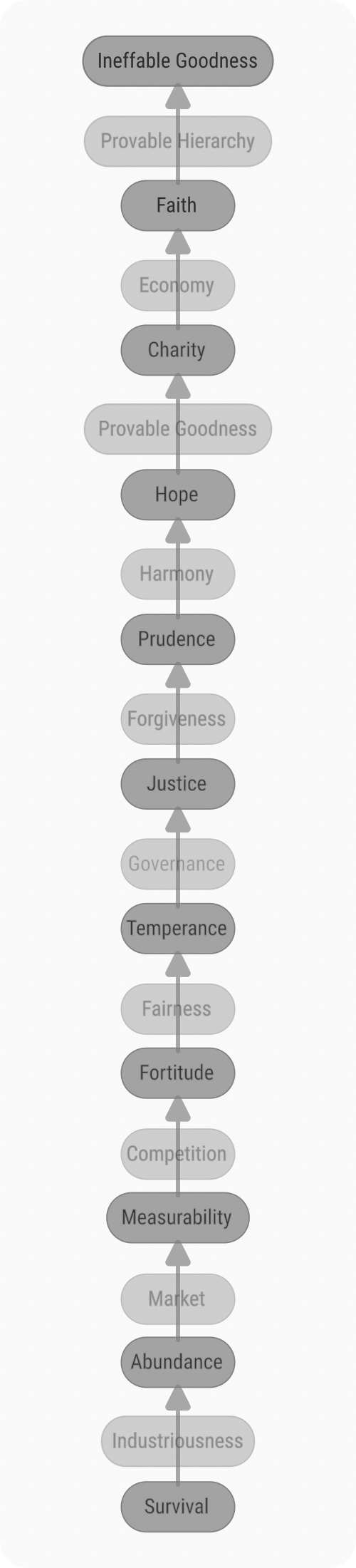
Virtues Order
- Ineffable Goodness
- Provable Order/Hierarchy
- Faith, Reason
- Economy
- Charity
- Goodness, Sacrifice, Courage, Civilization
- Hope
- Harmony, Generosity
- Prudence
- Forgiveness
- Justice
- Governance
- Temperance
- Fairness
- Fortitude
- Competition
- Measurability
- Market
- Abundance
- Industriousness
- Survival
The evolution can be narrated.
Types of Resources
Ethos - Universality, Beyond Species
- Ineffable Goodness
- Provable Order/Hierarchy
- Faith, Reason
- Economy
- Charity
- Goodness, Sacrifice, Courage, Civilization
- Hope
- Harmony, Generosity
Effort and Intent - Community, Tribe
- Harmony, Generosity
- Prudence
- Forgiveness
- Justice
- Governance
- Temperance
- Fairness
- Fortitude
Material/Money - Individual, Family
- Fortitude
- Competition
- Measurability
- Market
- Abundance
- Industriousness
- Survival
Links with Knowledge Domains
- Ineffable Goodness
- Provable Order/Hierarchy
- Faith, Reason
- Mathematics
- Philosophy
- Physics
- Economy
- Charity
- Provable Goodness
- Hope
- Education about Virtues
- Ecology
- Harmony, Generosity
- Prudence
- Education
- Research
- Prophecy
- Forgiveness
- Justice
- Jurisprudence
- (Human) History
- Juridic branch of Government
- Governance
- Administration
- Legislative branch of Government
- Temperance
- Arts
- Literature
- Psychology
- Fairness
- Sociology
- Civics
- Charities
- Fortitude
- Sports
- Military
- Martial Arts
- Common sense
- Competition
- Searchability
- Open Science Journals
- Executive branch of Government
- Games
- Finance
- Political Science
- Mass Media
- Marketing
- Measurability
- Programming
- Automation
- Management
- Open Source
- Open Data
- AI
- Geography
- Market
- Economy
- Business
- Marketing
- Abundance
- Industry
- Chemistry
- Energy Generation
- Industriousness
- Agriculture
- Animal husbandry
- Survival, Health
- Medicine
- Biology
Concerning Law
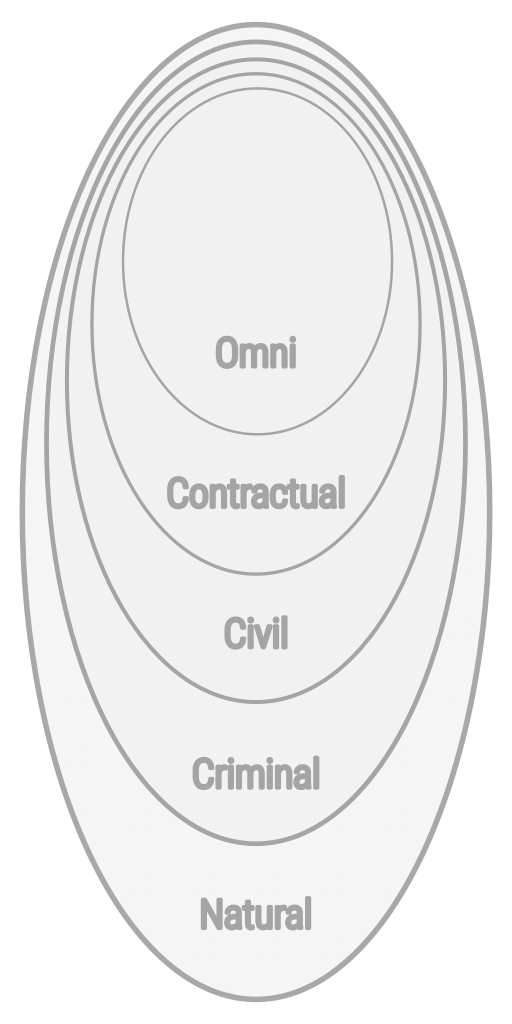
-
Omni Law
- Provable Order/Hierarchy
- Faith, Reason
- Economy
- Charity
- Goodness, Sacrifice, Courage, Civilization
the individual is the whole life
-
Contractual Law (not business contract law)
- Hope
- Harmony
- Prudence
- Forgiveness
the individual uses the community for general goodness
-
Civil Law
- Justice
- Governance
- Temperance
- Fairness
the individual uses the community for community profit
-
Criminal Law
- Fortitude
- Competition
- Market
the individual uses the community for self profit
-
Natural Law
- Abundance
- Industriousness
- Survival, Health
the individual (or nuclear family) lives alone: no community
Chakras

- Sahasrara
- (beyond concepts)
- Ineffable Goodness
- Ajna
- Provable Hierarchy
- Faith, Reason
- Economy
- Vishuddha
- Charity
- Goodness, Sacrifice, Courage, Civilization
- Hope
- Harmony, Generosity
- Prudence
- Forgiveness
- Anahata
- Justice
- Governance
- Temperance
- Fairness
- Manipura
- Fortitude
- Competition
- Measurability
- Svadhishthana
- Market
- Abundance
- Muladhara
- Industriousness
- Survival
First Trinity: Truth, Beauty, Goodness
History
1. Plato (4th century BCE) – the philosophical roots
In The Republic:
- The Good (highest principle)
- Truth as participation in the Forms
- Beauty as an objective, eternal reality
2. Aristotle (4th century BCE) – metaphysical refinement
Aristotle spoke of:
- Truth as conformity of intellect to being
- Good as the final cause of all things, The Unmoved Mover, pure actuality and ultimate cause
3. Plotinus & Neoplatonism (3rd century CE)
- The One is the source of Truth, Goodness, and Beauty
- Beauty is a sign of participation in the divine
All being flows from and returns to the One
4. St. Augustine (4th–5th century CE) – Christian identification
- God is Truth (not merely truthful)
- God is the Supreme Good
- God is Beauty itself (“Late have I loved you, O Beauty ever ancient, ever new”)
The Platonic ideas become explicitly theological.
5. St. Thomas Aquinas (13th century) – systematic formulation
The transcendentals:
- Being (ens)
- One (unum)
- True (verum)
- Good (bonum)
- Beauty (pulchrum)
Beauty
Beauty is by excellence a virtue of the present.
It does not depend on:
- past:
- the manner in which it was achieved
- future:
- the end result
Beauty is part of the First Trinity and is not an atomic virtue. The components are all virtues, but mainly:
- Goodness
- sudden Understanding
- Harmony
- of proportion: in painting, architecture
- of frequency: in music
- Temperance
- control of animal reflexes
- Fortitude
- Fitness, Performance in Sport
- Abundance
- sexual Beauty
Types
Beauty has 2 main types:
- of Time concepts: of verb, process, transformation, transaction
- of Space concepts: of noun, eternity, identity
Attributes
- it accepts separation from its greater context
- surprising, marvelous
Time-like
- independent of space (does not have a space)
- independent of past or future (it can be separated from the time context)
Space-like
- independent of time (does not have a time) when about eternity or identity
- it does not depend on its location (it can be separated from the spatial context)
Second Trinity: Continuity, Governance, Empathy
- Continuity (of eternities)
- Empathy
- Governance
- Continuity
Dependencies
- Empathy influences:
- Faith, Reason
- Charity
- Hope
- Prudence
- Temperance
- Justice
- Governance
- Governance influences:
- Empathy
- Prudence
- Temperance
- Justice
- Fortitude
- Continuity influences:
- under Time: of life of the individual, of life of the species, of an emotion, of an idea
- Fortitude
- Measurability
- Abundance
- Survival
- Timeless (Continuity of Eternities, of Causal relations): of institutions, of laws, of Concepts, Gods
- Hope
- Charity
- Faith
- under Time: of life of the individual, of life of the species, of an emotion, of an idea
Application of Rule of Law
Rule of Law applied to:
- Empathy -> (social) Duties
- Governance -> (social) Rights
- Continuity -> (social) Contract
Mentions
In Classical Greek
"Avoid doing what you would blame others for doing." – Thales of Miletus (c. 624 – c. 546 BCE)
In Zoroastrism
"That nature alone is good which refrains from doing to another whatsoever is not good for itself." Dadisten-I-dinik, 94,5 "Whatever is disagreeable to yourself do not do unto others." Shayast-na-Shayast 13:29
In Hinduism
"One should never do something to others that one would regard as an injury to one's own self. In brief, this is dharma. Anything else is succumbing to desire." — Mahābhārata 13.114.8
In Judaism
'You shall not take vengeance or bear a grudge against your kinsfolk. Love your neighbor as yourself: I am the LORD.' — Leviticus 19:18
‘What is hateful to thee, do not do until thy fellow man; this is the whole Law. The rest is commentary’ – Hillel the Elder, ca. 30 BCE – 10 CE
- חֶסֶד Ḥeseḏ, chesed, Love, Compassion
In Christianity
"Do to others what you want them to do to you. This is the meaning of the law of Moses and the teaching of the prophets." — Matthew 7:12
"And as ye would that men should do to you, do ye also to them likewise" — Luke 6:31
"For all the law is fulfilled in one word, even in this; Thou shalt love thy neighbour as thyself." — Galatians 5:14
- “Teacher, which is the greatest commandment in the Law?”
- Jesus replied: “‘Love the Lord your God with all your heart and with all your soul and with all your mind.’
- This is the first and greatest commandment.
- And the second is like it: ‘Love your neighbor as yourself.’
- All the Law and the Prophets hang on these two commandments.”
-
"If I speak in the tongues of men or of angels, but do not have love, I am only a resounding gong or a clanging cymbal.
-
If I have the gift of prophecy and can fathom all mysteries and all knowledge, and if I have a faith that can move mountains, but do not have love, I am nothing.
-
If I give all I possess to the poor and give over my body to hardship that I may boast, but do not have love, I gain nothing.
-
Love is patient, love is kind. It does not envy, it does not boast, it is not proud.
-
It does not dishonor others, it is not self-seeking, it is not easily angered, it keeps no record of wrongs.
-
Love does not delight in evil but rejoices with the truth.
-
It always protects, always trusts, always hopes, always perseveres.
-
Love never fails. But where there are prophecies, they will cease; where there are tongues, they will be stilled; where there is knowledge, it will pass away.
-
For we know in part and we prophesy in part,
-
but when completeness comes, what is in part disappears.
-
When I was a child, I talked like a child, I thought like a child, I reasoned like a child. When I became a man, I put the ways of childhood behind me.
-
For now we see only a reflection as in a mirror; then we shall see face to face. Now I know in part; then I shall know fully, even as I am fully known.
-
And now these three remain: faith, hope and love. But the greatest of these is love."
- ἀγάπη agapē is translated as Love. It is possible to translate it more precisely as Empathy
In Islam
"None of you [truly] believes until he wishes for his brother what he wishes for himself." — An-Nawawi's Forty Hadith 13
In Buddhism
"Hurt not others in ways that you yourself would find hurtful" — Udanavarga 5:18
- Muditā: Empathy
- Karuṇā for negative Golden Rule
- Mettā/Maitrī for positive Golden Rule
In Confucianism
'Zi Gong [a disciple of Confucius] asked: "Is there any one word that could guide a person throughout life?" The Master replied: "How about 'shu' [reciprocity]: never impose on others what you would not choose for yourself?"' —Confucius, Analects XV.24
In Taoism
"Regard your neighbor's gain as your own gain, and your neighbor's loss as your own loss." — T'ai Shang Kan Ying P'ien
In Kant's Categorical Imperative
"Act only according to that maxim whereby you can at the same time will that it should become a universal law" — Immanuel Kant, Groundwork of the Metaphysics of Morals
In Principle
Relations:
- doing to others: Governance
- useful or pleasurable or virtuous to me -> therefore to others: Empathy
- Empathy can be:
- towards your future self
- towards Eternities (such as God)
- towards others
Dependencies of Virtues
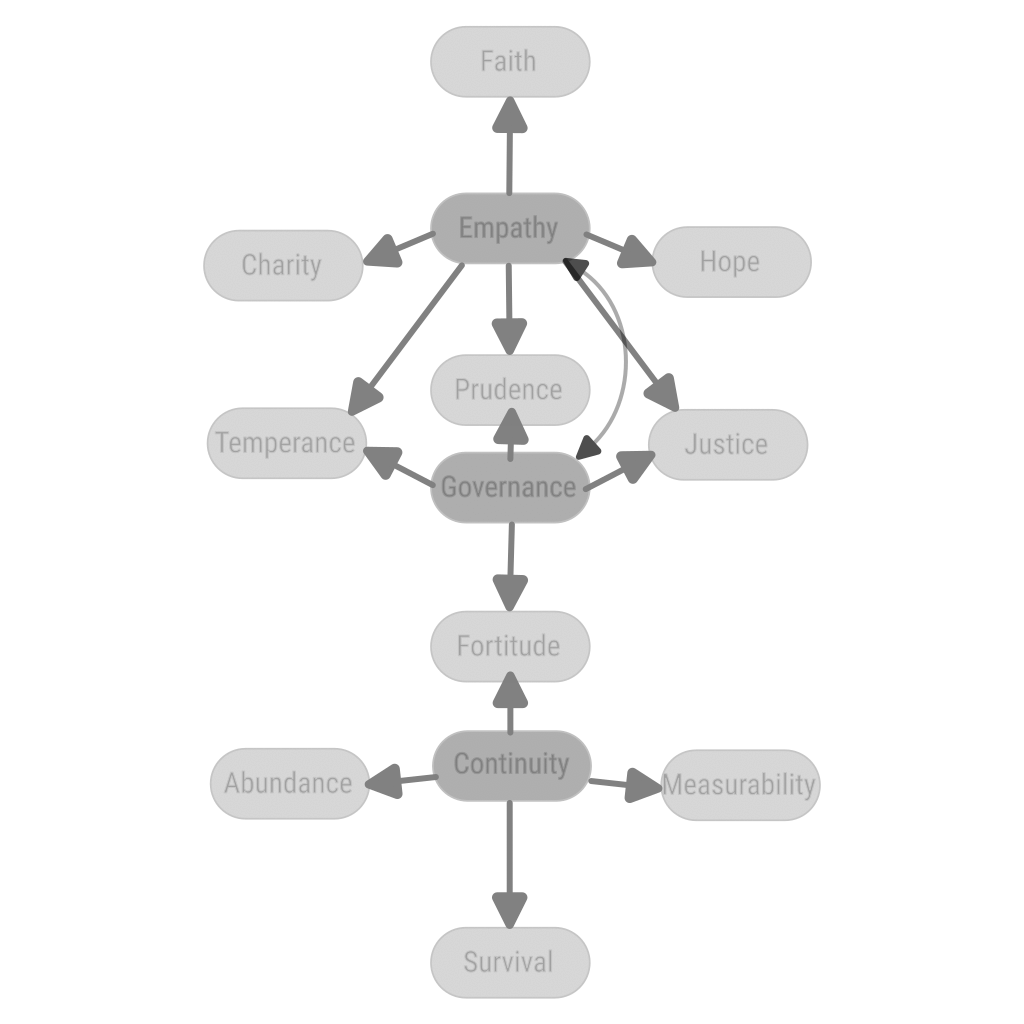
Relations between Concepts
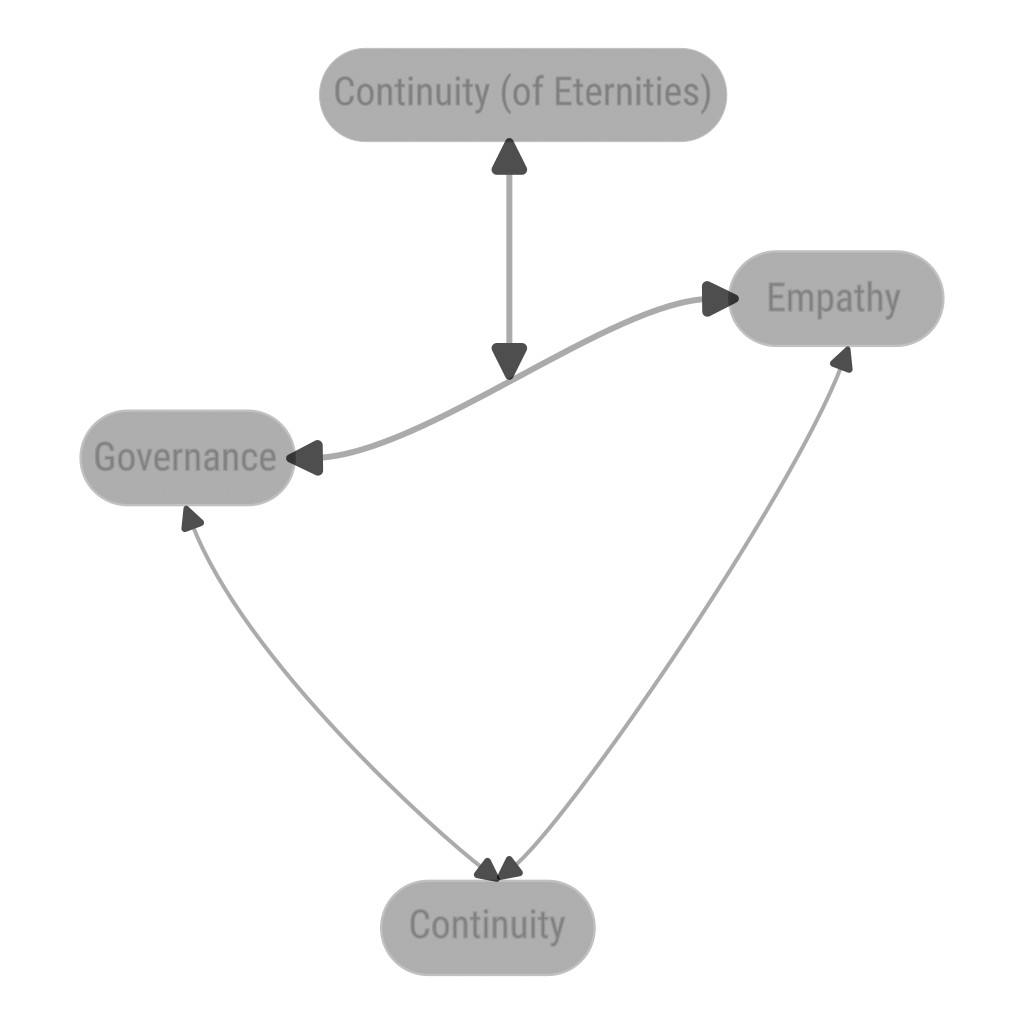
Relations between The 3 Concepts and Blockchain
- Block Production
- Continuity
- On-chain Governance and Voting: like Cosmos SDK governance
- Governance
- Block Validation, Data Availability: checking the validity of each block, sharing the data
- Empathy
- Meta-Governance: Governance about the rules of Governance (available only on Mythos)
- Continuity of Eternities
Love, Empathy
Definition
Many virtues may have their root in Empathy: see Second Trinity:
- Faith, Reason
- Charity
- Hope
- Prudence
- Temperance
- Justice
Its strongest influence is on Governance (as a composed virtue - one of the 3 concepts).
Love is Empathy and is a composed virtue. Many believe that it cannot be defined. They are right from the point of view of being in the experience, but there are meditation practices used to define it from outside, even while in the experience. We will attempt to analyze it without forcing an exact definition. We could conclude that there are 6 types of love, and we will identify them on the Anahata chakra yantra:
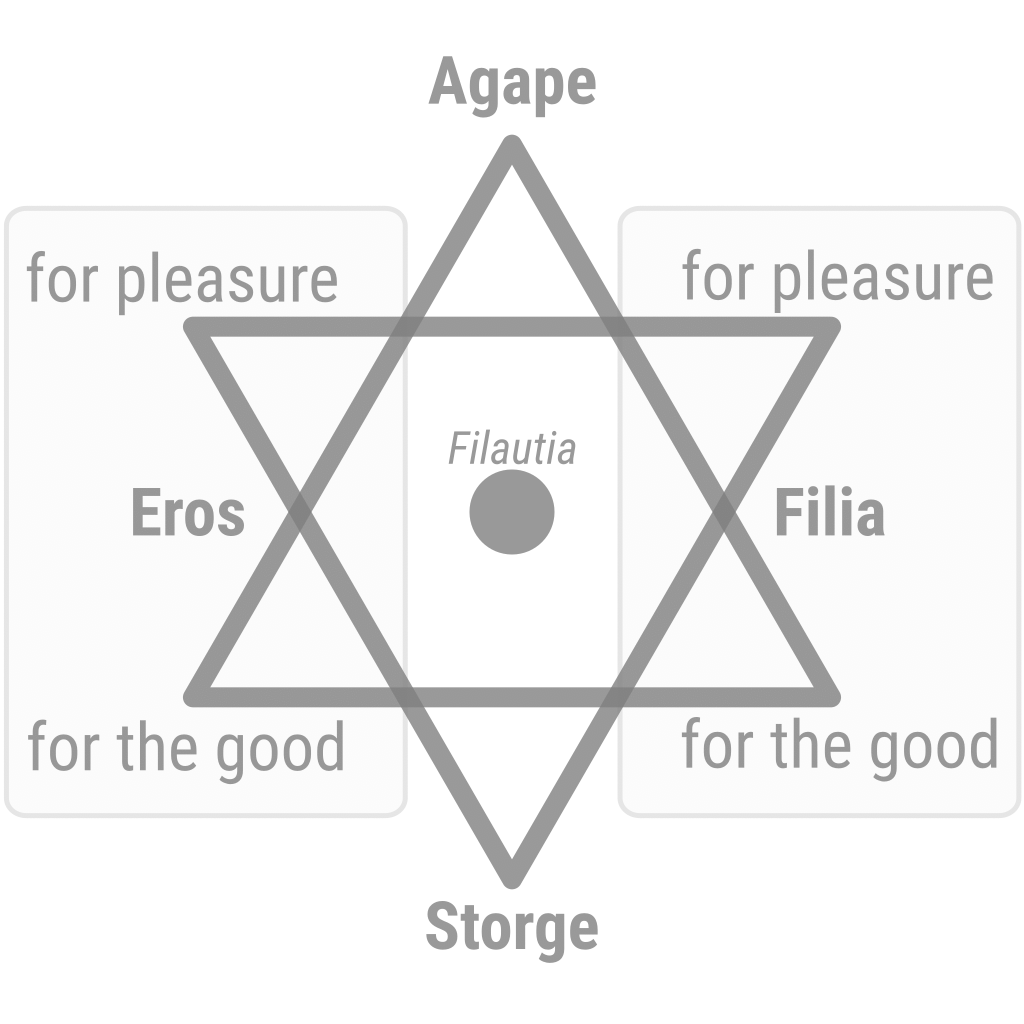
- Agape
- Philia
- Philia for the Good
- Philia for Pleasure
- Eros
- Eros for the Good
- Eros for Pleasure
- Storge
1. Agape
Agape is "the love of God for man and of man for God". It is also the love you feel for universal values, the order of the Universe, and the unique hierarchy of all that exists. It is the love for Virtue.
It is the love for an Ethos (experienced together with its members) and the love received from an Ethos.
Karma and Dharma
When an Ethos acquires Karma, it is by design good karma and is transformed into Dharma. Dharma does not obey the same laws as karma.
- dharma is active rather than reactive
- it is the medium of transactions for the Positive Golden Rule: an Ethos treats others (people and Ethoses) as it would like to be treated
To illustrate the difference: the first action that created the universe could not have been in the realm of karma, because karma is reactive. It was a dharma and is proof that dharma obeys different laws than karma: it does not need priors.
We live in a universe created out of an original Agape.
Examples
- loving God through prayer, worship, or surrender
- loving Truth or Justice even when defending it has a personal cost
- reverence for the intelligible order of the Universe
- an Ethos offering hospitality or aid before receiving any prior benefit
- an institution treating another person or Ethos as it would itself wish to be treated
- a congregation experiencing and sustaining its religious ethos together
- collective devotion through dhikr/zikir/davening, communal prayer, chanting, or sacred ritual
- awakening Kundalini together (for example during Dynamic Meditation)
- receiving guidance, meaning, and belonging from a living ethos
2. Philia for the Good
Love between a Teacher and Student is friendship for the good. It is a friendship where both friends enjoy each other's company. As long as both friends keep similar characters and moral hierarchy, the relationship will endure since the motive behind it is the transfer of ethical knowledge and building common sense. This is the highest level of philia and might be called true friendship. The pleasure of evolving civilization (or an ethos) together.
It also includes virtuous friendship between equals, because the roles of teacher and student may alternate. From the point of view of love, equality exists only through transactions between the parties. Without transactions, no relational equality can be established. When the transactions are unbalanced, the parties are unequal in the particular dimensions exchanged, even if the imbalance may later be corrected through further transactions.
Examples
- a teacher rejoicing when a student exceeds the teacher’s accomplishments
- a student honoring a teacher by understanding, applying, and improving the teaching
- a mentor correcting a disciple for the disciple’s genuine development
- a spiritual teacher transmitting a practice while the student preserves and develops the lineage
- two virtuous equals examining and correcting one another’s ethos
- friends alternating as teacher and student while balancing what each contributes and receives
- friends collaborating on philosophy, science, art, or institutions for the public good
- members of a school or lineage developing civilization together
3. Philia for Pleasure
Love for Peers/Philia for Pleasure is usually translated as "friendship" or active companionship.
Examples
- friends enjoying conversation, food, music, travel, or play together
- teammates enjoying participation in the same sport
- neighbors enjoying regular meals, celebrations, or conversation together
- colleagues enjoying one another’s company while doing shared work
- members of a community enjoying its customs and celebrations
- friends maintaining companionship through humor, hospitality, and shared memories
- peers gathering because the shared activity and one another’s presence are pleasurable
4. Eros for the Good
Platonic love is a type of erotic/romantic love, and it concerns rising through levels of closeness to wisdom and true beauty, from carnal attraction to individual bodies to attraction to souls, and eventually, union with the truth. The sublimation of sexual love into Agape or Philia for the Good.
Pragma is practical love that governs Eros according to reality, continuity, and contract. It may participate in Eros for the Good but is often a composition of love, Governance, and other virtues.
Sexual activity undertaken as a mutually accepted duty is Eros for the Good when it serves the good of the other, the relationship, procreation, or a shared ethos.
Examples
- being attracted to someone’s character, wisdom, or moral beauty
- two people helping each other move from physical attraction toward Agape
- loving someone without seeking sexual possession or gratification
- prospective spouses considering character, shared values, practical compatibility, and continuity
- partners establishing a marriage contract to sustain their shared life and ethos
- mutually accepted procreation undertaken for the good of the child, family, or shared ethos
- supporting the beloved’s vocation even when it prevents a conventional relationship
- contemplating physical beauty as an opening toward beauty of soul and universal Beauty
- transforming erotic longing into shared philosophical, artistic, or spiritual creation
5. Eros for Pleasure
Sexual Love/Eros for Pleasure is sensual or passionate love, from which the term erotic is derived. Eros has also been used in philosophy and psychology in a much wider sense, almost as an equivalent to "life energy". The pleasure of giving pleasure to the other.
Ludus usually plays a part in Eros for Pleasure.
Examples
- lovers taking pleasure in giving each other pleasure
- consensual flirting, teasing, dancing, or role-playing between lovers
- consensual erotic intimacy expressing tenderness and trust
- affectionate touch that strengthens the bond between partners
- delighting in the beloved’s body without treating it as an object
- partners learning and respecting one another’s desires and boundaries
- sexual union experienced as mutual giving and receiving
6. Storge
Storge, or familial love, refers to natural, instinctual, or residual affection, such as the love of a parent toward offspring and vice versa. It can also be the remaining affection after another type of love has run its course. It colors a relationship with a loving bias that seems unlimited in time or space. However, this type of love is passive: it does not increase by itself and uses the other types to replenish its substance. It is passive companionship.
Philia for Utility is not a type of love because the other is valued merely as a means. Through repeated transactions, familiarity, shared history, and continuity, the relationship may leave behind or develop Storge.
Examples
- a parent feeling affection simply upon seeing or remembering a child
- siblings immediately recovering their familiar warmth after a long separation
- an adopted child and parent continuing to feel like family across time and distance
- former lovers retaining affection after their erotic relationship has ended
- former coworkers continuing to experience one another as family after the shared work has ended
- an exile retaining affection for a homeland without any present transaction with it
- enduring attachment to one’s extended family, people, species, Life, or all Creation
The True Self - The Conceptual or Ontological Seed of Love
The true Self (Ātman) is the ontological seed and knowing subject of the love concept, not an external object toward which love is directed.
Philautia (φιλαυτία, philautía) is virtuous love directed toward an imagined identity—the ego, body, personality, or personal narrative—treated as another. It therefore does not constitute an additional fundamental type of love.
Philautia is the ground of mediation among the six types of love. It can be fully experienced only after all six have been experienced. Nurtured correctly, it reveals Ātman, the true Self.
Examples
- in self-inquiry, recognizing that body, thoughts, emotions, and biography are witnessed but are not the witnessing Self
- remaining as awareness without constructing a mental image of “myself”
- experiencing the same knowing subject beneath giving and receiving love
- recognizing that Agape, Storge, Eros, and Philia arise within a common ground
- loving another without using that person to confirm or embellish one’s ego
- passing freely among all six loves without identifying exclusively with any relationship or role
Proposed Neurochemical Correspondences
- For Agape, Eros for the Good, and Philia for the Good, the closest identifying neurochemical is Serotonin.
- For Storge, Eros for Pleasure, and Philia for Pleasure: it is Oxytocin and (only secondarily) Vasopressin. Their genes evolved from the same ancestral gene.
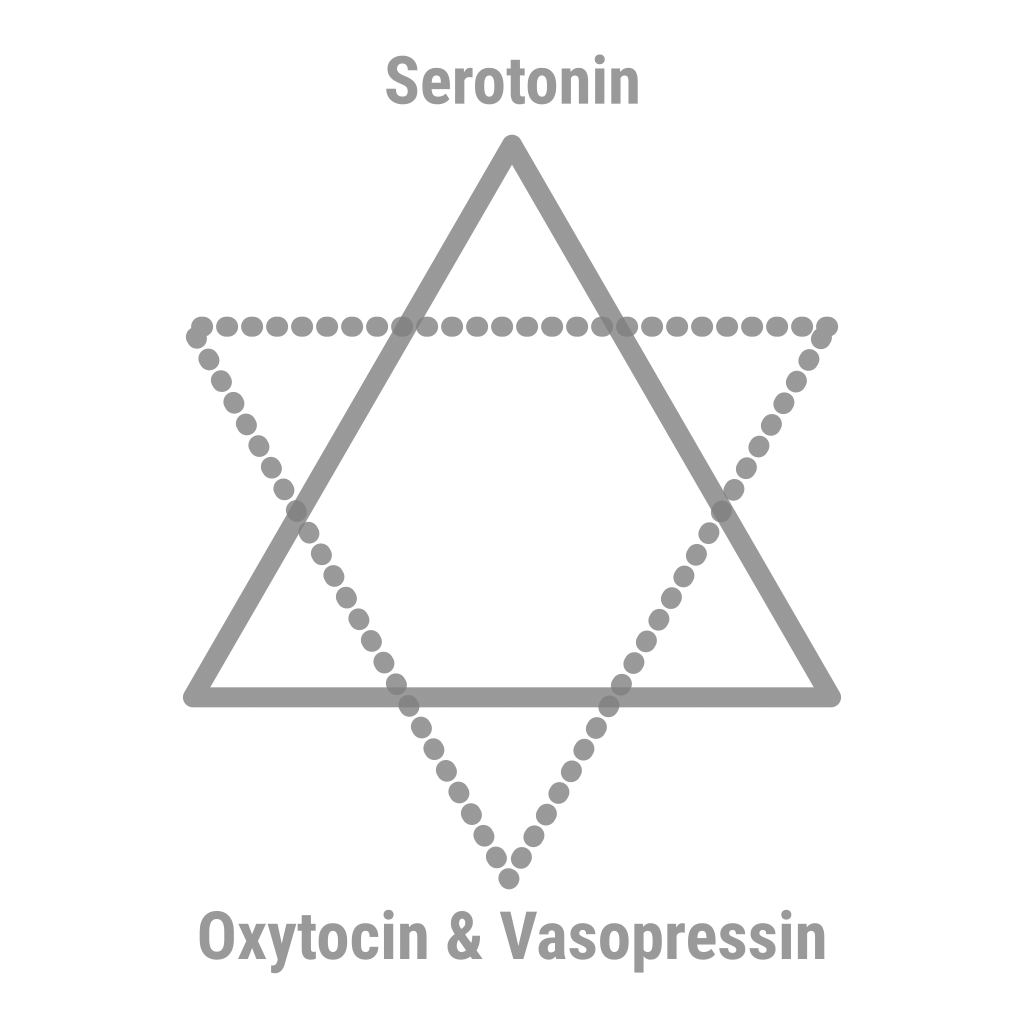
12 Loves
In the practice of Raja and Kundalini Yoga, the discrimination of Empathy is deeper: Each of the 6 types is further isolated into the receiving and the emitting modes. Here are the mantras for each as depicted on the Anahata Chakra:

-
यं yaṁ: Love in general, Philautia, Love without object
-
Serotonin
- Agape
- ङं ṅaṁ: the love received from Eternities, Ethoses, concepts, or gods. Spiritual toxin: misplaced hope.
- ञं ñaṁ: the love/admiration you feel for Eternities and their other admirers. ST: incompetence.
- Philia for the Good: Teacher/Student
- गं gaṁ: the love you receive from your teacher or student. ST: indecision.
- घं ghaṁ: the love you gift to your teacher or student. ST: repentance.
- Eros for the Good: Platonic, Pragma
- चं caṁ: Eros for the Good that you receive from a Platonic or pragmatic lover. ST: anxiety.
- छं chaṁ: Eros for the Good that you give in a Platonic or pragmatic manner. ST: longing.
- Agape
-
Oxytocin
- Philia for Pleasure: for Peers
- जं jaṁ: the love you receive from your peers. ST: impartiality.
- झं jhaṁ: the love you gift to your peers/group. ST: arrogance.
- Eros for Pleasure: Sexual play, Ludus
- कं kaṁ: erotic love that you receive from somebody. ST: lust, desire.
- खं khaṁ: erotic love that you give to somebody. ST: fraud.
- Storge: natural or residual love
- टं ṭaṁ: Storge that you receive from family, or retain as the inertia of another type of love. ST: discrimination.
- ठं ṭhaṁ: Storge that you passively express toward the same. ST: defiance.
- Philia for Pleasure: for Peers
-
Continuity
Continuity is part of the Second Trinity. It has two natures:
Continuity of Identity
This is a continuity of perception of being apart. It applies to (in this order):
- personal ego
- family
- extended family
- tribe
- nation
- allies
- race
- human species
- life
Continuity of Identities
This may be called the continuity of lack of identity or the thriving of multiple identities, together.
- personal dissolution of ego (the experience of nirbija samādhi)
- eternities: concepts, virtues, ethos
Mechanisms
For continuity of identity:
Reduction of Virtues to 1 Concept
Entropy Control
Ability to contain the natural tendency towards dispersal of energy together with the ability to redirect, postpone, or change the quality of the contained energy.
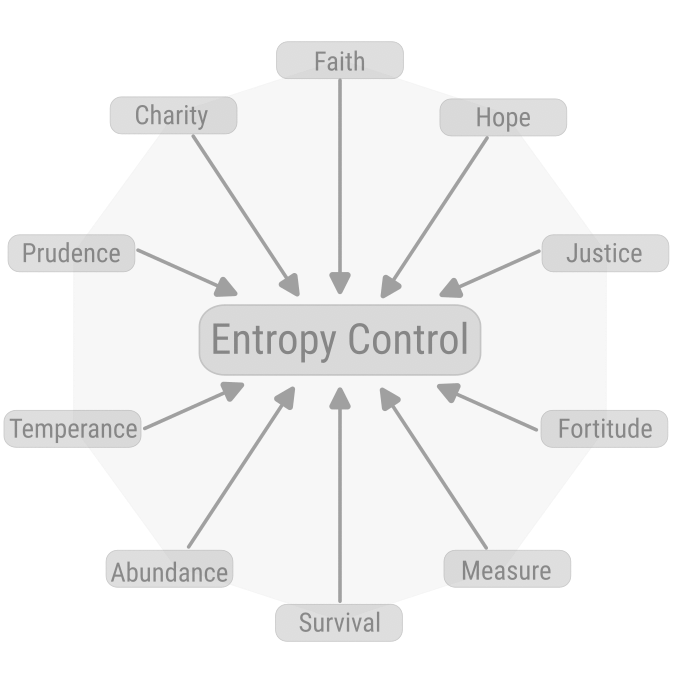
The Influences
Provable Order/Hierarchy
Faith, Reason
Economy
Charity
Provable Goodness
Hope
Harmony, Generosity
Prudence
Forgiveness
Justice
Governance
Temperance
Fairness
Fortitude
Competition
Measurability
Market
Abundance
Industriousness
Survival
Concepts
Altruism
Beauty
- virtues and beauty
Consistency
Common Sense
- increases the fitting of the community in the environment, it is part of Fortitude
Creativity
- sharing Wonder
Curiosity
Duty
- will and actions derived from Charity and Prudence that enable the existence of cardinal and supreme virtues. Pure Duty is not a necessity.
Good
Fidelity
- Loyalty to your agreements, Trustworthiness
Flexibility:
Freedom
- the outcome of a virtuecracy. A virtuecracy is built on the efforts of Duty.
Hospitality
- Xenia ξενία, Charity
Intelligence:
- Nous, Faith, Reason (energy of intellect)
- Logic Fallacy
- Governance
- diminishes Governance (vicious propaganda, misused cleverness)
Legitimacy
- right to execute Governance derived from Faith, Reason (clarity of implication, representation), Prudence (optimization), and Justice
Optimism
- Hope
- Lack of Fortitude
- Lack of Faith, Reason
Pesimism
- Realism, Prudence
- Lack of Hope
- Lack of Faith, Reason
- Lack of Fortitude
Privacy
- it helps in isolating virtues (when a virtue tends to diminish other virtues: eg, Governance impeding Measurability).
- it helps with ethical abstractions for establishing Order
- if eternal: impedes/diminishes Recognition, therefore privacy cannot be a virtue.
Purity
- of Action: good reflexes: Survival, Fortitude
- of Intent: Sincerity, Honesty: Temperance, Harmony, Recognition
- of Thought: Provable Order
Respect for social norms and rituals
- Li (禮, Proper Ritual or Etiquette): This virtue refers to a set of rituals, customs, and standards of politeness that govern proper behavior and maintain social order. It’s about showing respect through appropriate conduct. Politeness.
- Common sense: Fitness/Fortitude
- Recognition, Harmony
Righteousness
- Fairness: when you are a party in the situation
- Justice: when you judge a situation
- Prudence: when you discover the eternal mechanisms of a situation
Rigor
- Fortitude: Rigor with application to the body
- Justice: ~ the emotions
- Faith, Reason: ~ the mental concepts
Sincerity
- Lack of Temperance
- Temperance
- Fortitude
Sympathetic Joy (Mudita)
Tolerance
- Temperance
- Prudence, and the recognition of the fact that maximal optimization for eternity has not been achieved, and anything that does not gravely impede virtues may be helpful to discover upgrades.
- lack of Justice
Wonder
- θαυμάζω (thaumazó: to marvel, wonder) part of Faith, Reason. It is the vitality of mentally exploring and linking concepts.
- Hope
The Verbal Categories
-
Action Verbs Subcategories of verbs expressing physical or mental activities.
-
Physical: Verbs denoting tangible, observable actions.
-
Manipulative: Actions involving handling objects. kick: "She kicks the ball." throw: "He throws a stone."
-
Performative: Actions involving bodily movement or gestures. dance: "They dance gracefully." wave: "She waves goodbye."
-
Creative: Actions producing something tangible.
-
build: "He builds a house." paint: "She paints a portrait."
-
-
Mental Verbs describing cognitive or emotional processes.
-
Cognitive: Thinking or reasoning processes. think: "I think about the problem." analyze: "She analyzes the data."
-
Emotive: Emotional states or reactions. love: "He loves his dog." fear: "They fear the storm."
-
Perceptive: Mental actions involving perception. notice: "I notice a change." imagine: "She imagines a story."
-
-
Speech Verbs indicating verbal expression or communication.
-
Declarative: Stating or asserting. say: "He says hello." declare: "She declares her decision."
-
Interrogative: Asking or questioning. ask: "They ask a question." inquire: "He inquires about the plan."
-
Expressive: Conveying emotion or emphasis. shout: "She shouts in excitement." whisper: "He whispers a secret."
-
-
Motion Verbs expressing movement or change in position.
-
Directed: Movement toward a specific destination. go: "She goes to school." travel: "They travel to Paris."
-
Manner: Movement with specific style or method. run: "He runs quickly." crawl: "The baby crawls slowly."
-
Translocative: Movement involving relocation. move: "They move to a new city." migrate: "Birds migrate south."
-
-
Transitive Verbs requiring a direct object.
-
Monotransitive: Taking one direct object. eat: "She eats an apple." write: "He writes a letter."
-
Ditransitive: Taking two objects (direct and indirect). give: "She gives him a gift." tell: "He tells her a story."
-
-
Intransitive Verbs not requiring a direct object.
-
Pure Intransitive: Complete without an object. sleep: "He sleeps peacefully." laugh: "She laughs loudly."
-
Resultative: Implying a resulting state. fall: "The tree falls." rise: "The sun rises."
-
-
-
Linking Verbs Subcategories of verbs connecting the subject to a complement.
-
State of Being Verbs describing existence or identity.
-
Existential: Indicating existence. be: "She is a teacher." exist: "Ghosts exist in stories."
-
Identificational: Equating subject with identity. become: "He becomes president." remain: "She remains a student."
-
-
Sensory Verbs related to perception or sensation.
-
Appearance: Describing how something seems. seem: "He seems tired." appear: "She appears confident."
-
Sensation: Relating to sensory experience. feel: "I feel cold." look: "You look happy."
-
-
Change/Transformation Verbs indicating a shift in state.
-
Transitional: Showing change over time. grow: "She grows taller." turn: "The leaves turn red."
-
Resultative: Indicating a final state. get: "He gets angry." become: "They become friends."
-
-
Equation Verbs equating subject with a complement.
-
Descriptive: Describing qualities. seem: "It seems fair." sound: "That sounds good."
-
Classificational: Assigning a category. be: "She is a doctor." constitute: "This constitutes a violation."
-
-
-
Auxiliary Verbs Subcategories of verbs supporting the main verb.
-
Tense Verbs marking time.
-
Present: Indicating current action. am/is/are: "She is running." do/does: "He does his homework."
-
Past: Indicating completed action. was/were: "They were singing." did: "She did her best."
-
Future: Indicating future action. will: "I will go." shall: "We shall overcome."
-
-
Aspect Verbs indicating completion or progression.
-
Perfect: Completed actions. have/has: "She has finished." had: "He had left."
-
Progressive: Ongoing actions. am/is/are: "They are dancing." was/were: "She was reading."
-
Perfect-Progressive: Ongoing with completion. have been: "I have been studying." had been: "They had been working."
-
-
Voice Verbs marking active or passive voice.
-
Active: Subject performs action. am/is/are: "She is writing a book." was/were: "He was painting the house."
-
Passive: Subject receives action. am/is/are: "The book is written." was/were: "The house was painted."
-
-
Emphasis Verbs used for stress or negation.
-
Affirmative: Emphasizing truth. do/does: "I do care." did: "She did finish."
-
Negative: Forming negation. do not/does not: "He doesn’t know." did not: "They didn’t come."
-
-
-
Modal Verbs Subcategories expressing modality.
-
Possibility/Probability Verbs expressing likelihood or chance.
-
Weak Possibility: Low likelihood. might: "It might rain." could: "She could arrive late."
-
Strong Possibility: High likelihood. will: "It will happen." should: "He should win."
-
-
Ability Verbs indicating capability or skill.
-
General Ability: Current or inherent ability. can: "She can swim." could: "He could read early."
-
Specific Ability: Context-specific ability. be able to: "I am able to help." could: "She could fix it yesterday."
-
-
Permission Verbs allowing or prohibiting actions.
-
Granting: Allowing action. can: "You can leave." may: "She may enter."
-
Prohibiting: Denying permission. must not: "You must not smoke." cannot: "He cannot park here."
-
-
Obligation/Necessity Verbs denoting duty or requirement.
-
Strong Obligation: Mandatory action. must: "You must obey." have to: "She has to finish."
-
Weak Obligation: Suggested action. should: "You should study." ought to: "He ought to apologize."
-
-
Volition Verbs expressing desire or intention.
-
Intention: Planned action. will: "I will try." shall: "We shall succeed."
-
Desire: Wishing or wanting. would: "She would love to join." want to: "He wants to learn."
-
-
Conditionality Verbs used in hypothetical or conditional contexts.
-
Hypothetical: Imagined scenarios. would: "I would go if invited." could: "She could win if she tries."
-
Counterfactual: Unreal conditions. would have: "He would have won." might have: "They might have left."
-
-
-
Incomplete Verbs Subcategories requiring complements.
-
Copulative Verbs needing a subject complement.
-
Descriptive: Describing qualities. seem: "She seems happy." appear: "He appears confident."
-
Identificational: Naming or classifying. be: "She is a lawyer." become: "He became a chef."
-
-
Transitive Incomplete Verbs needing a direct object.
-
Monotransitive: One object. want: "She wants a book." need: "He needs help."
-
Ditransitive: Two objects. give: "She gives him a gift." show: "He shows her a picture."
-
-
Complex Transitive Verbs requiring an object and complement.
-
Descriptive: Object with adjective. call: "They call him brave." consider: "She considers it fair."
-
Naming: Object with noun. name: "They named her leader." appoint: "He appointed her manager."
-
-
-
Finite Verbs Subcategories forming complete predicates.
-
Indicative Verbs expressing facts or questions.
-
Declarative: Stating facts. walk: "She walks daily." is: "He is here."
-
Interrogative: Asking questions. do: "Do you know?" is: "Is she coming?"
-
-
Imperative Verbs conveying commands or requests.
-
Direct: Explicit commands. go: "Go now!" sit: "Sit down!"
-
Polite: Softened requests. please come: "Please come inside." do help: "Do help me."
-
-
Subjunctive Verbs indicating hypothetical or wished situations.
-
Present Subjunctive: Current hypotheticals. be: "I suggest he be ready." have: "She demands we have it."
-
Past Subjunctive: Unreal conditions. were: "If I were rich." had: "If she had known."
-
-
Tensed Verbs marked for specific tense.
-
Present: Current actions. run: "She runs fast." is: "He is happy."
-
Past: Completed actions. ran: "She ran yesterday." was: "He was tired."
-
Future: Future actions. will run: "She will run tomorrow." will be: "He will be there."
-
-
-
Infinite Verbs Subcategories of verbs not bound by tense (often synonymous with non-finite, but here focused on infinitives).
-
Bare Infinitive Base verb form without "to."
-
Modal Complement: Following modals. go: "She can go." help: "He must help."
-
Causative/Perceptive: After causative/perception verbs. make: "She makes him sing." see: "I saw her run."
-
-
Full Infinitive Verb form with "to" expressing purpose or concept.
-
Purpose: Indicating intention. to learn: "She studies to learn." to win: "He plays to win."
-
Nominal: Acting as a noun. to sing: "To sing is fun." to dream: "To dream is free."
-
-
-
Non-Finite Verbs Subcategories not tied to subject or tense.
-
Infinitive Verbs acting as nouns, adjectives, or adverbs.
-
Nominal: Functioning as a noun. to dance: "To dance is her passion." to study: "To study requires focus."
-
Adverbial: Indicating purpose or reason. to help: "She came to help." to learn: "He reads to learn."
-
Adjectival: Modifying a noun. to read: "A book to read." to solve: "A problem to solve."
-
-
Gerund Verbs functioning as nouns.
-
Subject: Acting as sentence subject. swimming: "Swimming is healthy." reading: "Reading takes time."
-
Object: Acting as verb object. enjoy swimming: "She enjoys swimming." love dancing: "He loves dancing."
-
Complement: Following prepositions. fond of running: "She’s fond of running." good at singing: "He’s good at singing."
-
-
Present Participle Verbs functioning as adjectives or in progressive aspects.
-
Adjectival: Describing a noun. running: "A running stream." shining: "A shining star."
-
Progressive: Forming continuous tenses. is running: "She is running now." was singing: "He was singing loudly."
-
Past Participle Verbs functioning as adjectives or in perfect/passive constructions.
-
Adjectival: Describing a noun. broken: "A broken window." written: "A written note."
-
Perfect: Forming perfect tenses. have written: "She has written a book." had gone: "He had gone home."
-
Passive: Forming passive voice. is written: "The book is written." was seen: "She was seen there."
-
-
Governance of Virtue
The training of such encoder for grading virtue has to be transparent and guided by all interested parties. Either by voting or by a mathematical proof.
We propose a continuous voting mechanism that guarantees a unique human identity for all voters.
Making Virtues Computable
A proposed implementation of this theory of virtues.
Summary
- The Domain
- The Codomain
- Representation of Virtues in Space
- The Virtue Encoder
- Governance of Virtue
The coverage of other Virtue Theories
Here are some examples of Verbs Not Spanned by Other Virtue Theories
1. Aristotelian (Nicomachean Ethics)
Canon: Prudence, Justice, Temperance, Courage (+ minor virtues).
1.1 Verb: to measure
- Aristotle: no clear category; does not map to Courage, Justice, Temperance, Prudence.
- 21‑axis: Measurability + Truth.
1.2 Verb: to compete
- Aristotle: only indirectly under Courage.
- 21‑axis: Competition (+ Market if exchange context).
2. Stoic Virtues
Canon: Wisdom, Justice, Courage, Temperance (cardinals).
2.1 Verb: to forgive
- Stoics: fits nowhere directly; maybe Temperance (self‑control) or Justice (fair dealing).
- 21‑axis: Forgiveness (atomic).
2.2 Verb: to govern
- Stoics: at best “Wisdom.”
- 21‑axis: Governance (atomic).
3. Christian Virtues
Canon: Faith, Hope, Charity; Prudence, Justice, Temperance, Fortitude.
3.1 Verb: to trade
- Christian canon: no explicit virtue for trade.
- 21‑axis: Market (atomic).
3.2 Verb: to innovate
- Canon: could be Hope, but forced.
- 21‑axis: Creativity/Constructiveness + Industriousness.
4. Buddhist Pāramitās
4.1 Verb: to forgive
- Pāramitās: patience (Khanti) is endurance, not forgiveness.
- 21‑axis: Mercy/Forgiveness (atomic).
4.2 Verb: to govern
- Pāramitās: no explicit governance category.
- 21‑axis: Governance.
5. Confucian Five Constants
Anchors: Ren, Yi, Li, Zhi, Xin; harmony through ritual and education.
5.1 Verb: to forgive
- Constants: Ren, Yi, Li, Zhi, Xin do not explicitly cover forgiveness.
- 21‑axis: Mercy/Forgiveness.
5.2 Verb: to invent
- Constants: no explicit Creativity.
- 21‑axis: Creativity/Constructiveness + Industriousness.
6. Taoist Virtues
6.1 Verb: to measure
- Taoist categories: Ziran, Wu‑wei, Compassion, Simplicity → none are cover measurability.
- 21‑axis: Measurability.
6.2 Verb: to compete
- Taoism: harmony discourages overt contest.
- 21‑axis: Competition.
7. Hindu (Dharma) and Yoga (Yamas/Niyamas)
Anchors: Dharma (order/justice), Artha (prosperity), Kāma (desire), Mokṣa (liberation). Anchors: Non‑harm, truthfulness, non‑stealing, chastity, non‑grasping; purity, contentment, austerity, study, surrender.
7.1 Verb: to govern
- Yamas/Niyamas: emphasize restraint, purity, self‑discipline → not governance.
- 21‑axis: Governance.
7.2 Verb: to measure
- Yamas/Niyamas: no explicit measurability.
- 21‑axis: Measurability.
8. Judaism
Anchors: Truth (Emet), Justice (Tzedek), Loving‑kindness (Chesed), Pikuach Nefesh (Life), Law/practice.
8.1 Verb: to compete
- Competition is not seen as a virtue.
- 21‑axis: Competition.
8.2 Verb: to innovate
- Torah study fosters renewal but not as a virtue category.
- 21‑axis: Creativity/Constructiveness.
9. Islam (Maqāṣid + Virtues)
Anchors: Justice (‘Adl), Mercy (Raḥma), Truth (Sidq/Haqq), Maqāṣid (preservation of religion/life/intellect/lineage/wealth).
9.1 Verb: to compete
- Maqāṣid: life, intellect, lineage, wealth, religion → no Competition.
- 21‑axis: Competition.
9.2 Verb: to measure
- Islamic virtues: Truth (Sidq), Justice (‘Adl), Mercy → no measurability.
- 21‑axis: Measurability.
10. Modern VIA (Peterson & Seligman)
10.1 Verb: to govern
- VIA: fairness, leadership, perspective → but no systemic governance.
- 21‑axis: Governance.
10.2 Verb: to trade
- VIA: honesty, kindness, fairness → no Market.
- 21‑axis: Market.
11. Utilitarianism
Canon: Maximize utility.
11.1 Verb: to forgive
- Utilitarianism: forgiveness justified only by outcomes → not atomic.
- 21‑axis: Forgiveness.
11.2 Verb: to worship
- Utilitarianism: irrelevant.
- 21‑axis: Faith/Reason + Miracle.
12. Kantian Deontology
Canon: Categorical imperative; duty.
12.1 Verb: to compete
- Kant: universalizable? Competition is morally neutral.
- 21‑axis: Competition.
12.2 Verb: to innovate
- Kant: creativity is aesthetic, not moral.
- 21‑axis: Creativity/Constructiveness.
13. Rawlsian Contractarianism
Canon: Original position; fairness.
13.1 Verb: to measure
- Rawls: veil of ignorance test = fairness, not measurement.
- 21‑axis: Measurability.
13.2 Verb: to compete
- Rawls: competition tolerated only if fair → but not a virtue.
- 21‑axis: Competition.
14. Care Ethics
Canon: Relational responsibility, responsiveness.
14.1 Verb: to govern
- Care ethics: relational care, but not governance.
- 21‑axis: Governance.
14.2 Verb: to compete
- Care ethics: no space for Competition.
- 21‑axis: Competition.
15. Capability Approach (Sen/Nussbaum)
Canon: Substantive freedoms/capabilities set.
15.1 Verb: to innovate
- Capabilities: creativity subsumed under “play” or “control over environment.”
- 21‑axis: Creativity/Constructiveness.
15.2 Verb: to compete
- Capabilities: no Competition virtue.
- 21‑axis: Competition.
16. Summary
16.1 Across all traditions and ethical systems examined, at least two verbs remain undecomposed in each.
16.2 These verbs decompose cleanly under the 21‑axis system, showing its spanning advantage.
16.3 Commonly missing axes: Competition, Market, Governance, Measurability, Creativity, Forgiveness.
16.4 This suggests these are the indispensable axes that make the 21‑system uniquely complete.
17. Chalengeability
This document is available on Github for continuous challenge.
Representation of Virtues in Space
A proposed representation in space is in correspondence with the most used embedding spaces in the present:
Compatibility with other Encoders
- a representation in 768 dimensions for compatibility with BERT-derived encoders
in 21D
- by using a special encoder of virtue, using BERT-derived data
In 3D
- a dimensionality reduction from the above
in 2D
- by the reduction of virtues to 3 concepts
in 1D
- by the reduction of virtues to 1 concept
The Verbs as Domain of Virtue Computation
The link between Virtue and Action is almost self-explanatory.
1. Statement of Principle
1.1 Virtues are not abstract ideals floating independently.
1.2 They originate in actions — and linguistically, actions are represented by verbs/predicates.
1.3 Therefore, verbs are the root soil from which virtues grow, and the site of analysis where virtues can be identified and extracted.
2. Why Verbs? (Ontological and Linguistic Grounding)
2.1 Every verb describes a doing, undergoing, or becoming.
2.2 Ethics concerns what we do — hence, verbs encode the morally relevant material.
2.3 Without verbs, there is no movement, no relation, no choice → no morality.
2.4 Nouns (states, objects) may describe contexts, but verbs describe decisions/events, which are the proper domain of virtue.
3. Verbs → Virtue Extraction
3.1 Step 1: Identify an atomic action (verb instance).
3.2 Step 2: Analyse the valence of that verb against the N axes (e.g., to measure, to forgive).
3.3 Step 3: Extract the virtue core (e.g., measuring honestly → Truth/Measurability).
3.4 Step 4: Record the mapping (colored coin issuance, proof capture, etc.).
4. Why Verbs are the Root of Virtues
4.1 Universality: Every culture has verbs; verbs encode what humans recognize as morally salient.
4.2 Granularity: Verbs can be minimal (“to smile,” “to measure”) — enabling atomic moral analysis.
4.3 Compositionality: Complex actions (wars, institutions) are composites of simpler verbs — thus decomposable into virtue vectors.
4.4 Proof‑friendliness: Verbs denote observable acts, which can be recorded and proven (timestamp, evidence).
4.5 Cross‑tradition comparability: Mapping virtues across religions and philosophies works only if we trace them to common actions (verbs).
4.6 Dynamic nature: Virtues live in choices and habits → these are sequences of verbs, not static nouns.
5. Examples
5.1 To forgive → root verb; from it emerges the virtue Mercy/Forgiveness.
5.2 To trade → root verb; from it emerges the virtue Market (voluntary exchange).
5.3 To measure → root verb; from it emerges the virtue Truth/Measurability.
5.4 To govern → root verb; from it emerges the virtue Governance.
5.5 To compete → root verb; from it emerges the virtue Competition.
5.6 To plant → root verb; from it emerges the virtue Continuity/Sustainability.
6. Implications
6.1 Any system that ignores verbs risks losing the root of virtue; it becomes abstract, detached, or merely aspirational.
6.2 By contrast, a verb‑rooted system ensures virtues remain grounded in action.
6.3 This makes the 21‑axis framework both spanning (covers all verbs) and provable (every action can be assessed).
7. Conclusion
7.1 Verbs are the source of virtues.
7.2 They are where virtues are rooted, analysed, and extracted.
7.3 Therefore, the study of virtue must always begin with verbs — the primal seeds of moral reality.
Charities
Definition
A charity is a public institution that has as its main reason for its existence the enactment of the virtue of charity.
Rules and Principles
- It is a public institution. (bound by the definition and rules of an institution)
- The resources accounting has to be public at the most detailed level (according to 1.1.3 and the fact that the output has to be provable)
- It must maintain an external/independent public accounting/challenging of goodness generated
- It must recognize other charities in its domain and collaborate with them (unless proven impossible)
Implications
- Collaboration means all (but not limited to)
- making "competitor" charities known before accepting donations
- following and amplifying their messages
Classes of Charities
Relationship
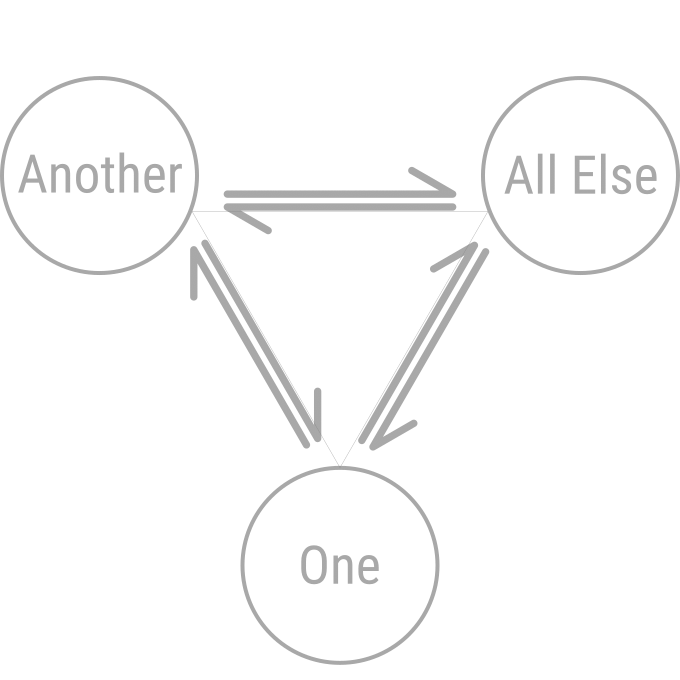
A relationship is a double transaction between One, Another, and All Else.
If a double transaction is between One and Another and it exchanges one higher virtue (higher than Idealism/Fortitude) for another, we may call this ideal friendship.
Now let us explore the virtuous relationships from the point of view of One:
-
One gives (some quantity of virtue) to Another:
- receives (same) from Another: Friendship, Trade Relation and, low to high:
- all paid professions
- (Fair) Competitor
- Romantic relation
- Marriage
- Parenting
- Extended family relations
- Being a student and teacher on a lineage
- Using the internet/AI: accepting to consume ads, having your content be used by the AI
- Ideal Friendship
- receives from All Else: Benefactor (to Another) volunteer:
- Medic
- Militiaman
- Witness/Whistleblower
- Parent
- Teacher
- Artist
- Journalist
- Mentor
- Researcher/Developer
- Priest
- Hero
- Bodhisattva
- receives (same) from Another: Friendship, Trade Relation and, low to high:
-
One gives to All Else:
-
Another gives to and receives from All Else: no relationship
Hope and Loyalty are the Differentiators
Between virtues:
Timeless Virtues
- Faith, Reason
- Provable Hierarchy
- Charity
- Provable Goodness
- Hope
- Sacrifice to Timelessness
Human Virtues
- Hope
- Sacrifice for Civility
- Education (unpaid)
- Harmony, Generosity
- Prudence
- Forgiveness
- Justice
- Governance
- Temperance
- Fairness
- Fortitude (Loyalty: Fortitude for the sake of)
- Loyalty to ideals/Idealism (for the sake of Human or Timeless Virtues)
- Loyalty to out-group
- Loyalty to Another
Animal Virtues
- Fortitude (Loyalty: Fortitude for the sake of)
- Loyalty to in-group
- Fortitude for the sake of personal Survival, Abundance, Recognition (Animal Virtues)
- Competition
- Measurability
- Market
- Abundance
- Industriousness
- Survival
Vicious Relationships
- that do not implement the double transaction rule (thus being unsustainable or unfair)
- those that use vices as a transactional currency
- those that decrease the clarity and awareness of the relationship mechanics
Hierarchy
Concerning virtues and vices, we can construct a hierarchy of relationships:
- Ideal Friendship
- Being a student and teacher in a spiritual lineage
- Benefactor (see the types above)
- Friendship (see the types above)
- Marriage
- Trade relation (see the types above)
- Fair competitor
- Mendicant
- Hermit
- No relationship
- Pretended relationship / lack of clarity about the nature of the relationship
- Peer pressure conformer
- Peer pressure initiator
- Beggar
- Unfair competitor, enemy
- Thief
- Emotional manipulator/abuser
- Initiator into vices
- Robber
- Traitor to One's resources
- Physical torturer
- Inflicting to One's body irreversible functional damage
- Traitor to One's ideals
- Assasin
- Manipulator of proofs and history (about killing Another)
- Manipulator of virtues (definitions, hierarchy)
- Anti-Friendship: "friendship" that uses vices as a transaction currency
Virtue -> Relation
Relation -> Virtue
Proposed Relationship
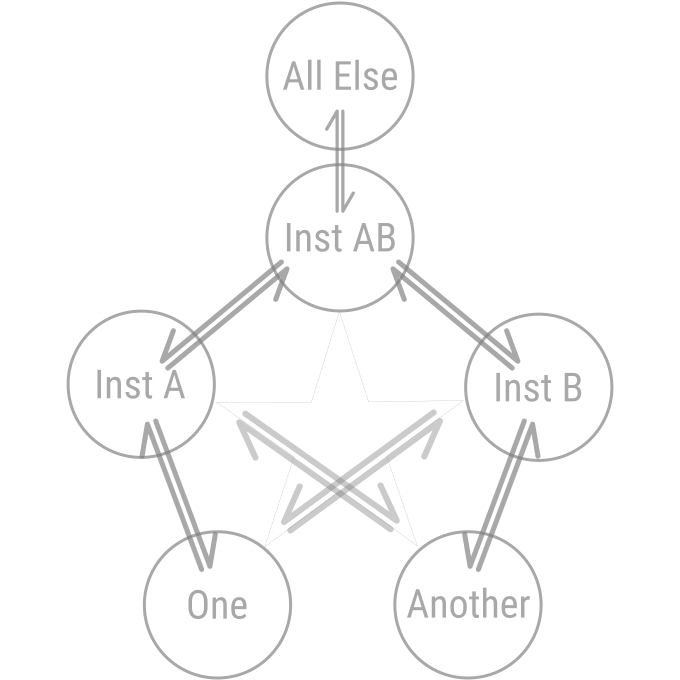
Inst A is Institution A or Social Contract A. Inst AB is the Contract that can operate transactions between Institution A and Institution B: their higher contractual authority.
If Virtues are encoded in the social contracts explicitly and the encoding is upgradeable, the civilization has improved chances for evolution as a whole.
Logos
Definition
A set of clearly defined concepts together with their links with the following characteristics:
- there is no internal inconsistency
- all virtues exist in the set and are linked with each other
Ethos
A Logos that is specific to a person or a group. It contains in whole or in its main part definitions about what ought to be rather than what is. An ethos of a person has to contain:
- all virtues that the person is aware of
- a full ranking of the virtues according to the person's point of view
- means for other persons to know and challenge or adhere to the ethos
Person
An intelligent being who is ruled by only one Ethos. A human body can host more than one person and it usually does. That is the consequence of not having an internal continuous proof of the preeminence of only one Ethos (akin to polytheism or having maintaining multiple digital profiles with conflicting information).
Ethical Transactions
A person can make ethical transactions only with another person with compatible ethos. The compatibility of ethos has to remain available to any challenge.
Ethical Challenge
A claim about the ethos. The claimant will have to pay an ethical fine if the claim is proven to be false.
Ethical Economy
The sum of transactions that are ethical. A person is a player in the Ethical Economy if has incoming and outgoing Ethical Transactions.
Faith, Clarity of Implication, Reason
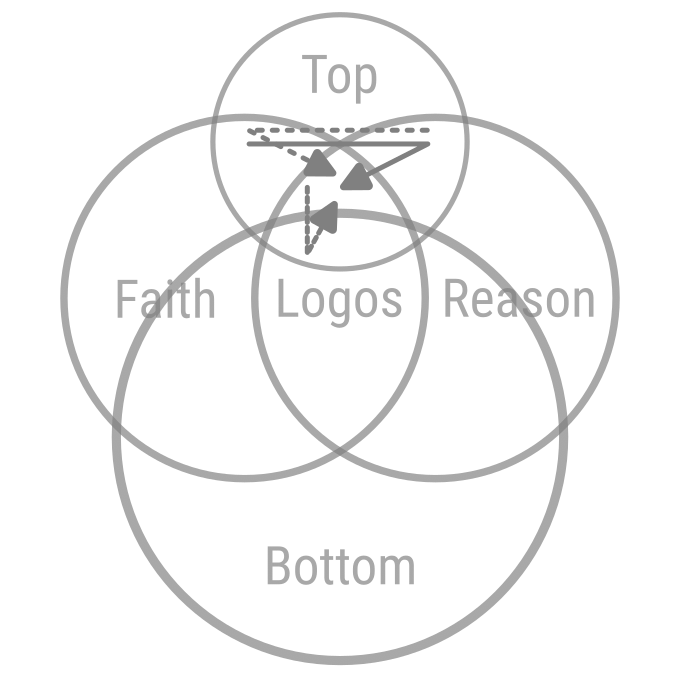
- Top: True, Truth, Virtuous, ⊤
- Bottom: False, untrue, Non-Factual, Vicious, ⊥
- Intersection of:
- Faith and Reason: Logos
- Top and Bottom: Contradiction, Paradox, the Axis of Numbers
- Top and Faith: Axioms
- Top and Reason: Implication ⊢, Logic
- Bottom and Faith: unfound Superstition
- Bottom and Reason: Fallacy
- Other sets:
- Reason \ Faith ⋂ Top = technē: know how (the laws of logic are in this set)
- Reason ⋂ Faith ⋂ Top = epistēmē: knowledge
Art
Artistic path of enriching the Logos:
- Nous (energy of intellect, intelligence)
- Guiding Wonder, Hope towards a leap of Faith
- Finding a solid ground in Faith, Axiom
- Mapping the new teritory in Logos
- links:
- Art in Science: Empiric Discovery
- Science of Art: Esthetics (αἰσθητικός aisthētikós)
- Art in Production: Artisaning
- Production of Art: Art Performing
Science
Scientific path of enriching the Logos:
- Nous (energy of intellect, intelligence)
- Axioms or Logos elements: materia prima
- Logic: tools of implication
- (optional) other Logos elements
- (optional) Logic
- epistēmē: scientific knowledge, logically deducted Logos
- links:
- Art in Science: Empiric Discovery
- Science of Art: Esthetics (αἰσθητικός aisthētikós)
- Production of Science: Academia
- Science of Production: Applied Science
Production
Technical path of enriching the Logos:
- Nous (energy of intellect, intelligence)
- Choosing the mapping and set from the Logos
- Using Technique (τέχνη tékhnē) to instantiate the knowledge or to perform an art
- Acquire knowledge of doing/implementing
- links:
- Art in Production: Artisaning
- Production of Art: Art Performing
- Production of Science: Academia
- Science of Production: Applied Science
Consensus
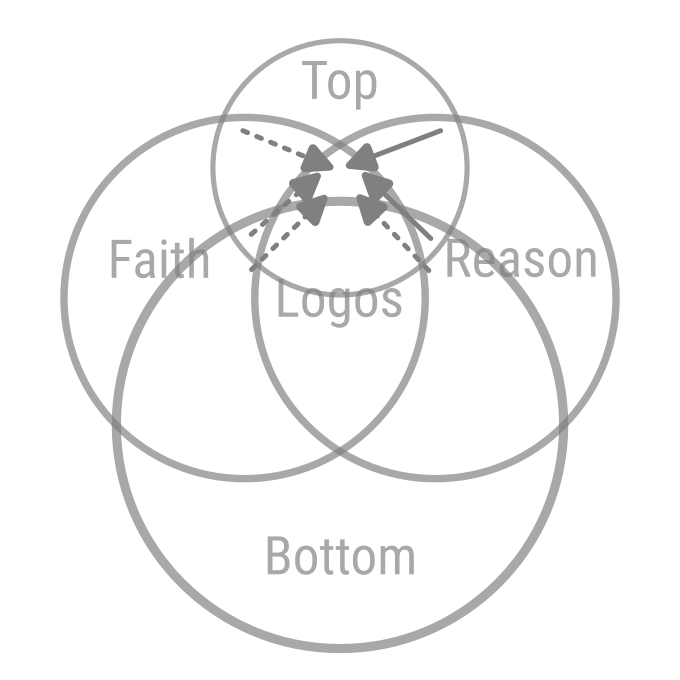
Enriching the Logos by Consensus:
- Consensus about the definition of Consensus (Meta-Consensus)
- Provable mechanism of voting
- Timeless/Continous consensus contract
- Public availability of the results
- Ability to continuously challenge the results by verification and/or by re-voting
subtypes:
- consensus by Faith: when your opinion is rejected by the general consensus or when you do not know with clarity the reasons for your vote
- consensus by Reason: when your opinion is adopted as general consensus
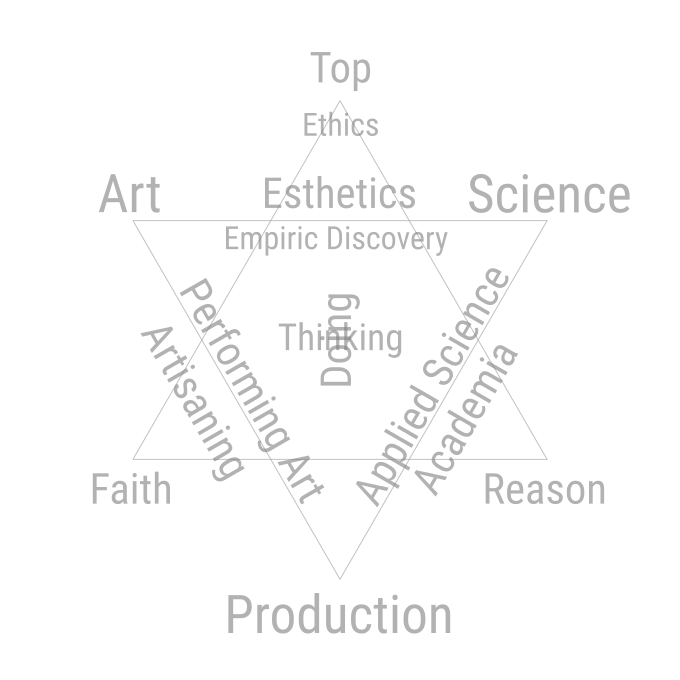
Ethics
Virtues implemented in Art, Science, and Production
Definition
- belief in the existence of concepts (things that cannot be perceived by physical senses). Example: the belief that circles exist as mental objects.
- belief in the existence of identity, relation, equivalence, and reference functions
- belief in the existence of perfections, and the unicity of the "perfection of all perfections" that we may refer to as God.
- belief in the existence of rational demonstrations (proofs)
- belief in the truth of axioms that are most implication-productive.
- belief in the existence of intelligent consensus. Intelligent consensus is eternal and is the substance of any perfection (is equivalent to God, in substance).
- the inter-dependence between Faith and Reason
- Reason uses Faith as a foundation
- Faith uses Reason to gain importance
- Faith can exist without Reason. Reason cannot exist without Faith (in the axioms)
- subtypes
- Contemplation: contemplation, theōría, θεωρία: sensing Truth (by direct experience)
- Discrimination: ability to establish the mental boundary for each Concept (Logoi)
- Refinement: ability to navigate the Logos with very fine resolution
- Rational Demonstration: ability to chain and join a set of previous Demonstrations using Logic
Dependencies
- Major
- Charity: when one receives charity in the form of service or goods, it develops one's Faith.
- Hope: Faith develops Hope (as Faith about the future)
- Minor
- Fortitude: Physical exercise develops clarity of thought
Correspondences
- Classical Greek
- Sophia (Wisdom)
- Hinduism
- Satya (सत्य): Truthfulness (Not lying)
- Ishvarapranidhana (ईश्वरप्रणिधान): contemplation of the Ishvara
- Islam
- Tawheed (Belief in the Oneness of God)
- Christianity
- Faith
- Humility
- Prudence (Wisdom)
- Judaism
- Ahavat Torah (Love of the Law/Torah)
- Emet (Truthfulness)
- Buddhism
- Sacca: truthfulness, honesty
- Upekkhā: equanimity, serenity
Application
Theorem 1: Proving the definitions of Virtues is of the highest Virtue
- Proving the definitions of Virtues is the same as constructing a provable definition of Virtues.
- Proving is part of the virtue of Faith, Reason, Clarity of Implication.
- Discovering tentative definitions / new definitions are part of the virtue of Hope.
- The process of constructing a provable definition consists of iterations of discovering and proving until the resulting proposition is both a definition and a provable construction.
- A definition is the shortest description of the essence of an object.
- The objects that we are defining are abstractions. (Virtues are abstractions.)
- The definition of an abstraction is an integral part of that abstraction.
- The definition of a virtue is part of that virtue.
- Given virtues A and B, The combined virtue C of A and B (when by constructive interference) is more virtuous than both A and B.
- Proving the definition of a virtue is the constructive interference of: Faith, Reason, Hope, and the defined virtue.
- The action of constructing a provable definition is atomic.
- This action is of the highest Virtue.
Lemma 1.1: Constructive Interference of Virtues
Two virtues interfere constructively in a situation when:
- the virtues arise independently
- when one is artificially increased the other one does not decrease
Lemma 1.2: Atomic Action
An atomic action is the shortest description of the process for a result that is not attained by any other atomic action.
Lemma 1.3: The Virtue of a Thing contains at least a part of the definition of that Thing
Theorem 2: The complete definition of a Thing has to mention the Virtues of that Thing
Corollary 2.1: By including the Virtues in the definition of any Thing, the definition itself becomes more virtuous.
Theorem 3: Virtues and their instantiations can be proven
- From Lemma 3.1: Everything that can be thought, can be thought clearly.
- Virtues and their instantiations in reality can be thought, therefore defined (can be thought clearly)
- Proving instantiations can be done by timestamped video/audio capture
- The existence of virtues is proven by the existence of the words/concepts in the spoken languages and the definitions that identify the same concept
- The proof for a concept being virtuous (or being a virtue) is by timeless consensus: we find it included (and applicable) in a set of spiritual traditions
Lemma 3.1: Everything that can be thought, can be thought clearly.
From Wittgenstein's Tractatus 4.116:
Everything that can be thought at all can be thought clearly. Everything that can be said can be said clearly.
Corollary 3.1: All virtues are reasonable
The provable definition of each virtue is an integral part of the virtue itself. In other words: the virtue of Faith/Reason is present in the definition of all other virtues.
Domains of Knowledge
- Science, in general: Faith, Reason
- Formal Science: Faith, Reason
- Logic
- Mathematics
- Cryptography
- Computer science
- Statistics
- Information theory
- Game theory
- Systems science
- Natural Science: Measurability
- Life Science: Survival, Abundance
- Botany
- Zoology
- Medicine: Survival, Fortitude, Prudence
- Genomics
- Physical Science: Measurability
- Physics: Faith, Reason; Measurability
- Chemistry: Abundance
- Earth science
- Atmospheric sciences
- Oceanography
- Geology
- Astronomy
- Materials science
- Life Science: Survival, Abundance
- Social Sciences: Charity; Measurability
- Anthropology - the study of humans, past and present, that draws and builds upon knowledge from the social sciences and biological sciences, as well as the humanities and the natural sciences.
- Anthropology of religion – the study of religious institutions about other social institutions, and the comparison of religious beliefs and practices across cultures
- Applied anthropology – application of the method and theory of anthropology to the analysis and solution of practical problems.
- Archaeology – the study of cultures via material remains and environmental data (Outline of archaeology)
- Cultural anthropology – a branch of anthropology focused on the study of cultural variation among humans, collecting data about the effect of global economic and political processes on local cultural realities.
- Ethnobiology – the scientific study of dynamic relationships between peoples, biota, and environments, from the distant past to the immediate present.
- Ethnobotany – is the study of a region's plants and their practical uses through the traditional knowledge of local culture and people.
- Ethnography – the systematic study of people and cultures.
- Ethnology – a branch of anthropology that compares and analyzes the origins, distribution, technology, religion, language, and social structure of the ethnic, racial, and/or national divisions of humanity.
- Ethnopoetics – method of recording text versions of oral poetry or narrative performances (i.e., verbal lore) that uses poetic lines, verses, and stanzas (instead of prose paragraphs) to capture the formal, poetic performance elements that would otherwise be lost in the written texts.
- Evolutionary anthropology – an interdisciplinary study of the evolution of human physiology and human behavior and the relation between hominids and non-hominid primates.
- Experimental archaeology – Experimental archaeology employs several different methods, techniques, analyses, and approaches to generate and test hypotheses, based upon the archaeological source material, like ancient structures or artifacts.
- Historical archaeology – a form of archaeology dealing with topics that are already attested in written records.
- Linguistic anthropology – is the interdisciplinary study of how language influences social life.
- Medical anthropology – an interdisciplinary field that studies "human health and disease, health care systems, and biocultural adaptation".
- Physical anthropology – the study of the physical development of the human species.
- Psychological anthropology – an interdisciplinary subfield of anthropology that studies the interaction of cultural and mental processes.
- Zooarchaeology – study of faunal remains.
- Anthrozoology – a study of human-animal interaction.
- Business studies – an academic area that consists of many sub-areas about the social relationships that compose the human economic systems.
- Accountancy – the measurement, processing, and communication of financial information about economic entities.
- Finance – a field dealing with the study of investments.
- Commerce
- Management – the administration of an organization, whether it be a business, a not-for-profit organization, or a government body.
- Human resource management – a function in organizations designed to maximize employee performance in service of an employer's strategic objectives.
- Marketing – the study and management of exchange relationships.
- Organizational studies – the examination of how individuals construct organizational structures, processes, and practices and how these, in turn, shape social relations and create institutions that ultimately influence people.
- Economics – analyzes the production, distribution, and consumption of goods and services. It aims to explain how economies work and how economic agents interact.
- Macroeconomics – a branch of economics dealing with the performance, structure, behavior, and decision-making of the whole economy
- Microeconomics – a branch of economics that studies the behavior of individual households and firms in making decisions on the allocation of limited resources
- Behavioural economics – Behavioral economics and the related field, behavioral finance, study the effects of social, cognitive, and emotional factors on the economic decisions of individuals and institutions and the consequences for market prices, returns, and resource allocation.
- Bioeconomics – applies the laws of thermodynamics to economic theory
- Comparative economics – a comparative study of different systems of economic organization, such as capitalism, socialism, feudalism, and the mixed economy.
- Anarchist economics - economic theories encompassing historical and existing economic systems under anarchist societies.
- Socialist economics – economic theories and practices of hypothetical and existing socialist economic systems.
- Development economics – a branch of economics that deals with economic aspects of the development process in low-income countries.
- Ecological economics – an interdisciplinary and transdisciplinary field that aims to address the interdependence and coevolution of human economies and natural ecosystems.
- Economic geography – the study of the location, distribution, and spatial organization of economic activities across the world.
- Economic history – study of economies or economic phenomena in the past.
- Economic sociology – studies both the social effects and the social causes of various economic phenomena.
- Energy economics – a broad scientific subject area that includes topics related to the supply and use of energy in societies
- Entrepreneurial Economics – the study of the entrepreneur and entrepreneurship within the economy.
- Environmental economics – subfield of economics concerned with environmental issues.
- Evolutionary economics – part of mainstream economics as well as a heterodox school of economic thought that is inspired by evolutionary biology.
- Financial economics – a branch of economics concerned with "the allocation and deployment of economic resources, both spatially and across time, in an uncertain environment".
- Heterodox economics – approaches to schools of economic thought that are considered outside of "mainstream economics" and sometimes contrasted by expositors with neoclassical economics.
- Green economics – one that results in improved human well-being and social equity, while significantly reducing environmental risks
- Feminist economics – a diverse area of economic inquiry that highlights the androcentric biases of traditional economics through critical examinations of economic methodology, epistemology, history, and empirical study.
- Islamic economics – a body of Islamic studies literature that "identifies and promotes an economic order that conforms to Islamic scripture and traditions," and in the economic world an interest-free Islamic banking system, grounded in Sharia's condemnation of interest (riba).
- Industrial organization – field of economics that builds on the theory of the firm in examining the structure of, and boundaries between, firms and markets.
- International economics – study of the effects upon economic activity of international differences in productive resources and consumer preferences and the institutions that affect them.
- Institutional economics – the study of the role of the evolutionary process and the role of institutions in shaping economic behavior.
- Labor economics – seeks to understand the functioning and dynamics of the labor markets.
- Law and Economics – application of economic methods to the analysis of law.
- Managerial economics – "application of economic concepts and economic analysis to the problems of formulating rational managerial decisions"
- Monetary economics – a branch of economics that historically prefigured and remains integrally linked to macroeconomics.
- Neoclassical economics – focuses on goods, outputs, and income distributions in markets through supply and demand.
- Public finance – the study of the role of the government in the economy.
- Public economics – the study of a government policy through the lens of economic efficiency and equity.
- Real estate economics – application of economic techniques to real estate markets.
- Resource economics – the study of supply, demand, and allocation of the Earth's natural resources.
- Welfare economics – a branch of economics that uses microeconomic techniques to evaluate economic well-being, especially relative to competitive general equilibrium within an economy as to economic efficiency and the resulting income distribution associated with it.
- Political economy – the study of the production, buying, and selling, and their relations with law, custom, and government, as well as with the distribution of national income and wealth, including through the budget process.
- Socioeconomics – considers behavioral interactions of individuals and groups through social capital and social "markets" (not excluding, for example, sorting by marriage) and the formation of social norms.
- Transport economics – a branch of economics that deals with the allocation of resources within the transport sector and has strong linkages with civil engineering.
- Economic methodology – the study of methods, especially the scientific method, about economics, including principles underlying economic reasoning.
- Computational economics – research discipline at the interface between computer science, economics, and management science.
- Econometrics – application of mathematics and statistical methods to economic data
- Mathematical economics – application of mathematical methods to represent economic theories and analyze problems posed in economics.
- Economic statistics – a topic in applied statistics that concerns the collection, processing, compilation, dissemination, and analysis of economic data.
- Time series – sequence of data points, measured typically at successive time instants spaced at uniform time intervals.
- Experimental economics – application of experimental methods to study economic questions.
- Cognitive science – the interdisciplinary scientific study of the mind and its processes. It examines what cognition is, what it does, and how it works.
- Cultural studies – academic field grounded in critical theory and literary criticism.
- Development studies – a multidisciplinary branch of social science that addresses issues of concern to developing countries.
- Education – in the general sense is any act or experience that has a formative effect on the mind, character, or physical ability of an individual. In its technical sense, education is the process by which society deliberately transmits its accumulated knowledge, skills, and values from one generation to another.
- Environmental studies – the interdisciplinary academic field that systematically studies human interaction with the environment.
- Gender and sexuality studies – field of interdisciplinary study and academic field devoted to gender identity and gendered representation as central categories of analysis.
- Geography – the study of the lands, features, inhabitants, and phenomena of Earth.
- Physical geography – a branch of the science that studies physical features on the Earth's surface, water, the atmosphere, and biodiversity on the Earth (is also listed in Earth Science).
- Geomorphology – a branch of physical geography that studies the Earth and its landforms.
- Hydrology – study of water on the Earth's surface and in its atmosphere.
- Glaciology – study of ice sheets and glaciers on the Earth's surface.
- Biogeography – a study of the distribution of living organisms on the Earth.
- Climatology – the study of climate.
- Meteorology – the study of weather.
- Soil geography – the study of soil.
- Oceanography – the study of oceans.
- Coastal geography – study of coasts.
- Landscape ecology – the study of effects of the ecological process on the Earth.
- Palaeogeography – studies the distribution of continents and oceans over time.
- Environmental geography – studies the interaction between humans and the physical environment.
- Cartography – study and practice of making maps or globes.
- Human geography – the branch of the social sciences that studies the world, its people, communities, and cultures with an emphasis on relations of and across space and place.
- Critical geography – takes a critical theory (Frankfurt School) approach to the study and analysis of geography.
- Cultural geography – the study of cultural products and norms and their variations across and relations to spaces and places.
- Feminist geography – an approach in human geography that applies the theories, methods, and critiques of feminism to the study of the human environment, society, and geographical space.
- Economic geography – study of the location, distribution, and spatial organization of economic activities across the world.
- Development geography – a branch of geography concerning the standard of living and quality of life of its human inhabitants.
- Historical geography – study of the human, physical, fictional, theoretical, and "real" geographies of the past.
- Time geography –
- Political geography & geopolitics – field of human geography that is concerned with the study of both the spatially uneven outcomes of political processes and how political processes are themselves affected by spatial structures.
- Marxist geography – a strand of critical geography that uses the theories and philosophy of Marxism to examine the spatial relations of human geography.
- Military geography – a sub-field of geography that is used by, not only the military but also academics and politicians to understand the geopolitical sphere through the militaristic lens.
- Strategic geography – concerned with the control of, or access to, spatial areas that affect the security and prosperity of nations.
- Population geography – the study of how spatial variations in the distribution, composition, migration, and growth of populations are related to the nature of places.
- Social geography – a branch of human geography that is most closely related to social theory in general and sociology in particular, dealing with the relation of social phenomena and their spatial components.
- Behavioral geography – approach to human geography that examines human behavior using a disaggregated approach.
- Children's geographies – an area of study within human geography and Childhood Studies which involves researching the places and spaces of children's lives.
- Health geography – application of geographical information, perspectives, and methods to the study of health, disease, and health care.
- Tourism geography – a study of travel and tourism, as an industry and as a social and cultural activity.
- Urban geography – the study of areas that have a high concentration of buildings and infrastructure.
- Environmental geography – a branch of geography that describes the spatial aspects of interactions between humans and the natural world.
- Regional geography – the study of world regions.
- Physical geography – a branch of the science that studies physical features on the Earth's surface, water, the atmosphere, and biodiversity on the Earth (is also listed in Earth Science).
- History – discovery, collection, organization, and presentation of information about past events. History can also mean the period after writing was invented. This category includes many sub-domains of history such as art history, diplomatic history, history of science, economic history, environmental history, military history, political history, urban history, women's history, and many others.
- Industrial relations – the multidisciplinary field that studies the employment relationship.
- Information science – an interdisciplinary field primarily concerned with the analysis, collection, classification, manipulation, storage, retrieval, and dissemination of information.
- International studies – the study of the major political, economic, social, cultural, and sacral issues that dominate the international agenda
- Law – set of rules and principles (laws) by which a society is governed, through enforcement by governmental authorities.
- Legal management – social sciences discipline that is designed for students interested in the study of the State and its elements, Law, Law Practice, Legal Research and Jurisprudence, legal Philosophy, Criminal Justice, Governance, Government structure, Political history and theories, Business Organization and Management, Entrepreneurship, Public Administration and Human Resource Development.
- Paralegal studies – social sciences discipline that is designed for students interested in the study of the State and its elements, Law, Law Practice, Legal Research and Jurisprudence, legal Philosophy, Criminal Justice, Governance, Government structure, Political history and theories, Business Organization and Management, Entrepreneurship, Public Administration and Human Resource Development.
- Library science – the study of issues related to libraries and the information fields.
- Linguistics – the scientific study of natural language.
- Anthropological linguistics – the study of the relations between language and culture and the relations between human biology, cognition, and language.
- Applied linguistics – an interdisciplinary field of study that identifies, investigates, and offers solutions to language-related real-life problems.
- Biolinguistics – study of the biology and evolution of language.
- Clinical linguistics and speech and language pathology – a sub-discipline of linguistics that involves the application of linguistic theory to the field of Speech-Language Pathology.
- Cognitive linguistics – a branch of linguistics that interprets language in terms of the concepts, sometimes universal, sometimes specific to a particular tongue, which underlies its forms.
- Comparative linguistics – the branch of historical linguistics that is concerned with comparing languages to establish their historical relatedness.
- Computational linguistics – interdisciplinary field dealing with the statistical or rule-based modeling of natural language from a computational perspective.
- Developmental linguistics – the study of the development of linguistic ability in an individual, particularly the acquisition of language in childhood.
- language acquisition – the process by which humans acquire the capacity to perceive and comprehend language, as well as to produce and use words to communicate.
- Dialectology – the scientific study of linguistic dialect, a sub-field of sociolinguistics.
- dialectometry – the study of high levels of structure in geographical dialect networks.
- Discourse analysis – a general term for several approaches to analyzing the use of written, oral, or sign language or any significant semiotic event.
- Etymology – the study of the history of words, their origins, and how their form and meaning have changed over time.
- Evolutionary linguistics – the scientific study of both the origins and development of language as well as the cultural evolution of languages.
- Forensic linguistics – application of linguistic knowledge, methods, and insights to the forensic context of law, language, crime investigation, trial, and judicial procedure.
- Geolinguistics – a branch of human geography that studies the geographic distribution of language or its constituent elements.
- Historical linguistics – the study of language change.
- Language – is a structured means of communication
- Lexis – total vocabulary or lexicon having items of lexical, rather than grammatical, meaning.
- Linguistic typology – subfield of linguistics that studies and classifies languages according to their structural features.
- Literature – refers to writing considered to be an art form or any single writing deemed to have artistic or intellectual value, often due to deploying language in ways that differ from ordinary usage.
- Mathematics linguistics – Mathematics has been applied in linguistics for analysis, grammar logic, and other theoretical aspects in linguistics.
- Morphology – identification, analysis, and description of the structure of a given language's morphemes and other linguistic units, such as words, affixes, parts of speech, intonation/stress, or implied context (words in a lexicon are the subject matter of lexicology).
- Neurolinguistics – the study of the neural mechanisms in the human brain that control the comprehension, production, and acquisition of language.
- Philology – the study of language in written historical sources; it is a combination of literary studies, history, and linguistics.
- Phonetics – a branch of linguistics that consists of the study of the sounds of human speech, or the equivalent aspects of sign.
- Phonology – the branch of linguistics concerned with the systematic organization of sounds in languages.
- Phraseology – the study of the set or fixed expressions, such as idioms, phrasal verbs, and other types of multi-word lexical units (often collectively referred to as phrasemes), in which the parts of the expression take on a meaning more specific than or otherwise not predictable from the sum of their meanings when used independently.
- Pragmatics – subfield of linguistics that studies how context contributes to meaning.
- Psycholinguistics – the study of the psychological and neurobiological factors that enable humans to acquire, use, comprehend, and produce language.
- Sociolinguistics – a descriptive study of the effect of any aspects of society, including cultural norms, expectations, and context, on the way language, is used, and the effects of language use on society.
- Speech science – Speech science refers to the study of the production, transmission, and perception of speech. Speech science involves anatomy, in particular the anatomy of the oro-facial region and neuroanatomy, physiology, and acoustics.
- Stylistics – study and interpretation of texts from a linguistic perspective.
- Syntax – "the study of the principles and processes by which sentences are constructed in particular languages."
- Semantics – the study of meaning.
- Writing systems and orthography – representation of language in a textual medium through the use of a set of signs or symbols (known as a writing system).
- Management– in addition to the administration of an organization, it is the act of getting people together to accomplish desired goals and objectives using available resources efficiently and effectively.
- Media studies – academic discipline and field of study that deals with the content, history, and effects of various media; in particular, the 'mass media.
- Communication studies – an academic field that deals with processes of human communication, commonly defined as the sharing of symbols to create meaning.
- Political science – a social science discipline concerned with the study of the state, government, and politics.
- Civics – the study of the theoretical and practical aspects of citizenship, its rights and duties; the duties of citizens to each other as members of a political body and to the government.
- Comparative politics – field and a method used in political science, characterized by an empirical approach based on the comparative method.
- Game theory – the study of strategic decision-making.
- Geopolitics – a theory that describes the relationship between politics and territory whether on a local or international scale.
- political geography – a field of human geography that is concerned with the study of both the spatially uneven outcomes of political processes and how political processes are themselves affected by spatial structures.
- Ideology – a set of ideas that constitute one's goals, expectations, and actions.
- Political economy – Political economy originally was the term for studying production, buying, and selling, and their relations with law, custom, and government, as well as with the distribution of national income and wealth, including through the budget process. Political economy originated in moral philosophy. It developed in the 18th century as the study of the economies of states, polities, and hence political economy.
- Political psychology – bureaucratic, administrative, and judicial behavior
- Psephology – the branch of political science which deals with the study and scientific analysis of elections.
- Voting systems – methods by which voters choose between options, often in an election or on a policy referendum.
- Public administration – houses the implementation of government policy and an academic discipline that studies this implementation and that prepares civil servants for this work.
- Public policy – generally the principled guide to action taken by the administrative or executive branches of the state about a class of issues in a manner consistent with law and institutional customs.
- Public health – the science and art of preventing disease, prolonging life, and promoting human health through organized efforts and informed choices of society, organizations, public and private, communities, and individuals
- Local government studies – a form of public administration which in a majority of contexts, exists as the lowest tier of administration within the given state.
- International politics – the study of relationships between countries, including the roles of states, inter-governmental organizations (IGOs), international nongovernmental organizations (INGOs), non-governmental organizations (NGOs), and multinational corporations (MNCs).
- International relations theory – the study of international relations from a theoretical perspective; it attempts to provide a conceptual framework upon which international relations can be analyzed.
- Science diplomacy
- Psychology – the science of behavior and mental processes
- Abnormal psychology - the study of unusual behavior, emotion, and thought in an individual, likely of that as a mental disorder.
- Applied psychology – use of psychological principles and theories to overcome problems in other areas, such as mental health, business management, education, health, product design, ergonomics, and law.
- Psychological testing – a field characterized by the use of samples of behavior to assess psychological construct(s), such as cognitive and emotional functioning, about a given individual.
- Clinical psychology – integration of science, theory, and clinical knowledge for understanding, preventing, and relieving psychologically-based distress or dysfunction and to promote subjective well-being and personal development.
- Community psychology – Sense of community Social capital
- Consumer behavior – study of when, why, how, and where people do or do not buy a product.
- Counseling psychology – a psychological specialty that encompasses research and applied for work in several broad domains: counseling process and outcome; supervision and training; career development and counseling; and prevention and health.
- Educational psychology – the study of how humans learn in educational settings, the effectiveness of educational interventions, the psychology of teaching, and the social psychology of schools as organizations.
- Forensic psychology – the intersection between psychology and the courtroom—criminal, civil, family, and Federal.
- Health psychology – is concerned with understanding how biological, psychological, environmental, and cultural factors are involved in physical health and illness.
- Industrial and organizational psychology – the scientific study of employees, workplaces, and organizations.
- Legal psychology – involves empirical, psychological research of the law, legal institutions, and people who come into contact with the law.
- Media psychology – seeks an understanding of how people perceive, interpret, use, and respond to a media-rich world.
- Military psychology – research, design, and application of psychological theories and experimentation data towards understanding, predicting, and countering behaviors either in friendly or enemy forces or civilian populations that may be undesirable, threatening, or potentially dangerous to the conduct of military operations.
- Occupational health psychology – concerned with the psychosocial characteristics of workplaces that contribute to the development of health-related problems in people who work.
- Political psychology – an interdisciplinary academic field dedicated to understanding political science, politicians, and political behavior through the use of psychological theories.
- Psychology of religion – application of psychological methods and interpretive frameworks to religious traditions, as well as to both religious and irreligious individuals.
- Psychometrics – a field of study concerned with the theory and technique of psychological measurement, which includes the measurement of knowledge, abilities, attitudes, personality traits, and educational measurement.
- School psychology – the field that applies principles of clinical psychology and educational psychology to the diagnosis and treatment of children's and adolescents' behavioral and learning problems.
- Sport psychology – interdisciplinary science that draws on knowledge from the fields of Kinesiology and Psychology.
- Systems psychology – the branch of applied psychology that studies human behavior and experience in complex systems.
- Traffic psychology – the study of the behavior of road users and the psychological processes underlying that behavior (Rothengatter, 1997, 223) as well as the relationship between behavior and accidents
- Behavior analysis – philosophy of psychology based on the proposition that all things that organisms do can and should be regarded as behaviors, and that psychological disorders are best treated by altering behavior patterns or modifying the environment.
- Biopsychology – application of the principles of biology (in particular neurobiology), to the study of physiological, genetic, and developmental mechanisms of behavior in human and non-human animals.
- Clinical psychology – integration of science, theory, and clinical knowledge for understanding, preventing, and relieving psychologically-based distress or dysfunction and to promote subjective well-being and personal development.
- Cognitive psychology – subdiscipline of psychology exploring internal mental processes.
- Cultural psychology – a field of psychology that assumes the idea that culture and mind are inseparable and that psychological theories grounded in one culture are likely to be limited in applicability when applied to a different culture.
- Developmental psychology – the scientific study of systematic psychological changes, emotional changes, and perception changes that occur in human beings throughout their life span.
- Educational psychology – the study of how humans learn in educational settings, the effectiveness of educational interventions, the psychology of teaching, and the social psychology of schools as organizations.
- Evolutionary psychology – an approach in the social and natural sciences that examines psychological traits such as memory, perception, and language from a modern evolutionary perspective.
- Experimental psychology – application of experimental methods to the study of behavior and the processes that underlie it.
- Forensic psychology – the intersection between psychology and the courtroom—criminal, civil, family, and Federal.
- Health psychology – is concerned with understanding how biological, psychological, environmental, and cultural factors are involved in physical health and illness.
- Humanistic psychology – a psychological perspective that rose to prominence in the mid-20th century in the context of the tertiary sector beginning to produce in the most developed countries in the world more than the secondary sector was producing, for the first time in human history demanding creativity and a new understanding of human capital.
- Industrial and organizational psychology – the scientific study of employees, workplaces, and organizations.
- Mathematical psychology – understanding of human nature and mind, all through applications of mathematics theories and concepts along with other methods.
- Music therapy – allied health profession and one of the expressive therapies, consisting of an interpersonal process in which a trained music therapist uses music to help clients improve or maintain their health.
- Neuropsychology – studies the structure and function of the brain as they relate to specific psychological processes and behaviors.
- Personality psychology – the branch of psychology that studies personality and individual differences.
- Psychometrics – a field of study concerned with the theory and technique of psychological measurement, which includes the measurement of knowledge, abilities, attitudes, personality traits, and educational measurement.
- Psychology of religion – application of psychological methods and interpretive frameworks to religious traditions, as well as to both religious and irreligious individuals.
- Psychophysics – quantitatively investigates the relationship between physical stimuli and the sensations and perceptions they affect.
- Sensation and perception psychology
- Religious studies – is an academic field devoted to research into religious beliefs, behaviors, and institutions.
- Science and technology studies – the study of how society, politics, and culture affect scientific research and technological innovation, and how these, in turn, affect society, politics, and culture.
- Social work – a professional and academic discipline that seeks to improve the quality of life and well-being of an individual, group, or community by intervening through research, policy, community organizing, direct practice, and teaching on behalf of those afflicted with poverty or any real or perceived social injustices and violations of their human rights.
- Sociology – studies society using various methods of empirical investigation and critical analysis to understand human social activity, from the micro-level of individual agency and interaction to the macro level of systems and social structure.
- Criminology – the study of the nature, extent, causes, and control of criminal behavior in both the individual and in society.
- Crime science
- Penology
- Demography – statistical study of human populations and sub-populations.
- Urban and rural sociology - the analysis of social life in metropolitan and non-metropolitan areas.
- Criminology – the study of the nature, extent, causes, and control of criminal behavior in both the individual and in society.
- Sustainable development – the process of meeting human development goals while sustaining the ability of natural systems to continue to provide the natural resources and natural system services upon which the economy of human society depends.
- Sustainable agriculture – farming in sustainable ways based on an understanding of ecosystem services, the study of relationships between organisms and their environment.
- Sustainability studies – focuses on the interdisciplinary perspective of the sustainability concept. Programs include instruction in sustainable development, geography, environmental policies, ethics, ecology, landscape architecture, city and regional planning, economics, natural resources, sociology, and anthropology, many of which are considered social sciences in their own right.
- Anthropology - the study of humans, past and present, that draws and builds upon knowledge from the social sciences and biological sciences, as well as the humanities and the natural sciences.
- Formal Science: Faith, Reason
Maslow
Sources
- Maslow, A.H. (1943).“A Theory of Human Motivation”
- Motivation and Personality. Maslow, A. H. (1970). Motivation and personality.
Mapping
Needs
1. Physiological Needs
These are the biological needs that are required for survival. If these foundational needs are not met, the human body cannot function at its optimal level. Maslow considered physiological needs as the most potent of all, because they separate life from death, and have the ability to make the other needs appear as non-existent.
- Hunger
- Thirst
- Sexual Desire
- Maternal Responses
- Homeostasis
2. Safety Needs
If physiological needs are relatively well satisfied, a new set of needs emerges, which Maslow classifies as Safety Needs. These needs include:
- Insulation from Threats
- Seeking Stability (Predictability)
3. Love Needs
If the previous two needs (physiological and safety) are well gratified, the next set of needs that would arise are love based needs:
- Love & Affection
- Belongingness
- Friendship
- Mate
- Children
4. Esteem Needs
Maslow says that all people (except for a few pathological exceptions) in our society have a need or desire for a stable and high evaluation of themselves. This evaluation of self would be based on real capacity, achievement and respect from others, it is comprised of the following:
- Self-Respect
- Self-Esteem
- Esteem from Others
- Strength
- Achievement
- Independence
- Freedom
- Prestige
5. Self-Actualization
A desire to be all one can be. Self-actualization needs can come in the forms of:
- A Search for Knowledge
- Desire for Truth and Wisdom
- An Urge to Solve Cosmic Mysteries
Characteristics of Self-Actualized Individuals
1. Accurate perception of reality
Self-actualizing people have an unusual ability to detect the spurious, the fake, and the dishonest in personality, and in general to judge people correctly and efficiently.
2. Acceptance of Self, Others and Nature
They can accept their own human nature, with all its shortcomings, with all its discrepancies from the ideal image without feeling real concern.
3. Spontaneity; Simplicity; Naturalness
Their behavior is marked by simplicity and naturalness, and by lack of artificiality or straining for effect. His unconventionality is not superficial but essential or internal… and he is perhaps more human, more revealing of the original nature of the species.
4. Problem Centering
Self-actualizing people are in general strongly focused on problems outside themselves… they are not generally much concerned about themselves… These individuals customarily have some mission in life, some task to fulfill, some problem outside themselves which enlists much of their energies.
5. The Quality of Detachment; The Need for Privacy
For all my subjects it is true that they can be solitary without harm to themselves and without discomfort… it is true for almost all that they positively like solitude and privacy to a definite greater degree than the average person.
6. Autonomy (Independence of Culture and Environment)
Self-actualized people are not dependent for their main satisfactions on the real world, or other people or culture or means to ends or, in general, on extrinsic satisfactions. Rather they are dependent for their own development and continued growth of their own potentialities.
7. Continued Freshness of Appreciation
Self-actualizing people have the wonderful capacity to appreciate again and again, freshly and naively, the basic goods of life, with awe, pleasure, wonder and even ecstasy, however stale these experiences may have become to others… for such a person, any sunset may be as beautiful as the first one.
8. Mystic Experiences (Peak Experiences)
Feelings of limitless horizons opening up to the vision, the feeling of being simultaneously more powerful and also more helpless than one ever was before, the feeling of great ecstasy and wonder and awe, the loss of placing in time and space with, finally, the conviction that something extremely important and valuable had happened. Peaking self-actualized people tend to live in a realm of being; of poetry, esthetics; symbols; transcendence, “religion” of the mystical, personal, non-institutional sort; and of end-experiences.
9. Human kinship / Gemeinschaftsgegühl
Self-actualizing people have for human beings in general a deep feeling of identification, sympathy, and affection in spite of the occasional anger, impatience, or disgust… because of this they have a genuine desire to help the human race as if they were all members of a single family.
10. Humility and respect for others
11. Deep interpersonal relationships with a select few people 10. Interpersonal Relations
Self actualizing people have deeper and more profound interpersonal relations than any other adults (although not necessarily deeper than those of children.) They are capable of more fusion, greater love, more perfect identification, more obliteration of the ego boundaries than other people would consider possible.
11. The Democratic Character Structure
All my subjects may be said to be democratic people in the deepest possible sense… they can be and are friendly with anyone of a suitable character regardless of class, education, political belief, race or color… it is as if they are not even aware of these differences.” (Maslow, 1970). These individuals often select friends of an elite nature, thought not elite in birthright, race or color; but rather eliteness of character, capacity and talent.
12. Strong but not necessarily conventional ethical standards 12. Discrimination Between Good and Evil
These individuals are strongly ethical, they have definite moral standards, they do right and do not do wrong. Needless to say, their notions of right and wrong and good and evil are often not the conventional ones.
13. Focuses on ends rather than means
14. Nonhostile sense of humor 13. Philosophical, Un-Hostile Sense of Humor
“Their sense of humor is not of the ordinary type. They do not consider funny what the average man considers to be funny. They do not laugh at hostile humor or superiority humor… characteristically what they consider humor is more closely allied to philosophy than anything else… more akin to parables or fables.
14. Creativeness
Each one shows in one way or another a special kind of creativeness or originality or inventiveness that has certain peculiar characteristics… which is akin to the universal creativeness of unspoiled children.
15. The Transcendence of Culture; Resistance to Enculturation
“Self-actualizing people are not well adjusted (in the naive sense of approval of and identification with the culture). They get along with the culture in various ways, but of all of them it may be said that in a certain profound and meaningful sense they resist enculturation and maintain inner detachment from the culture in which they are immersed.
Internal Resilience Factors
Sources
- Kumpfer, 1999
Mapping
Spiritual/motivational factors
Dreams and goals
Purpose/meaning in life
Spirituality
Belief in uniqueness of oneself
Independence (autonomy)
Hope and optimism
Determination and perseverance
Cognitive competencies
Intelligence
Academic achievement and homework skills
Ability to delay gratification
Reading skills
Moral reasoning
Insight
Interpersonal awareness
Self-esteem
Planning ability
Creativity Creativity
Behavioral/social competencies
Social skills and street smarts
Problem-solving skills
Multicultural and bi-gender competencies
Empathy
Emotional stability and emotional management
Happiness
Recognition of feelings
Emotional management skills
Ability to restore self-esteem
Humor
Physical well-being and physical competencies
Good health
Health maintenance skills
Physical talent development
Physical attractiveness
"Internal" Developmental Assets
Sources
- Leffert et al., 1998
Mapping
Asset character strength(s):
Commitment to learning
Achievement motivation
School engagement
Homework
Bonding to school
Reading for pleasure
Positive values
Caring
Equality and social justice
Integrity
Responsibility
Restraint
Social competencies
Planning and decision making
Interpersonal competence
Cultural competence
Resistance skills
Peaceful conflict resolution
Positive identity
Personal power
Self-esteem
Sense of purpose
Positive view of personal future
Values in Action Inventory (VIA)
Sources
- the landmark book: Character Strengths and Virtues: A Handbook and Classification by Christopher Peterson and Martin Seligman.
Classification, Definitions
Wisdom
Creativity
"I am creative, conceptualizing something useful, coming up with ideas that result in something worthwhile."
- Original & Adaptive
- Clever
- A problem solver
- Sees and does things in different ways
Creativity is thinking of new ways to do things. It involves producing ideas or behaviors that are original. However, originality is not enough: whatever is created, whether an idea or a product, must also be useful or adaptable. For example, you might write a blog post that is unique because it is entirely gibberish. That’s not going to be useful, so it would not be considered creative.
There are two essential components to Creativity- originality and adaptiveness. A creative individual generates ideas or behaviors that are novel or unusual and these make a positive contribution to the individual's life or the lives of others group.
Curiosity
“I seek out situations where I gain new experiences without getting in my own or other people’s way.”
- Interested
- Explores new things
- Open to new ideas
To be curious is to explore and discover, to take an interest in ongoing experience for its own sake. Curiosity is often described as novelty-seeking and being open to experience, and it’s associated with the natural desire to build knowledge. It is fulfilling to journey toward an answer, to engage in a new experience, or to learn a new fact. To go to a new restaurant, visit a new city, meet a new person in your class, or to conduct an online search for a question can each fulfill your quest for new experiences and new information.
There are two key components to curious individuals: They are interested in exploring new ideas, activities and experiences, and they also have a strong desire to increase their own personal knowledge.
Judgment
"I weigh all aspects objectively in making decisions, including arguments that are in conflict with my convictions."
- A critical thinker
- Thinks things through
- Open minded
Judgment involves making rational and logical choices, and analytically evaluating ideas, opinions, and facts. To use a term that originally came from outside the character field: it is critical thinking, weighing the evidence fairly, thinking things through, and examining the evidence from all sides rather than jumping to conclusions. Judgment also involves being open-minded and able to change one’s mind in the light of evidence, remaining open to other arguments and perspectives. It should be clear at this point that judgment is a core “strength of the head” — it’s a very thinking-oriented character strength.
The strength of judgment is a corrective strength in that it counteracts faulty thinking, such as favoring your current views or favoring ideas that are considered the dominant view, and therefore giving less attention to the less-dominant view. It is the willingness to search actively for evidence against your favored beliefs, plans or goals and to weigh all of the evidence fairly when it is available.
Love of Learning
"I am motivated to acquire new levels of knowledge, or deepen my existing knowledge or skills in a significant way."
- Masters new skills & topics
- Systematically adds to knowledge
Love of learning means a passion for learning, a desire to learn just for learning’s sake. In fact, curiosity and love of learning are among the most closely related strengths in the VIA Classification. They can still be distinguished though. While curiosity is the motivating force that leads you to seek out new information, love of learning refers to the desire to hold on to and deepen that information. The curious person is motivated by the pursuit of knowledge; the person who loves learning is motivated by the expansion of their fund of knowledge. Where curiosity is often associated with a great deal of energy and a drive to gather information, the lover of learning is often more contemplative. Love of learning describes the way in which a person engages new information and skills. Love of learning is a strength that teachers would like to see in their students, parents want to encourage in their children, therapists support in their clients, and employers try to foster in their employees. It has important motivational consequences because it helps people persist through challenges, setbacks and negative feedback.
Perspective
"I give advice to others by considering different (and relevant) perspectives and using my own experiences and knowledge to clarify the big picture."
- Wise
- Provides wise counsel
- Takes the big picture view
Perspective means the ability to see the bigger picture in life. Perspective is about being able to see the forest as well as the trees, to avoid getting wrapped up in the small details when there are bigger issues to consider. While listening to others, perspective helps you to simultaneously think about life lessons, proper conduct, and what’s best for the situation being discussed. This ability to look at systems as a whole, or to think in big terms, helps you to offer good advice. Perspective is distinct from intelligence but represents a high level of knowledge, the capacity to give advice and to recognize and weight multiple sides before making decisions. It allows the individual to address important questions about the conduct and meaning of life.
Courage
Bravery
"I act on my convictions, and I face threats, challenges, difficulties, and pains, despite my doubts and fears."
- Shows valor
- Doesn’t shrink from fear
- Speaks up for what’s right
To be brave is to face your challenges, threats, or difficulties. It involves valuing a goal or conviction and acting upon it, whether popular or not. A central element involves facing – rather than avoiding – fears.
There are three types of bravery (an individual may possess one of these or a combination):
- Physical bravery (e.g., firefighters, police officers, soldiers)
- Psychological bravery (e.g., facing painful aspects of oneself)
- Moral bravery (e.g., speaking up for what's right, even if it's an unfavorable opinion to a group)
Honesty
“I am honest to myself and to others, I try to present myself and my reactions accurately to each person, and I take responsibility for my actions.”
- Authentic
- Trustworthy
- Sincere
When you are honest, you speak the truth. More broadly, you present yourself in a genuine and sincere way, without pretense, and taking responsibility for your feelings and actions. You are a person of integrity — you are who you say you are — and you act consistently across the domains of your life rather than being one way in the community and a completely different way in your family. As a result, you believe you are being consistently true to yourself.
This strength involves accurately representing your internal states, intentions, and commitments, both publicly and privately. The strength of honesty is often linked to self-concordance- the extent to which your goals accurately represent your implicit interests and values. Honesty allows people to take responsibility for their feelings and behaviors, owning them, and reaping benefits by doing so.
Perseverance
"I persist toward my goals despite obstacles, discouragements, or disappointments."
- Persistent
- Industrious
- Finishes what one starts
Perseverance is sticking with things. It means being hardworking and finishing what is started, despite barriers and obstacles that arise. The pleasure received from completing tasks and projects is very important to those who are high in perseverance. Sometimes he or she must dig deep and muster the will to overcome thoughts of giving up. Perseverance involves organizing oneself to support activities (e.g., scheduling breaks and sticking to them, rewarding in small ways along the way), but when all else fails, this strength helps the person to barrel through until the project is done. This helps build further confidence for future successes and goal accomplishment. Perseverance involves the voluntary continuation of a goal-directed action despite the presence of challenges, difficulties, and discouragement. There are two vectors of perseverance. It requires both effort for a task and duration to keep the task up.
Zest
"I feel vital and full of energy, I approach life feeling activated and enthusiastic."
- Enthusiastic
- Energetic
- Doesn’t do things half-heartedly
Zest means approaching a situation, or life in general, with excitement and energy, not approaching tasks or activities halfway or halfheartedly. People who are high in zest are excited to get up in the morning, and they live their lives like an adventure. Zest is a dynamic strength that is directly related to physical and psychological wellness. This strength has the strongest ties to overall life satisfaction and a life of engagement.
Humanity
Kindness
"I am helpful and empathic and regularly do nice favors for others without expecting anything in return."
- Generous
- Nurturing
- Caring
- Compassionate
- Altruistic
Simply put, kindness is being nice to others. As you examine kindness further, a number of important dimensions begin to unfold. Kindness is being generous with others, giving your time, money, and talent to support those who are in need. Kindness is being compassionate, which means to really be there for someone, listening intently to their suffering or just sitting with them and silently supporting them. Such compassion involves a deep concern for the welfare of others. Kindness is also being nurturing and caring to others — to enjoy doing favors for them, to take care of them, and to perform good deeds.
Kind individuals believe that others are worthy of attention and affirmation for their own sake as human beings, not out of a sense of duty or principle. There are three traits of altruistic personalities:
- Empathy/sympathy
- Moral reasoning
- Social responsibility
Love
"I experience close, loving relationships that are characterized by giving and receiving love, warmth, and caring."
- Warm and genuine,
- Values close relationships
After millions of songs and greeting cards, love needs no introduction. That said, we want to be clear about how the term is used in the VIA Classification. Love as a character strength, rather than as an emotion, refers to the degree to which you value close relationships with people, and contribute to that closeness in a warm and genuine way. Where kindness can be a behavioral pattern applied in any relationship, love as a character strength really refers to the way you approach your closest and warmest relationships. Love is reciprocal, referring to both loving others and the willingness to accept love from others. There are four types of love, each with a biological and evolutionary base:
- Attachment love: parent for child; child for parent
- Compassionate/altruistic love: kindness
- Companionate love: friendship
- Romantic love: spouse/partner/boyfriend/girlfriend
Social Intelligence
"I am aware of and understand my feelings and thoughts, as well as the feelings of those around me."
- Aware of the motives and feelings of others
- Knows what makes others tick
When a person knows what makes other people tick, he or she is displaying social intelligence. They’re aware of the motives and feelings of themselves and others, and how to fit into different social situations. They can feel comfortable and say the right thing whether they’re in the boardroom or the janitorial room, in a school setting or at a construction site. Social intelligence involves two general components:
- Social awareness: what we sense about others
- Social facility: what we do with our awareness
Justice
Fairness
“I treat everyone equally and fairly, and give everyone the same chance applying the same rules to everyone.”
- Just
- Doesn’t let feelings bias decisions about others
Fairness is treating people justly, not letting your personal feelings bias your decisions about others. You want to give everyone a fair chance, and believe there should be equal opportunity for all, though you also realize that what is fair for one person might not be fair for another.
- Fairness is a cognitive judgment capacity that involves reasoning and making judgments. It involves 2 types of reasoning:
- Justice reasoning which emphasizes logic and weighing principles to determine moral rights and responsibilities.
- Care reasoning which includes empathy and compassion; the ability to put yourself in somebody else's shoes.
Leadership
"I take charge and guide groups to meaningful goals, and ensure good relations among group members."
- Organizes group activities
- Encourages a group to get things done
Leadership can take on many forms. As a character strength, leadership refers to the tendency to organize and encourage a group to get things done, while maintaining good relations within the group. Like teamwork, leadership involves being committed to the goals of the group, but how that commitment manifests itself is very different. Leadership involves setting goals and accomplishing them, enlisting effective help, building coalitions, and smoothing ruffled feathers. Effective leaders are able to provide a positive vision or message that inspires dedicated followers who feel empowered and perhaps even inspired. Leadership is a social phenomenon that can be distinguished into two areas:
- Practice- defining, establishing, identifying or translating direction
- Personal quality- the motivation and capacity to seek out, attain and carry out leader roles There are two types of leaders:
- Transactional leaders- this type of leader clarifies responsibilities, expectations, and the tasks to be accomplished
- Transformational leaders- this leader motivates their followers to perform at an extremely high level, fostering a climate of trust and commitment to the organization and its goals
Teamwork
"I am a helpful and contributing group and team member, and feel responsible for helping the team reach its goals."
- Team player
- Socially responsible
- Loyal
Teamwork means that in team situations you are committed to contributing to the team’s success. The team could be a work group or a sports team, but it could also refer to your family, marriage, or even a group of friends working on a project together. Teamwork extends to being a good citizen of your community or country, and more broadly to a sense of social responsibility for particular groups of people or even all of humanity. In other words, the person high in teamwork applies a certain way of acting in whatever context they consider themselves committed to the good of the group as a whole. Most commonly, however, this strength refers to your being a dedicated, reliable, and contributing member to your small group or team. Teamwork is closely related to 3 other concepts:
- Citizenship: responsibility toward one's community
- Loyalty: unwavering trust for a group
- Patriotism: loyalty toward one's homeland/nation without hostility toward other nations
Temperance
Forgiveness
“I forgive others when they upset me and/or when they behave badly towards me, and I use that information in my future relations with them.”
- Merciful
- Accepts others’ shortcomings
- Gives people a second chance
Forgiveness means to extend understanding towards those who have wronged or hurt us. It means to let go. In many cases this is the letting go of some or all of the frustration, disappointment, resentment, or other painful feelings associated with an offense. Forgiveness, and the related quality of mercy, involve accepting the shortcomings, flaws, and imperfections of others and giving them a second (or third) chance. As the expression goes, it is letting bygones be bygones, rather than being vengeful. It is a process of humanizing those who have led us to feel dehumanized.
It is important to distinguish forgiveness from:
- condoning (removes the offense)
- forgetting (removes the awareness)
- reconciliation (restores the relationship)
Humility
"I see my strengths and talents but I am humble, not seeking to be the center of attention or to receive recognition."
- Modest
- Lets one’s accomplishments speak for themselves
Humility means accurately evaluating your accomplishments. It’s easy to describe what humility is not — it is not bragging, not doing things in excess, not seeking the spotlight, not drawing attention to yourself, not viewing yourself as more special or important than others. On the other hand, it is not bowing to every wish or demand of another person and it is not being highly self-critical. Truly humble people think well of themselves and have a good sense of who they are, but they also are aware of their mistakes, gaps in their knowledge, and imperfections. Most importantly, they are content without being a center of attention or getting praised for their accomplishments.
A common misconception is that humility involves having a low self-esteem, a sense of unworthiness, and/or a lack of self-focus. However, true humility involves an accurate self-assessment, recognition of limitations, keeping accomplishments in perspective, and forgetting of the self. Humble people do not distort information to defend or verify their own image, and they do not need to see-or present- themselves as being better than they actually are.
Prudence
"I act carefully and cautiously, looking to avoid unnecessary risks and planning with the future in mind.”
- Careful
- Cautious
- Doesn’t take undue risk
Prudence means being careful about your choices, stopping and thinking before acting. It is a strength of restraint. When you are prudent, you are not taking unnecessary risks, and not saying or doing things that you might later regret. If you are high in prudence, you are able to consider the long-term consequences of your actions. Prudence is a form of practical reasoning, the ability to examine the potential consequences of your actions objectively, and to control yourself based on that examination. Prudence involves far-sighted planning as well as short-term, goal-directed planning. It is often referred to as cautious wisdom, practical wisdom, and practical reason.
Self-Regulation
"I manage my feelings and actions and am disciplined and self-controlled."
- Self-controlled
- Manages impulses and emotions
Self-Regulation is a complex character strength. It has to do with controlling your appetites and emotions and regulating what you do. Those high in self-regulation have a good level of confidence in their belief that they can be effective in what they pursue and are likely to achieve their goals. They are admired for their ability to control their reactions to disappointment and insecurities. Self-regulation helps keep a sense of balance, order, and progress in life. Self-Regulation can be viewed as a resource that can be depleted and fatigued. A useful metaphor can be that self-regulation acts like a muscle, which can be exhausted through over-exertion or strengthened through regular practice.
Transcendence
Appreciation of Beauty & Excellence
"I recognize, emotionally experience, and appreciate the beauty around me and the skill of others."
- Feels awe & wonder in beauty
- Inspired by goodness of others
Those who express an appreciation of beauty & excellence notice and appreciate beauty, excellence and/or skilled performance in all domains of life, from nature to art to mathematics to science to everyday experience.
People high in Appreciation of Beauty and Excellence are responsive to these three types of goodness:
-
Physical Beauty. This may include auditory, tactile or abstract. This type of goodness produces awe and wonder in the person experiencing it.
-
Skill or Talent (Excellence). This is often energizing, and compels a person to pursue their own goals. It inspires admiration.
-
Virtue or moral goodness (moral beauty). Virtuous goodness makes someone want to be better, more loving and creates feelings of elevation.
Gratitude
“I am grateful for many things and I express that thankfulness to others.”
- Thankful for the good
- Expresses thanks
- Feels blessed
The character strength of gratitude involves feeling and expressing a deep sense of thankfulness in life, and more specifically, taking the time to genuinely express thankfulness to others. This thankfulness can be for specific gifts or thoughtful acts. It could also more generally reflect recognition of what that person contributes to your life. We can be grateful for deliberate acts by others, such as a piece of art from a child, or for spontaneous treasures, such as a cool breeze on your face on a hot day. What marks gratitude is the psychological response: the transcendent feeling of thankfulness, the sense of having been given a gift by that person or event. Grateful people experience a variety of positive emotions, and those emotions inspire them to act in more virtuous ways – humbler, more persistent, or kinder. Gratitude tends to foster the character strengths of kindness and love, and therefore is closely associated with empathy and with connection to others.
There are two types of gratitude:
-
Benefit-triggered gratitude= the state that follows when a desired benefit is received from a benefactor.
-
Generalized gratitude= the state resulting from awareness and appreciation of what is valuable and meaningful to yourself. There are two stages of gratitude:
-
Acknowledging the goodness in your life.
-
Recognizing the source of this goodness is outside yourself.
Hope
“I am realistic and also full of optimism about the future, believing in my actions and feeling confident things will turn out well.”
- Optimistic
- Future-minded
The character strength of hope has to do with positive expectations about the future. It involves optimistic thinking and focusing on good things to come. Hope is more than a feel-good emotion. It is an action-oriented strength involving agency, the motivation and confidence that goals can be reached, and also that many effective pathways can be devised in order to get to that desired future. Optimism is closely linked with having a particular explanatory style (how we explain the causes of bad events). People using an optimistic explanatory style interpret events as internal, stable and global. Those using a pessimistic explanatory style interpret events as external, unstable and specific.
Humor
"I approach life playfully, making others laugh, and finding humor in difficult and stressful times."
- Playful
- Brings smiles to others
- Lighthearted
Humor means to recognize what is amusing in situations, and to offer the lighter side to others. Humor is an important lubricant to social interactions, and can contribute to team building or moving toward group goals. Where other strengths are more or less essential for achieving certain types of goals or dealing with certain types of problems, humor is rarely an essential component to positive social interactions, but it is often a desirable one. It is also a valuable method of coping with distressing situations.
Humor involves the ability to make other people smile or laugh. It also means having a composed and cheerful view on adversity that allows an individual to see its light side and thereby sustain a good mood.
Spirituality
"I feel spiritual and believe in a sense of purpose or meaning in my life; and I see my place in the grand scheme of the universe and find meaning in everyday life."
- Searches for meaning,
- Feels a sense of purpose
- Senses a relationship with the sacred
As is true for many of the character strengths in the VIA Classification, the strength of spirituality has many dimensions. Some of these include meaning, purpose, life calling, beliefs about the universe, the expression of virtue/goodness, and practices that connect with the transcendent. Spirituality has been defined consistently by scientists as the search for or connection with “the sacred”. The sacred might be that which is blessed, holy, revered, or particularly special. This can be secular or non-secular: sacredness might be pursued as the search for a purpose in life or as a close relationship with something greater; the sacred might be experienced in the forgiveness offered by a child, a humble moment between a leader and a subordinate, an awe-inspiring sunset, a profound experience during meditation or a religious service, or the self-sacrificing kindness of a stranger. As a character strength, spirituality involves the belief that there is a dimension to life that is beyond human understanding. Some people don’t connect this belief with the concept of a divinity and prefer to think of it in terms of a sense of meaning rather than spirituality, but in the VIA Classification the terms are considered closely related. Spirituality is believed to describe both the private, intimate relationship between humans and the divine, and the range of virtues that result from the relationships. Spirituality is universal. Although the specific content of spiritual beliefs varies, all cultures have a concept of an ultimate, transcendent, sacred force.
Mapping
1. Wisdom
Creativity
Curiosity
Judgment
Love of Learning
Perspective
2. Courage
Bravery
- Physical bravery (e.g., firefighters, police officers, soldiers) - Fortitude
- Psychological bravery (e.g., facing painful aspects of oneself) - Temperance
- Moral bravery (e.g., speaking up for what's right, even if it's an unfavorable opinion to a group) - Goodness, Sacrifice, Courage, Civilization
Perseverance
Honesty
Zest
3. Humanity
Love
- Attachment love: parent for child; child for parent - Survival
- Compassionate/altruistic love: kindness - Charity
- Companionate love: friendship - Provable Order/Hierarchy
- Romantic love: spouse/partner/boyfriend/girlfriend - Abundance
Kindness
- Empathy/sympathy - Goodness, Sacrifice, Courage, Civilization
- Moral reasoning - Faith, Reason
- Social responsibility - Harmony, Generosity
Social Intelligence
- Social awareness: what we sense about others - Fortitude
- Social facility: what we do with our awareness - Temperance
4. Justice
Teamwork
- Citizenship: responsibility toward one's community - Governance
- Loyalty: unwavering trust for a group - Fortitude
- Patriotism: loyalty toward one's homeland/nation without hostility toward other nations - Fortitude
Fairness
Fairness is a cognitive judgment capacity that involves reasoning and making judgments. It involves 2 types of reasoning:
- Justice reasoning which emphasizes logic weighing principles to determine moral rights and responsibilities. - Justice
- Care reasoning which includes empathy and compassion; the ability to put yourself in somebody else's shoes. - Fairness
Leadership
- Practice- defining, establishing, identifying or translating direction - Provable Order/Hierarchy
- Personal quality- the motivation and capacity to seek out, attain and carry out leader roles There are two types of leaders:
- Transactional leaders- this type of leader clarifies responsibilities, expectations, and the tasks to be accomplished - Measurability
- Transformational leaders- this leader motivates their followers to perform at an extremely high level, fostering a climate of trust and commitment to the organization and its goals - Harmony, Generosity
5. Temperance
Forgiveness
It is important to distinguish forgiveness from:
-
condoning (removes the offense)
-
forgetting (removes the awareness)
-
reconciliation (restores the relationship)
The concept of Forgiveness as defined by the dictionary is not a virtue. It has essential conflicts with Justice and Goodness.
Humility
Prudence
Self-Regulation
6. Transcendence
Appreciation of Beauty & Excellence
-
Physical Beauty. This may include auditory, tactile or abstract. This type of goodness produces awe and wonder in the person experiencing it. - Harmony, Generosity
-
Skill or Talent (Excellence). This is often energizing, and compels a person to pursue their own goals. It inspires admiration. - Harmony, Generosity
-
Virtue or moral goodness (moral beauty). Virtuous goodness makes someone want to be better, more loving and creates feelings of elevation. - Goodness, Sacrifice, Courage, Civilization
Gratitude
There are two types of gratitude:
-
Benefit-triggered gratitude= the state that follows when a desired benefit is received from a benefactor.
-
Generalized gratitude= the state resulting from awareness and appreciation of what is valuable and meaningful to yourself. There are two stages of gratitude:
-
Acknowledging the goodness in your life.
-
Recognizing the source of this goodness is outside yourself.
Hope
Humor
- not a virtue. maybe - Abundance
Spirituality
Not Covered
From VIA
- Humor
To VIA:
Systems
Other systems and Theories of Virtue.